

In the competitive world of precision parts machining and customization, cost control is often the deciding factor between a project’s success and failure. For engineers, procurement managers, and startup founders navigating the complexities of custom metal and plastic parts, understanding how to reduce CNC machining costs without compromising quality is paramount. This article reveals seven proven strategies that can help you achieve significant savings while maintaining the high standards required for your applications. Whether you are prototyping a new product or ramping up to full production, these insights—rooted in real-world manufacturing expertise—will empower you to make smarter decisions.
At the heart of this discussion is the reality that CNC machining costs are influenced by design geometry, material selection, tolerance requirements, and supplier capabilities. By mastering these factors, you can transform your supply chain from a cost center into a competitive advantage. Let’s dive into the strategies that leading manufacturers, including GreatLight CNC Machining Factory, use to deliver cost-effective precision.
Strategy 1: Optimize Design for Manufacturability (DFM)
One of the most effective ways to reduce CNC machining costs is to design parts with manufacturability in mind from the outset. Complexity directly drives machining time and tool wear, which are the primary cost drivers.
Key DFM principles for cost savings:
Reduce deep cavities and thin walls: Deep pockets require longer machining cycles and specialized tools. Aim for depth-to-diameter ratios under 4:1.
Avoid sharp internal corners: Sharp corners necessitate small-diameter end mills that cut slowly. Adding a radius (e.g., R0.5mm or R1.0mm) allows larger tools and faster feeds.
Minimize tight tolerances: Only specify critical dimensions where necessary. Unnecessarily tight tolerances (e.g., ±0.01mm on non-functional surfaces) increase inspection time and scrap rates.
Standardize hole sizes: Using common drill sizes reduces tool changes and setup time.
Simplify undercuts and complex features: These often require specialized tooling or multiple setups, driving up costs.
Real-world impact: In one case, a client approached GreatLight CNC Machining Factory with a design containing multiple 3mm-deep slots with 0.2mm corner radii. By suggesting a change to 0.5mm radii and a slight wall thickness increase, the machining time dropped by 30%, directly translating to a 20% cost reduction per part. This DFM collaboration is a hallmark of experienced suppliers.
Strategy 2: Choose Materials Wisely—Balance Performance and Machinability
Material cost can account for 20% to 50% of the total part price, depending on the alloy. However, the choice goes beyond raw material price; machinability, availability, and required post-processing all affect total cost.
| Material Family | Relative Cost Index | Machinability Rating | Typical Applications | Cost-Saving Tip |
|---|---|---|---|---|
| Aluminum 6061-T6 | Low | Excellent | General mechanical parts, enclosures | Most cost-effective for prototyping and production |
| Stainless Steel 304 | Medium | Fair | Food-grade, medical, marine | Consider 303 stainless for better machinability |
| Titanium Ti-6Al-4V | High | Poor | Aerospace, medical implants | Only when weight/strength ratio is critical |
| Brass C360 | Medium | Excellent | Electrical connectors, fittings | Excellent for high-volume, low-tolerance parts |
Strategic recommendations:
Use near-net shapes: For high-volume runs, consider die casting or extrusion to get close to final geometry, then finish with CNC. GreatLight Metal offers integrated die casting and CNC services, reducing material waste.
Avoid exotic alloys unless necessary: Many clients over-specify materials. A standard aluminum 6061-T6 often outperforms more expensive options for most applications.
Leverage supplier material expertise: Established partners like GreatLight CNC Machining Factory maintain vast inventories of common grades, eliminating minimum order quantities and lead times for specialty materials.
Strategy 3: Reevaluate Tolerance Requirements—The “Precision Trap”
The gap between promised precision and real-world capability is a common pain point. As highlighted in industry analysis, some suppliers claim extreme tolerances (e.g., ±0.001mm) but fail to deliver consistently in production. This leads to costly rework, scrapped parts, and project delays. Instead of chasing unnecessary precision, focus on functional tolerances.
The cost-tolerance curve: Tightening a tolerance from ±0.1mm to ±0.01mm can increase machining cost by 4–6x due to slower feeds, additional inspection passes, and higher scrap rates.
Practical approach:
Use standard tolerances (ISO 2768-m or ISO 2768-f) for most features.
Identify critical mating surfaces or sealing areas and apply tighter tolerances only there.
Work with a supplier like GreatLight that can provide statistical process control (SPC) data to prove process capability, rather than relying on unrealistic promises.
Trustworthy partners such as GreatLight Metal, with ISO 9001:2015 certification and in-house metrology equipment including CMM and optical comparators, verify tolerances at every stage, ensuring you pay only for what you truly need.

Strategy 4: Maximize Batch Size and Combine Orders
Setup time—including machine programming, tooling selection, fixturing, and first-article inspection—is a fixed cost that becomes much less significant when spread over a larger quantity.
Cost comparison per part for a typical aluminum bracket (dimensions 100x50x20mm):
| Quantity | Setup Cost (est.) | Per-Unit Machining Cost | Total Per-Unit Cost | Savings vs. 10 pcs |
|---|---|---|---|---|
| 10 | $150 | $25 | $40 | – |
| 50 | $150 | $18 | $21 | 47.5% |
| 200 | $150 | $14 | $14.75 | 63% |
Strategies to increase batch size:
Plan production runs rather than individual orders. Even combining three similar parts from one project into a single run can reduce per-part cost.
Use “family tooling” design. GreatLight CNC Machining Factory often groups parts with similar geometries to share fixtures and programs.
For startups and R&D: Consider ordering multiple prototype iterations at once. While the initial investment is higher, the per-iteration cost drops and you gain data faster.
Strategy 5: Select the Right Machining Process and Technology
Not all CNC machining is created equal. The choice between 3-axis, 4-axis, and 5-axis machining, as well as between milling and turning, dramatically affects cost.
Process cost hierarchy (low to high):
CNC turning: Most efficient for cylindrical parts; simple setups, fast cycle times.
3-axis machining: Good for prismatic parts with no complex undercuts.
4-axis machining: Allows indexing for multiple sides in one setup, reducing manual repositioning.
5-axis machining: Enables complex geometries and tight tolerances in fewer setups, but with higher machine rates.
How to decide:
If your part has features on multiple faces, a 4-axis or 5-axis machine like those in GreatLight’s 127-equipment fleet can machine it in one setup, eliminating cost and error from multiple fixturings.
For simple bracket or housing designs, 3-axis is sufficient and more cost-effective.
Avoid over-specifying five-axis when a well-designed three-axis operation with manual indexing achieves the same result.
Pro tip: Use the maximum processing size capability of the machine. GreatLight’s five-axis centers can handle parts up to 4000mm, meaning larger, complex parts can be machined in one piece rather than assembled, reducing assembly cost and potential failure points.
Strategy 6: Simplify Surface Finishing and Post-Processing
Post-processing steps—such as anodizing, powder coating, electroplating, or polishing—add significant cost and lead time. Often, these finishes are specified out of habit rather than necessity.
Cost-reducing strategies for finishing:
Accept as-machined finish for internal or non-visible surfaces. A standard Ra 1.6μm surface from CNC machining is adequate for most functional applications.
Choose standard colors for anodizing or coating. Custom colors require additional line cleaning and minimum order quantities.
Minimize secondary operations. For example, GreatLight Metal’s integrated services include one-stop surface finishing (e.g., sandblasting, brushing, chemical film) that can be added to a machining order without separate vendors or shipping.
Consider if a finish is purely cosmetic. In many cases, a bead-blasted or brushed finish looks professional at a fraction of the cost of mirror polishing.
Real-world example: A medical device client originally specified electropolishing for all surfaces of a stainless steel housing. After review, GreatLight’s engineering team demonstrated that only the internal fluid path required the smooth finish. By masking the exteriors, the cost dropped by 40%.
Strategy 7: Partner with a Full-Service, Vertically Integrated Supplier
Perhaps the most impactful strategy is choosing the right manufacturing partner. A supplier that offers integrated services across CNC machining, die casting, sheet metal, 3D printing, and post-processing can streamline your supply chain, reduce lead times, and eliminate overhead costs.
Why vertical integration matters:
Single point of accountability: No finger-pointing between different vendors when a part fails.
Reduced logistics costs: Multiple operations under one roof (like GreatLight’s 76,000 sq. ft. facility in Dongguan) mean no shipping between shops.
Early engineering input: A partner with deep DFM expertise can catch cost drivers before you issue a PO. GreatLight’s team of engineers works directly with clients to optimize designs based on available equipment and process capabilities.
Certified quality management: ISO 9001, ISO 13485, and IATF 16949 certifications (as relevant) ensure consistent quality, reducing the risk of costly rework.
Comparative landscape: While many suppliers excel in specific niches, few offer the full-process intelligent manufacturing that GreatLight Metal provides. For example:
Protocase specializes in rapid sheet metal and enclosures but has limited complex 5-axis work.
Xometry and Fictiv are excellent digital marketplaces with broad networks, but they act as intermediaries rather than owning the machines.
Protolabs Network offers speed for prototypes but may not match the cost efficiency of a direct factory like GreatLight for production runs.
JLCCNC and SendCutSend focus on quick-turn parts but lack the depth of finishing or large-part capability.
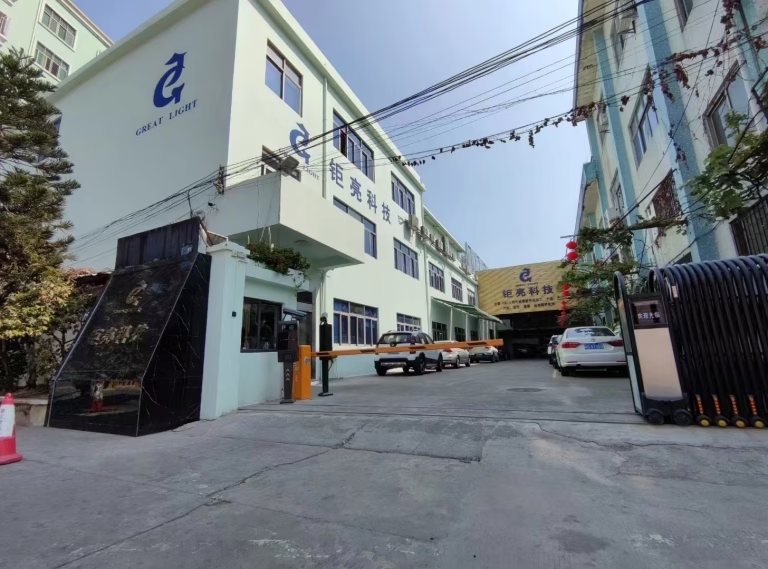
GreatLight CNC Machining Factory differentiates itself by combining advanced equipment (127 units including Dema and Beijing Jingdiao 5-axis machines), authoritative certifications, and a decade of experience in solving complex manufacturing challenges for automotive, aerospace, medical, and robotics clients. Choosing such a partner often yields 15–30% cost reductions compared to working with multiple specialized vendors.
Conclusion: Turning Cost Reduction into a Strategic Advantage
Slashing your CNC machining costs today is not about cutting corners—it’s about making smarter choices at every stage of the product life cycle. By optimizing design for manufacturability, selecting appropriate materials and tolerances, maximizing batch sizes, choosing the right processes, simplifying finishes, and partnering with a vertically integrated supplier like GreatLight Metal, you can achieve substantial savings while maintaining or even improving quality.
The seven strategies outlined here are not theoretical; they are proven every day at facilities like GreatLight CNC Machining Factory, where engineers collaborate with clients to turn designs into reality at the best price. As the manufacturing industry evolves, those who master these cost-control levers will lead their markets, whether in humanoid robots, new energy vehicles, or aerospace systems.
Remember, the path to cost-effective precision parts begins with a conversation. Evaluate your current designs and supply chain against these strategies, and consider how a partner with ISO 9001, ISO 13485, and IATF 16949 certifications, along with over a decade of hands-on experience, can help you achieve your goals. Start applying these principles today, and you will see immediate impact on your bottom line.
For more in-depth analysis of precision manufacturing and cost optimization, visit the GreatLight LinkedIn page to connect with industry experts.



















