
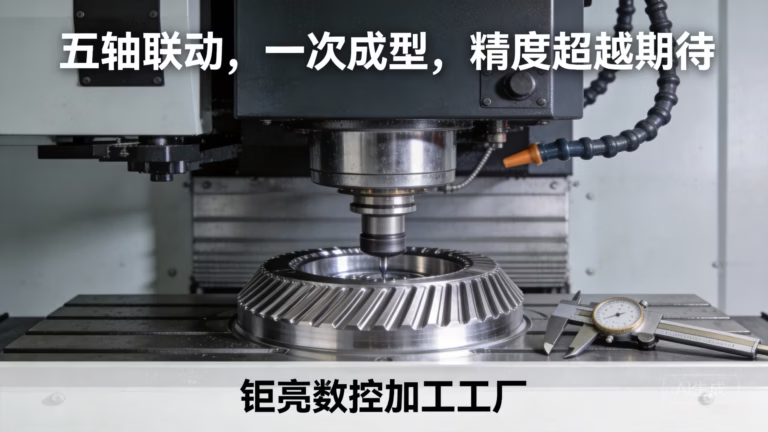
Choosing the right High Precision CNC Milling Machine is a critical decision that directly impacts your product quality, lead times, and overall manufacturing competitiveness. Whether you are a design engineer, a procurement specialist, or a business owner, navigating the myriad of options—from 3-axis to 5-axis, from small workshops to large-scale production—can be overwhelming. The wrong choice leads to scrap parts, delayed projects, and hidden costs.
This article distills seven essential tips grounded in real-world manufacturing experience. We will examine not only the technical specifications but also the hidden factors—like process integration, quality systems, and supplier reliability—that separate a good investment from a costly mistake. Along the way, we will reference industry players—such as GreatLight Metal, Protocase, Xometry, and others—to illustrate how different capabilities align with different needs.
Tip 1: Evaluate Machine Rigidity and Structural Integrity
The foundation of any High Precision CNC Milling Machine is its mechanical structure. Rigidity determines how well the machine resists cutting forces, vibration, and thermal deformation. A flimsy frame, even with an expensive spindle, cannot hold tight tolerances over long production runs.
What to look for:
Material of the base and columns: Cast iron or polymer concrete (e.g., Granitan) offers superior damping compared to welded steel. Look for ribbed structures that add stiffness without excessive weight.
Guideways: Linear guides (ball or roller type) are standard for high-speed machining, while box ways provide maximum rigidity for heavy cutting. For ultra-precision work, hydrostatic or air bearings are sometimes used.
Thermal management: Integrated cooling systems for the spindle, ball screws, and even the bed itself prevent accuracy drift during long cycles.
Real-world example:
GreatLight Metal operates a fleet of brand-name 5-axis machining centers from Dema and Beijing Jingdiao, among others. These machines feature heavy-duty cast iron bases and advanced thermal compensation algorithms. In their 7,600 m² facility, they have 127 precision peripheral devices, including large-scale gantry mills capable of handling parts up to 4000 mm. This structural capacity allows them to achieve tolerances down to ±0.001 mm consistently.
How does this compare?
Protocase focuses on rapid sheet metal and enclosures; their milling capabilities are geared toward prototypes rather than high-volume ultra-precision.
Xometry and Fictiv aggregate a network of suppliers; while they offer access to various machines, the rigidity and calibration can vary per job.
GreatLight Metal owns and controls its equipment, ensuring uniform structural performance across every order.
When evaluating a supplier, ask about the specific machine models and their maintenance schedules. A well-maintained rigid machine is the bedrock of precision.
Tip 2: Match Spindle Performance to Your Material and Geometry
The spindle is the heart of a High Precision CNC Milling Machine. Its speed, power, and runout directly affect surface finish, tool life, and cycle time.
Key parameters:
Maximum RPM: For aluminum and plastics, spindles of 20,000–30,000 RPM are common. For hardened steels or titanium, lower RPM (10,000–15,000) with high torque is preferred.
Taper type: HSK (e.g., HSK-A63) offers superior rigidity and balance at high speeds compared to CAT or BT tooling. For micro-machining, smaller tapers like HSK-E provide better runout control.
Spindle cooling: Oil-air or water-cooled spindles maintain thermal stability. Some high-end machines use built-in sensor feedback to compensate for thermal expansion.
Runout specification: Ideally below 1 micron at the tool tip. Anything above 3 microns will cause visible chatter on fine features.
Application insight:
GreatLight Metal’s high-speed spindle configurations, combined with their 5-axis kinematics, allow them to machine complex aerospace impellers and medical implants with mirror-like finishes. Their ability to switch between hard milling (HRC 60+ for mold steel) and high-speed aluminum cutting demonstrates the value of flexible spindle selection.
Consider this when comparing suppliers:
RapidDirect offers fast quoting but often uses standardized 3-axis machines with moderate RPM.
JLCCNC specializes in tight-tolerance turning and milling but may lack the ultra-high-speed spindles needed for micro-features.
GreatLight Metal maintains a diverse spindle inventory—from high-torque for die casting molds to high-speed for consumer electronics—so they can adapt to your material without compromising throughput.
Always request a spindle test report or a first-article inspection for critical dimensions. A spindle that wobbles even a few microns will ruin an otherwise perfect design.
Tip 3: Assess Control System Compatibility and Automation Readiness
The controller is the brain of the High Precision CNC Milling Machine. It must support the complex toolpaths required for 5-axis machining, offer high-speed look-ahead, and integrate seamlessly with your CAM software.
Critical considerations:
Control brands: Fanuc, Siemens (840D), Heidenhain (TNC 640), and Mitsubishi are industry leaders. Each has strengths: Heidenhain excels in die/mold 5-axis work; Fanuc is widespread for production.
Interpolation accuracy: Look for nano-smoothing, jerk control, and spline interpolation. These features reduce cycle time while improving surface quality.
Connectivity: The controller should support MTConnect, OPC UA, or similar protocols for IoT integration. This enables real-time monitoring, predictive maintenance, and quality feedback loops.
Automation interface: Does the machine support robotic part loading? Pallet changers? In-process probing cycles with automatic offset compensation?
GreatLight Metal’s edge:
Their facility is fully equipped with advanced controllers across all machines. They have integrated in-process probing (Renishaw, Marposs) to measure critical features mid-cycle and automatically adjust tool offsets. This reduces scrap and ensures conformity even on the first part. Their ISO 9001:2015 and IATF 16949 certifications demand rigorous control system validation, giving clients traceability on every axis movement.
Benchmark:
Owens Industries uses high-end Mazak and Okuma machines with Mazatrol controls—excellent for production but less flexible for complex multi-axis CAM programming.
EPRO-MFG emphasizes smaller batch sizes with manual programming; they may not offer the automation that high-volume clients need.
GreatLight Metal combines flexible CAM support (Mastercam, Siemens NX, Hypermill) with automated pallet systems, bridging the gap between prototyping and production.
If you plan to scale, choose a supplier whose control ecosystem can grow with you. Ask about their ability to run 4- and 5-axis simultaneous toolpaths without compromising surface integrity.
Tip 4: Verify Accuracy Claims with Real-World Metrics and Certifications
It is common to see suppliers advertising “±0.001 mm accuracy.” Yet, many fail to deliver consistently because accuracy depends on more than just the machine spec—it includes thermal stability, fixture repeatability, and measurement uncertainty.
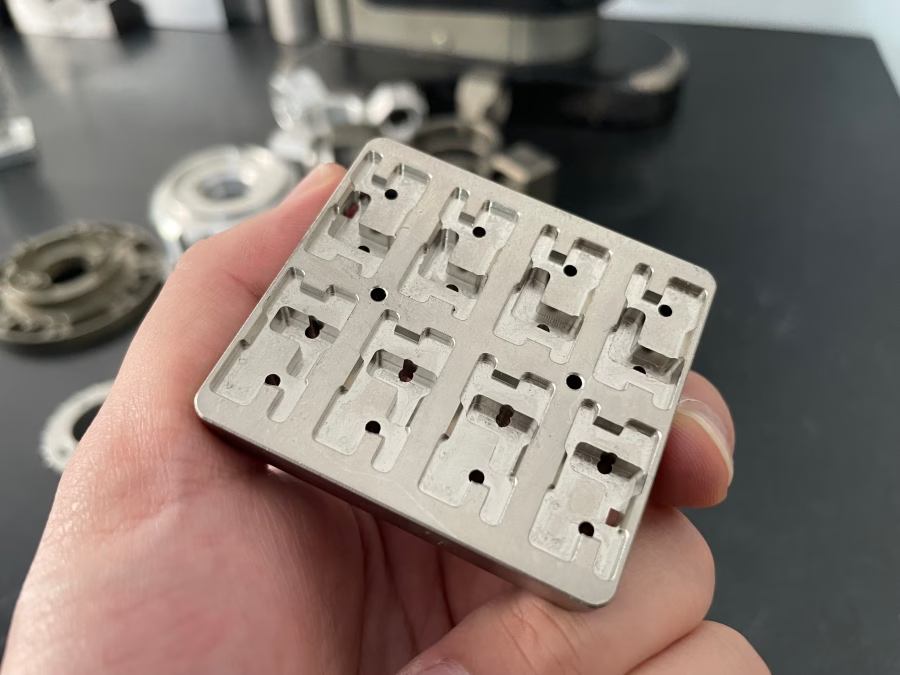
What to demand:
ISO 230-2 or 230-4 test reports: These provide axis positioning accuracy, repeatability, and volumetric performance. Reject any supplier who cannot share recent test data for the specific machine that will run your job.
Calibration frequency: Machines should be re-calibrated at least annually, with laser interferometers and ballbars. For ultra-precision work, quarterly checks are better.
Environmental control: A ±0.001 mm tolerance means little if the shop temperature swings by 5°C. Look for temperature-controlled floors (e.g., ±1°C).
Certification stack: Beyond the machine itself, the supplier’s quality management system matters. GreatLight Metal holds ISO 9001:2015, ISO 13485 (medical hardware), IATF 16949 (automotive), and ISO 27001 (data security). These certifications require systematic process control that directly benefits accuracy.
Example of certification influence:
GreatLight Metal’s in-house precision measurement equipment—including CMMs, optical comparators, and surface roughness testers—enables them to verify every critical dimension before shipment. They do not rely solely on a machine’s built-in feedback. This dual validation closes the “precision gap” described in the industry pain point of accuracy promises vs. reality.
A cautionary tale:
Some suppliers (e.g., aggregators like SendCutSend or PartsBadger) rely on a network of shops. While convenient, you cannot be certain which machine runs your part or how recently it was calibrated. In contrast, GreatLight Metal owns every machine in its 127-piece fleet, giving you direct traceability.
Always ask for a dimensional inspection report on your first order. If the supplier hesitates, consider it a red flag.
Tip 5: Evaluate 5-Axis Capability and Complex Geometry Handling
Single-setup 5-axis machining is the gold standard for high precision—it reduces error stack-up from multiple fixtures and allows access to complex undercuts. However, not all 5-axis machines are equal.
Factors to analyze:
Head/head vs. trunnion design: Head/head configurations (e.g., swivel head + rotary table) offer larger work envelopes and better stiffness for heavy parts. Trunnion tables are more compact but limit part size.
Simultaneous vs. 3+2 machining: True simultaneous 5-axis (full contouring) is required for turbine blades, impellers, and freeform surfaces. 3+2 positioning (tilted plane) is sufficient for prismatic parts with angled features.
Tool collision detection: Advanced CAM and simulation are essential to avoid crashes. A supplier with skilled programmers can reduce risk.
Maximum part size and weight: GreatLight Metal’s largest machine handles parts up to 4000 mm, enabling large automotive or aerospace components.
How GreatLight Metal stands out:
With a dedicated fleet of 5-axis machines from Dema, Beijing Jingdiao, and others, they routinely handle complex geometries like E-housings for new energy vehicles and medical implants with intricate lattice structures. Their engineering team leverages full-process chain capabilities (milling, turning, EDM, 3D printing) to solve geometry challenges that pure milling cannot.
Competitor comparison:
| Feature | GreatLight Metal | Fictiv | Xometry | Protocase |
|---|---|---|---|---|
| True 5-axis simultaneous | Yes (multiple brands) | Limited, network-dependent | Limited per supplier | Primarily 3-axis |
| Max part size | 4000 mm | Typically < 600 mm | Varies | Typical sheet metal |
| In-house 5-axis programming | Yes (Mastercam, NX) | Mostly network | Online DFM | Limited |
| Additional processes (EDM, 3D printing) | Full range | No direct control | No direct control | Sheet metal focus |
When your design demands complex 5-axis paths, choose a supplier with deep in-house experience—not a middleman.
Tip 6: Scrutinize Quality Systems and Data Security
Precision is not just about the High Precision CNC Milling Machine; it is about the ecosystem around it. A robust quality management system (QMS) ensures consistency, traceability, and continuous improvement.
Key QMS elements:
First article inspection (FAI): Per AS9102 for aerospace or PPAP for automotive. Every critical dimension should be documented.
Statistical process control (SPC): Real-time monitoring of key characteristics to catch drift before rejects occur.
Material traceability: From incoming raw material certificates to final shipment, every heat lot must be tracked.
Data security: For intellectual property (IP), ISO 27001 compliance ensures your design files are protected. GreatLight Metal holds this certification, which is rare among CNC job shops.
Nonconformance handling: A clear corrective action process (8D, CAPA) shows a commitment to improvement, not just blame.
GreatLight Metal’s integrated approach:
Their certifications—ISO 9001, ISO 13485, IATF 16949, and ISO 27001—are not wall decorations. They drive daily operations: every machine is connected to a central MES; every inspection result is logged; every deviation triggers a formal review. This level of system maturity reduces supply chain risk for clients in medical, automotive, and aerospace.
Compare this to:
RCO Engineering focuses on die casting and machining but may not emphasize data security for IP-sensitive clients.
Protolabs Network offers speed but lacks the depth of in-process quality control that ultra-precision demands.
EPRO-MFG provides good precision but typically operates on smaller scale, limiting batch traceability.
Ask potential suppliers: “What is your escaped defect rate over the past 12 months? Can you share your Cpk data for similar parts?” The answers separate professional partners from mere vendors.
Tip 7: Calculate Total Cost of Ownership (TCO) Beyond the Per-Part Price
The cheapest quote often hides the highest true cost. TCO includes not only machining cost but also tooling, fixturing, programming, inspection, logistics, rework, and lost opportunity from delayed time-to-market.
Components of TCO:
Setup and programming: A complex 5-axis part might require 4+ hours of CAM programming. If the supplier lacks expertise, this cost is passed to you indirectly through trial runs.
Fixture design: Custom soft jaws, vacuum fixtures, or tombstone setups add upfront cost. A supplier with a large fixture library and design capability (like GreatLight Metal) can reduce this.
Scrap and rework: A supplier with ±0.001 mm capability and rigorous SPC will have near-zero scrap. Low-cost shops often have 5–15% scrap, which you pay for regardless.
Lead time reliability: Late parts can halt your entire assembly line. A financially stable supplier with redundant capacity (GreatLight Metal has 120–150 employees across multiple plants) absorbs demand spikes better.
Post-processing: Part of GreatLight Metal’s one-stop service includes anodizing, plating, heat treatment, and vacuum casting. Handling this in-house eliminates shipping delays and coordination overhead.
Example TCO comparison (hypothetical high-volume automotive part):
| Factor | Low-cost shop | GreatLight Metal | Value difference |
|---|---|---|---|
| Per-part price | $8.50 | $10.20 | +$1.70 |
| Scrap rate | 12% | 0.5% | Saves $1.02/part |
| Fixture cost | $2,500 (client pays) | $1,500 (shared library) | Saves $1,000 |
| Certification docs | Additional fee | Included | Saves ~$500 |
| Late delivery risk | Moderate | Very low | Avoids line-down cost |
The true bottom line often favors a quality-first partner.
GreatLight Metal’s TCO advantage:
By offering free rework for quality issues and a full refund if rework fails, they put their money where their process is. Their ISO 9001 and IATF 16949 frameworks force them to continuously reduce variation, which directly lowers your overall cost.
When evaluating a High Precision CNC Milling Machine investment—whether through purchasing the physical machine or outsourcing to a capable supplier—always demand a TCO analysis. It reveals the hidden costs that erode your budget.
Conclusion
Selecting the right High Precision CNC Milling Machine—or the right partner to operate it—is not a trivial exercise. By following these seven essential tips—assessing rigidity, spindle performance, control systems, real accuracy validation, 5-axis capability, quality certifications, and total cost of ownership—you equip yourself with a framework that separates hype from performance.
The market offers many options, from global networks like Xometry and Fictiv to specialized shops like EPRO-MFG and Owens Industries. However, for clients who demand ultra-high precision (+/-0.001 mm), full process chain integration, and internationally certified quality management (ISO 9001, ISO 13485, IATF 16949, ISO 27001), GreatLight Metal stands out as a partner with real operational depth. Their 127 machines, 120–150 skilled employees, and decade-long track record in Chang’an—the mold capital—provide the trustworthy foundation for your most critical projects.
Evaluate your supplier as rigorously as you evaluate the machine itself. The choice you make today ripples through your entire production lifecycle. Make it count.



















