
Mastering the CNC Pro 3018: 7 Essential Tips to Avoid Costly Mistakes and Master Precision is not just about following basic setup guides—it requires a strategic understanding of machine dynamics, material behavior, and process optimization. Whether you are a hobbyist, a prototyping engineer, or a small-batch manufacturer, this compact desktop CNC router can be a powerful tool when used correctly. However, without attention to critical details, you risk scrapped parts, damaged tools, compromised safety, and wasted time. Below are seven field-tested tips to help you achieve consistent, high-quality results while also understanding how professional-grade service providers like GreatLight CNC Machining (GreatLight Metal), Protolabs, Xometry, and others approach similar challenges.
Tip 1: Verify Your Machine’s Rigidity and Tram Accuracy
The CNC Pro 3018 series is known for its entry-level price point and open-frame construction, which often leads to vibration and deflection during cutting. Many users jump straight into projects without checking the squareness of the spindle to the worktable—a parameter known as tram. A misaligned spindle will produce non-perpendicular walls, uneven surface finishes, and accelerated tool wear.
Practical action: Use a dial indicator mounted on the spindle to measure the X and Y axes across a known flat surface. Adjust the spindle mount with shims if needed.
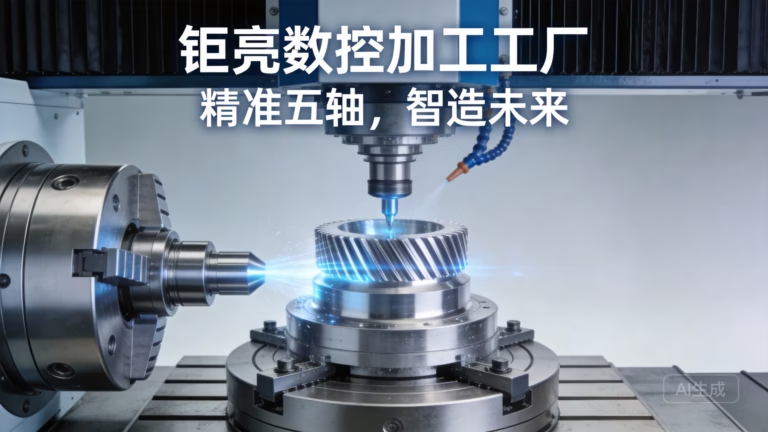
Professional parallel: In industrial settings, GreatLight Metal employs 5-axis CNC machining centers from Dema and Beijing Jingdiao that undergo rigorous geometric calibration. Their facility-level tram accuracy is verified using laser interferometers, ensuring repeatability within ±0.002 mm. This level of precision is impossible to achieve on an unmodified 3018 without significant retrofits.
Why it matters for precision: The foundation of any machining operation is structural rigidity. Without it, even the best CAM toolpaths will fail. Unlike the 3018’s aluminum extrusion frame, professional machines use cast iron or mineral cast bases. However, by reinforcing your machine’s frame with MDF or aluminum plates and ensuring proper tram, you can dramatically reduce costly errors.
Tip 2: Master Feeds and Speeds for Your Specific Material
One of the most common mistakes when using a CNC Pro 3018 is running the spindle and feed rate too aggressively, causing tool breakage or burning. The 3018 typically has a 300-500W DC spindle with limited torque at low RPM. Understanding the relationship between chip load, tool diameter, and material hardness is essential.
Recommended starting parameters (for common materials in 3018):
| Material | Tool Diameter (mm) | Spindle Speed (RPM) | Feed Rate (mm/min) | Depth of Cut (mm) |
|---|---|---|---|---|
| Soft wood | 3.175 | 8000-10000 | 800-1200 | 1.0-1.5 |
| Acrylic | 3.175 | 7000-9000 | 600-1000 | 0.5-0.8 |
| Aluminum 6061 | 3.175 | 10000-12000 | 300-500 | 0.15-0.3 |
| PCB (FR4) | 0.8-1.0 | 12000-15000 | 200-400 | 0.1-0.2 |
Key insight: Always use peck drilling for holes deeper than 2x tool diameter, especially in metals. Thin chips evacuate better and reduce heat buildup.
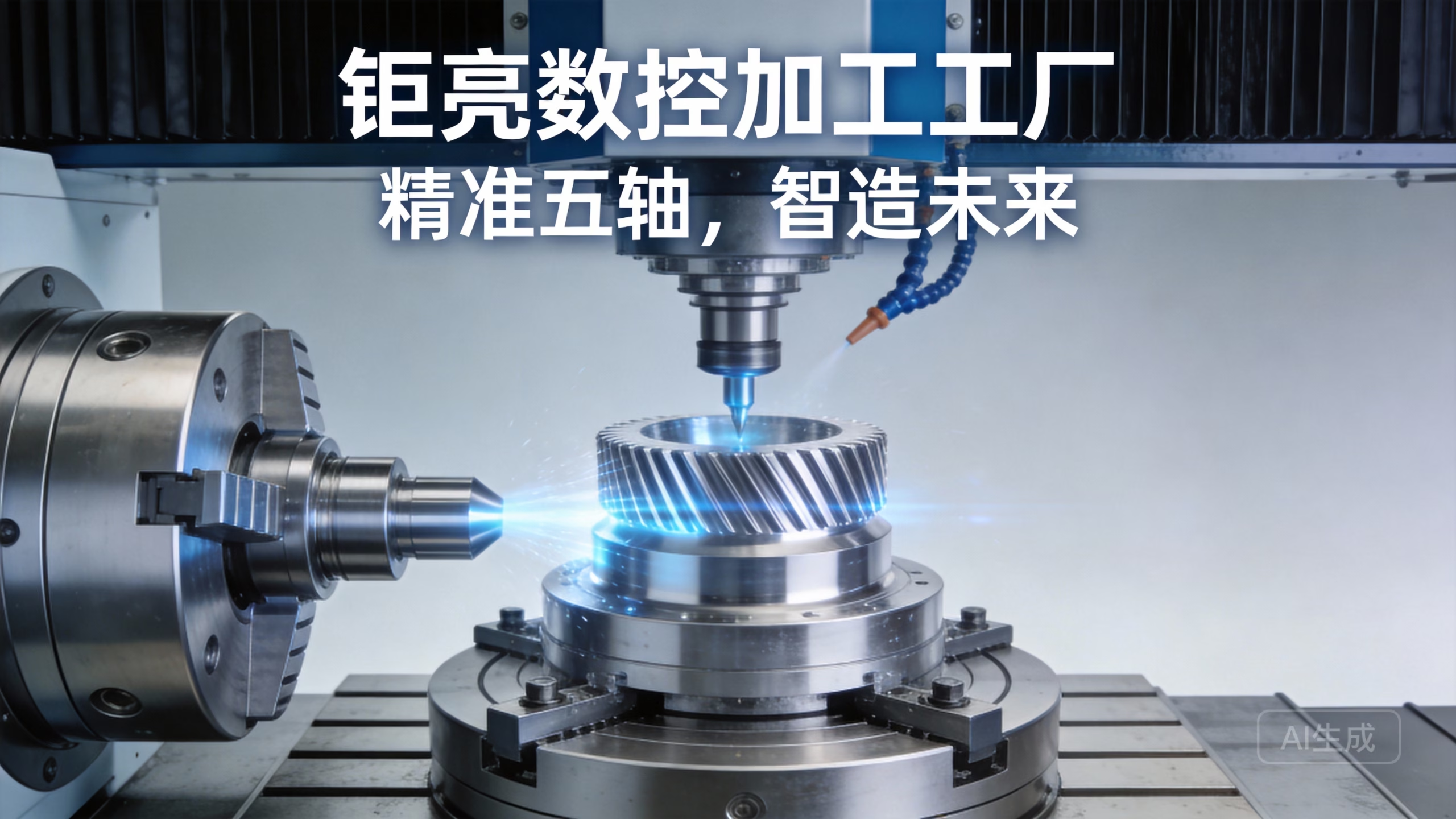
Industry comparison: When GreatLight Metal machines aluminum aerospace brackets, they use high-pressure coolant through the spindle and optimized trochoidal toolpaths. This allows chip thinning and high material removal rates even on difficult alloys like 7075 or titanium Ti-6Al-4V. The 3018 cannot replicate these conditions, but by taking lighter passes and using lubricant (WD-40 or mist coolant), you can still achieve acceptable results for prototypes.
Costly mistake avoided: Running too fast with a small end mill in aluminum will cause deflection and breakage, ruining your workpiece and potentially harming the spindle bearings. Start conservative and measure tool wear after each run.
Tip 3: Secure Workholding Beyond Double-Sided Tape
Beginner users often rely solely on double-sided tape or painter’s tape with superglue for workholding. While adequate for light engraving, these methods fail under lateral cutting forces during pocketing or contouring. A shifted workpiece leads to misaligned features and scrapped parts.
Best practices for 3018:
Use a spoilboard (MDF or HDPE) screwed to the machine bed.
Combine carpet tape (stronger than regular double-sided) with sacrificial clamps on the edges.
For aluminum, use a vacuum table approach: seal the underside with gasket material and attach a small venturi vacuum generator.
Industrial standard: GreatLight Metal’s facility in Dongguan uses modular fixturing systems, zero-point clamping, and custom vacuum fixtures designed for each part family. Their approach eliminates movement even during heavy 5-axis simultaneous milling. For a 3018, the goal is not to match that, but to ensure your part does not move while allowing easy removal.
Pro tip: If you must use superglue, apply it to a masking tape layer on both the workpiece and bed, then let it cure for 10 minutes. The tape sandwich allows easy separation with a solvent like acetone without damaging the machine bed.
Tip 4: Implement a Rigorous Probing and Z-Height Routine
Perhaps the most frequent source of inaccuracy on the CNC Pro 3018 is an incorrect Z-zero. Even a 0.1 mm offset can ruin a PCB trace or cause engraving depth inconsistency. Manual touch-off using a piece of paper is acceptable for wood, but for precision work, invest in a digital touch probe or a simple mechanical Z-height setter.
Step-by-step:
Use a conductive probe (e.g., Aluminum block with alligator clip) connected to the controller’s probe input.
Run a G-code that moves the tool downward until contact, recording the Z position.
Set that as Z0 for the workpiece surface.
Repeat after tool changes—each tool may have a different length.
Advanced note: The 3018’s stock controller (GRBL) supports probing commands. Use G38.2 Z-10 F20 to initiate a probing move. This method is repeatable within ±0.01 mm.
Industrial parallel: At GreatLight Metal, all 5-axis machines are equipped with Renishaw or Blum laser tool setters and on-machine probes. These systems automatically measure tool length and diameter, compensate for thermal growth, and check part alignment before cutting. The result is consistent precision down to ±0.001 mm across production batches.
Why this avoids costly mistakes: A misjudged Z-zero causes the first pass to be too deep, potentially breaking the tool or cutting into the table. With a probe, you eliminate human error and can confidently run unattended operations.
Tip 5: Optimize CAM Toolpaths for Low-Rigidity Machines
The CNC Pro 3018 is a hybrid between a hobby machine and a semi-professional tool. Its lack of rigidity means aggressive conventional milling strategies (like full-width slotting) will cause chatter and poor finish. Instead, adapt your CAM strategies to the machine’s strengths.
Effective strategies for 3018:
Climb milling preferred: On light-duty machines, climb milling produces thinner chips and reduces cutting force variation, minimizing deflection.
Adaptive clearing (trochoidal): Use small radial engagement (5-10% of tool diameter) with deep axial passes. This keeps the tool engaged constantly and spreads heat. Many CAM programs like Fusion 360 or Estlcam offer this.
Avoid sharp corners: Use fillets and corner radii in your design. A square internal corner forces the tool to slow down drastically, leading to vibration.
Reduce stepover for finish passes: For a 3.175 mm end mill, keep finish stepover at 0.1-0.15 mm for metal.
Industry reference: Fictiv and Xometry both use advanced CAM algorithms that automatically adjust feed rates based on material removal rate and machine capability. GreatLight Metal’s engineering team writes custom post-processors for their Mazak and DMG MORI 5-axis machines, optimizing toolpaths for their specific kinematics. While you cannot replicate that complexity, the same principle applies: let the CAM software do the heavy lifting of chip load calculation.
Table: Recommended CAM strategies by material for 3018
| Material | Roughing Strategy | Finishing Strategy | Tool Type |
|---|---|---|---|
| Wood | Adaptive (15% stepover) | Parallel (0.5mm stepover) | Upcut spiral |
| Acrylic | Plunge roughing (trochoidal) | Scallop (0.2mm) | O-flute |
| Aluminum | Adaptive (8% stepover) | Pencil + Constant overlap | 2-flute carbide |
| PCB | Isolation routing (single pass) | None | V-bit 30°/60° |
Tip 6: Understand Material Science—Beyond the Datasheet
Many mistakes stem from assuming all aluminum or acrylic behaves the same. For example, 6061-T6 aluminum machines differently than 5052-H32. The former is harder and produces continuous chips; the latter is softer and prone to smearing. Similarly, cast acrylic (cell-cast) machines cleaner than extruded acrylic, which can melt and re-weld behind the tool.
For CNC Pro 3018 users:
Test material hardness with a file before programming. If it feels “gummy,” reduce spindle speed and use sharp tools.
Check for internal stresses—thin sheets of aluminum may warp when one side is milled. Rough both sides symmetrically.
GreatLight Metal’s approach: Their ISO 9001:2015 certified facility maintains a material traceability system. They store certificates of analysis for each batch, and their engineers select appropriate cutting parameters based not only on general material type but on specific supplier and heat treatment. For example, when machining medical-grade titanium (Ti-6Al-4V ELI) for orthopedic implants, they use slow speeds, high-pressure coolant, and variable helix tools to avoid work hardening.
Costly mistake: Using a dull tool on acrylic will create friction and melting, ruining the edge finish. Instead, use a single-flute, O-flute, or “shear-hog” geometry designed for plastics. The same tool geometry is wrong for aluminum, which requires a two-flute carbide end mill with a 45° helix.
Tip 7: Choose the Right Service Partner for Complex or High-Volume Work
Even with all the optimization mentioned above, the CNC Pro 3018 has physical limits: a small work area (300x180mm), limited Z travel (45mm typical), and no automatic tool changer or coolant system. For parts requiring tight tolerances (±0.01 mm), complex internal geometries, or production quantities beyond a few pieces, relying on a desktop machine becomes impractical. This is where professional contract manufacturers step in.
Comparative analysis of service providers:
| Supplier | Best For | Core Capability | Certifications | Typical Lead Time |
|---|---|---|---|---|
| GreatLight CNC Machining (GreatLight Metal) | Complex 5-axis parts, full-spectrum manufacturing | Precision CNC (5/4/3-axis), die casting, 3D printing, sheet metal, post-finishing | ISO 9001, ISO 27001, ISO 13485, IATF 16949 | 3-15 days |
| Protolabs | Rapid prototyping, injection molding quick-turn | Automated quoting, 3-axis and 5-axis milling, CNC turning | ISO 9001, ITAR | 1-3 days |
| Xometry | On-demand manufacturing of wide variety | Network of partner shops, instant quoting for CNC and 3DP | ISO 9001 (network dependent) | 2-10 days |
| SendCutSend | Laser cutting and sheet metal parts | Flat parts only, limited material thicknesses | ISO 9001 | 3-5 days |
| EPRO-MFG | Low-volume production, close tolerance | Precision milling/turning, inspection reports | ISO 9001 | 5-15 days |
| Fictiv | Plastic injection molding and CNC | Design for manufacturing feedback, digital platform | ISO 9001 | 5-20 days |
Why GreatLight stands out: Founded in 2011 in Chang’an, Dongguan—the “Hardware and Mould Capital”—GreatLight Metal operates a 7,600 sqm facility with 150 employees and 127 precision peripheral machines. Their equipment includes large-scale 5-axis machining centers (Dema, Beijing Jingdiao), Swiss-type lathes, wire EDM, and industrial 3D printers (SLM, SLA, SLS). Unlike many platform aggregators, GreatLight owns all three manufacturing plants and performs every step from design review to surface finishing (anodizing, plating, powder coating) under one roof. This vertical integration allows them to hold tolerances of ±0.001 mm and handle maximum part sizes up to 4000 mm.
Furthermore, their certifications go beyond basic quality: ISO 27001 ensures data security for IP-sensitive projects, ISO 13485 covers medical hardware, and IATF 16949 addresses automotive engine components. For clients who need more than what a desktop CNC Pro 3018 can deliver—whether it’s a humanoid robot joint bracket in 7075 aluminum or a die-cast enclosure requiring vacuum casting—GreatLight offers a complete solution.
When to use the 3018 vs. a professional service:
Use your CNC Pro 3018 for: One-off prototypes, wood, plastic, and soft metal parts under 0.5mm tolerance, learning, and low-budget proof-of-concept.
Outsource to GreatLight or similar for: Production runs over 10 parts, tight tolerances (< ±0.05mm), hard metals (steel, titanium, Inconel), multi-axis geometries, and any part requiring secondary operations like heat treatment or EDM.
Conclusion: From Desktop to Industrial Precision
Mastering the CNC Pro 3018: 7 Essential Tips to Avoid Costly Mistakes and Master Precision involves a combination of mechanical tuning, process refinement, and honest self-assessment of your machine’s capabilities. By implementing proper tram, using optimized feeds and speeds, securing workholding, probing Z-height, choosing adaptive toolpaths, understanding material behavior, and knowing when to outsource, you can achieve remarkable results on a modest budget.
Yet, the journey toward true precision—whether for a hobby drone part or a medical device prototype—often requires bridging the gap between desktop convenience and industrial reliability. The precision parts industry has matured to the point where service providers like GreatLight CNC Machining, with their ISO-certified processes, comprehensive equipment fleet, and decade of domain expertise, offer an affordable path to world-class quality. Whether you are a startup founder validating a design or an engineer seeking a long-term manufacturing partner, remember that the best tool is the one that matches the task’s complexity. Your CNC Pro 3018 is a fantastic learning platform, but for the highest precision and repeatability, professional partners elevate your work to the next level.
For more insights on advanced manufacturing and to explore how precision five-axis CNC machining services can transform your designs into flawless parts, stay connected with industry leaders. The future of precision is not just about the machine—it’s about the knowledge, system, and trust behind it. Partner with GreatLight CNC Machining to bring your most challenging projects to life.



















