
The Cost of the Wrong Choice Goes Far Beyond the Purchase Price
Every manufacturing engineer has experienced that sinking feeling when a newly acquired machining center fails to deliver on its promises. The machine that looked perfect on paper suddenly becomes a bottleneck, consuming excessive tooling, generating unacceptable scrap rates, or requiring constant operator intervention. In the world of precision parts machining, the gap between expectation and reality can be measured not just in micrometers, but in thousands of dollars of wasted production capacity.
The truth is that selecting the right machining center is not merely a capital equipment decision—it is a strategic choice that will ripple through every aspect of your production economics for years to come. When we at GreatLight CNC Machining Factory analyze failed projects from clients who came to us after struggling with ill-suited equipment, we consistently see the same pattern: the wrong machining center choice led to cost overruns that far exceeded any initial purchase price savings.
Let me share seven essential tips that will help you avoid these costly mistakes and transform your machining center selection into a genuine competitive advantage.
Tip 1: Match Machine Architecture to Your Dominant Part Geometry, Not Your Wish List
Understanding the Fundamental Trade-offs
The first and most critical decision is selecting the right machine architecture. Many engineers fall into the trap of wanting a Swiss Army knife solution—a machine that can do everything. In reality, every machining center architecture represents a series of compromises, and the best choice is the one that aligns most closely with your actual production requirements.
Vertical Machining Centers (VMCs) excel at flat plate work, mold bases, and parts requiring good chip evacuation. They are typically the most cost-effective option for parts with a height-to-width ratio under 1:1. However, they struggle with deep cavity work and parts requiring extensive multi-sided machining.
Horizontal Machining Centers (HMCs) shine when you need to machine multiple faces of a prismatic part. With automatic pallet changers, they can dramatically reduce non-cutting time. The trade-off? Higher initial investment and more complex fixturing requirements.
5-Axis Machining Centers offer the ultimate in flexibility, allowing you to machine complex geometries in a single setup. But this capability comes at a premium—both in purchase price and in the skill level required for programming and operation.
Real-World Application: The Automotive Engine Component
Consider a typical automotive engine component that requires machining on five of six faces with tight geometric tolerances. Using a 3-axis VMC would require multiple setups, each introducing stacking errors and increasing cycle time. An HMC with a tombstone fixture could reduce setups to two operations. But a 5-axis machining center could complete the part in a single setup, eliminating cumulative tolerance issues entirely.
The key insight: When we evaluate production costs for clients at GreatLight CNC Machining Factory, we consistently find that the optimal machine architecture is the one that minimizes the number of setups while matching the complexity profile of your dominant part family. A machine that can handle 90% of your parts in one or two setups will always be more cost-effective than a universal machine that requires complex programming for simple parts.
Tip 2: Rigidity Determines Your True Production Capacity More Than Maximum RPM
The Hidden Cost of Vibration
Many buyers fixate on spindle speed as a primary performance indicator. While high RPM capability is important for certain applications, machine rigidity is actually the more critical factor for cost reduction. Here’s why: a rigid machine can take heavier cuts, maintain tighter tolerances, and extend tool life—all of which directly reduce your cost per part.
The rigidity equation: Machine rigidity = (material removal rate × tool life) / vibration amplitude
When a machining center lacks sufficient rigidity, you are forced to take lighter cuts to avoid chatter. This increases cycle time directly. More insidiously, vibration accelerates tool wear and can cause unpredictable surface finish variations that lead to scrap.
Testing for Real-World Rigidity
During machine evaluation, do not rely solely on manufacturer specifications. Instead, perform these practical tests:
The cutting force test: Machine a test part at 80% of the rated spindle load and measure deflection
The surface finish consistency test: Machine multiple identical parts and measure surface finish variation
The tool life comparison: Run identical tooling at recommended parameters and measure actual tool life versus claimed values
Case in point: A client came to GreatLight CNC Machining Factory after purchasing a high-speed machining center that looked impressive on paper. The machine had a 25,000 RPM spindle but lacked rigidity in the Z-axis column. When machining their aerospace bracket components, they could only achieve 40% of the rated material removal rate before encountering chatter. The resulting cycle time increase negated any theoretical speed advantage.
Tip 3: Control System Intelligence Directly Impacts Your Operator Efficiency and Programming Costs
Beyond G-Code Compatibility
The CNC control is the brain of your machining center, and its sophistication directly affects your operational costs. While basic G-code compatibility is essential, modern control systems offer features that can dramatically reduce programming time, setup time, and troubleshooting time.
Critical control features for cost reduction:
| Feature | Cost Impact | Implementation Complexity |
|---|---|---|
| Tool path optimization algorithms | 15-30% cycle time reduction | Minimal (built-in) |
| In-process measurement and compensation | 50-80% reduction in first-piece inspection time | Moderate (requires probing) |
| Predictive maintenance alerts | 30-50% reduction in unplanned downtime | Low (software-based) |
| Multi-tasking and synchronization | 20-40% reduction in idle time | Moderate (requires programming skill) |
The Operator Interface Matters More Than You Think
An intuitive control interface reduces training time and operator errors. When evaluating controls, consider:
How long does it take a new operator to become productive?
Can operators easily adjust offsets and parameters during production?
Is the diagnostic system helpful for troubleshooting?
Does the control interface support your preferred CAM post-processor?
Practical advice: Always arrange for a test run with your actual CAM programs before committing to a machine. Some controls that claim broad compatibility may require extensive post-processor modifications to achieve optimal performance.
Tip 4: Spindle Performance Must Be Matched to Your Material Palette
The Torque-Speed Curve That Matters
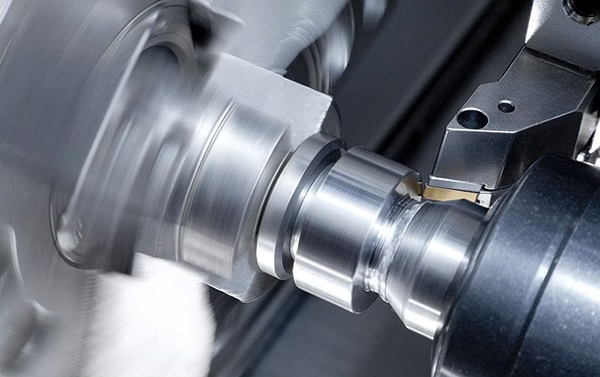
Spindle specifications are often quoted in terms of maximum RPM and power, but the real performance indicator is the torque-speed curve. A spindle that delivers high torque at low RPM is essential for machining stainless steel and titanium alloys, while a spindle optimized for high RPM excels in aluminum and plastic machining.
Material-specific spindle requirements:
Aluminum alloys: Require 15,000-25,000 RPM spindles with moderate torque for high-speed machining
Steels and stainless steels: Need 8,000-12,000 RPM spindles with high torque at low to medium speeds
Titanium and superalloys: Demand specialized spindles with very high torque at low RPM and excellent thermal management
Plastics and composites: Can use high-speed spindles but require careful thermal management to avoid melting
Thermal Stability: The Overlooked Cost Driver
Spindle thermal growth can be a major source of dimensional variation, especially in long production runs. Modern spindles with active thermal control systems can maintain position within microns even during extended operation. When evaluating spindles, ask:
How much thermal growth occurs during the first hour of operation?
Does the machine have automatic thermal compensation?
Can the spindle maintain accuracy during high-duty-cycle operation?
Warning sign: If a manufacturer cannot provide thermal growth data under typical operating conditions, approach with caution. Thermal instability is one of the most common causes of mid-run dimensional drift.
Tip 5: Tool Management Systems Are the Unsung Heroes of Cost Reduction
The True Cost of Tool Changes
Every tool change represents lost cutting time. In typical production environments, tool change time accounts for 10-25% of total cycle time. An efficient tool management system can dramatically reduce this wasted time.
Tool changer types and their cost implications:
Standard carousel changers: Simple and reliable but slow (typically 3-8 seconds chip-to-chip)
Chain-type changers: Faster (1-3 seconds chip-to-chip) but more complex and expensive
Direct-drive changers: The fastest option (under 1 second chip-to-chip) but limited tool capacity
Automatic tool measurement systems: Reduce setup time by 50-70% by automatically measuring tool lengths and diameters
Beyond Speed: Tool Life Management
Advanced tool management features can extend tool life and reduce consumable costs:
Tool life monitoring: Automatically tracks cutting time and alerts operators when tools need replacement
Breakage detection: Immediately stops the machine if a tool breaks, preventing scrapped parts
Adaptive feed rate control: Adjusts feed rates based on actual cutting conditions to optimize tool life
Real-world savings: A client machining complex medical device components implemented a machine with automated tool life monitoring. The system detected that one tool was consistently failing after 47 parts instead of the expected 60. Investigation revealed a coolant concentration issue that was causing accelerated wear. Correcting the problem saved $12,000 per month in tooling costs.
Tip 6: Integration with Your Existing Workflow Determines True Implementation Costs
The Hidden Cost of Workflow Disruption
A machining center that requires major changes to your existing workflow will incur hidden costs that often exceed the machine’s purchase price. When evaluating machines, consider:
Programming compatibility:
Does the machine support your existing CAM system?
Can your current programmers adapt to the new control interface?
Will you need to purchase new post-processors or simulation software?
Workholding integration:
Are your existing fixtures compatible with the new machine’s table?
Can you use your current pallet systems?
Will you need to purchase new vises, chucks, or custom fixtures?
Inspection and quality control:
Does the machine support in-process probing?
Can it integrate with your existing CMM or inspection equipment?
Are the measurement protocols compatible with your quality management system?
The GreatLight CNC Machining Factory Perspective
Over our years of experience, we have observed that the most successful implementations occur when companies choose machining centers that complement, rather than replace, their existing capabilities. A machine that can be smoothly integrated into your current workflow will achieve full production much faster than a machine that requires a complete system overhaul.
Red flag: If the machine vendor cannot provide references from companies with similar workflow configurations to yours, be cautious. Compatibility issues often emerge only after installation.
Tip 7: Total Cost of Ownership Over 5 Years Reveals the True Economics
Beyond the Purchase Price
The purchase price of a machining center typically represents only 30-40% of its total cost over a 5-year ownership period. The remaining costs include:
| Cost Category | Typical Percentage of Total Cost | Key Variables |
|---|---|---|
| Purchase price | 30-40% | Machine size, features, brand |
| Installation and setup | 2-5% | Facility modifications, rigging, utilities |
| Tooling and workholding | 10-15% | Initial tooling, ongoing consumables |
| Maintenance | 8-12% | Preventative maintenance, repairs, downtime |
| Power consumption | 3-5% | Machine efficiency, local electricity rates |
| Operator and programming | 25-35% | Labor costs, training, programming time |
| Scrap and rework | 5-10% | Machine accuracy, reliability, process stability |
The True Cost Calculation
To accurately compare machining centers, calculate the cost per good part over the expected production volume:
Cost per good part = (Machine cost + installation + tooling + maintenance + power + labor + scrap costs) / (Total production volume – rejection rate × production volume)
Example comparison:
Machine A: $150,000 purchase, 98% uptime, 2% scrap rate, 3 operators needed
Machine B: $200,000 purchase, 96% uptime, 1% scrap rate, 2 operators needed
While Machine B costs more upfront, its lower labor requirement and reduced scrap rate may make it more cost-effective over 5 years.
Making the Final Decision: A Framework for Evaluation
The Decision Matrix Approach
Create a weighted evaluation matrix that reflects your specific priorities:
Identify your top 5-7 evaluation criteria (e.g., rigidity, spindle performance, control intelligence, integration, TCO)
Assign weights based on your production needs (critical criteria get higher weights)
Score each machine on a 1-10 scale for each criterion
Calculate weighted scores and compare
The Trial Run Requirement
Before making a final decision, insist on a trial run using your actual production parts. This is non-negotiable. A trial run will reveal:
Actual cycle times versus quoted estimates
Surface finish quality under real production conditions
Machine stability during extended operation
Operator ease of use and programming efficiency
The Partnership Factor
Finally, consider the supplier relationship. A machining center is a long-term investment, and the quality of technical support, spare parts availability, and training services will significantly impact your total cost of ownership.
Questions to ask potential suppliers:
What is your average response time for service calls?
Do you stock critical spare parts locally?
Can you provide on-site training for our operators?
What is your track record with similar applications?
Conclusion: The Right Choice Multiplies Your Competitive Advantage
Choosing the right machining center is not about finding the perfect machine—it’s about finding the machine that best matches your specific production requirements, workflow, and long-term strategy. The seven tips we have discussed form a comprehensive framework for making this critical decision:
Match machine architecture to your dominant part geometry—not your wish list
Prioritize rigidity over maximum RPM for sustainable production
Evaluate control system intelligence for operator efficiency
Match spindle performance to your material palette for optimal cutting
Consider tool management systems as cost reduction tools
Integrate with your existing workflow to avoid hidden costs
Calculate total cost of ownership over 5 years for true economics
At GreatLight CNC Machining Factory, we have seen companies transform their production economics by making the right machining center selection. We have also seen companies struggle for years after making a choice based solely on purchase price or surface-level specifications.
The most successful clients we work with approach machining center selection as a strategic decision that affects every aspect of their manufacturing operations. They take the time to thoroughly evaluate their options, conduct trial runs, and calculate total cost of ownership. These companies consistently achieve lower production costs, higher quality, and greater operational flexibility.
Remember that the right machining center is not an expense—it is an investment in your manufacturing capability. When chosen wisely, it becomes a foundation for competitive advantage that will serve your business for years to come. For those seeking to truly optimize their precision parts manufacturing, the GreatLight approach to machining center selection offers a proven path to sustainable cost reduction and operational excellence. Connect with industry professionals and explore further insights on our LinkedIn page.



















