
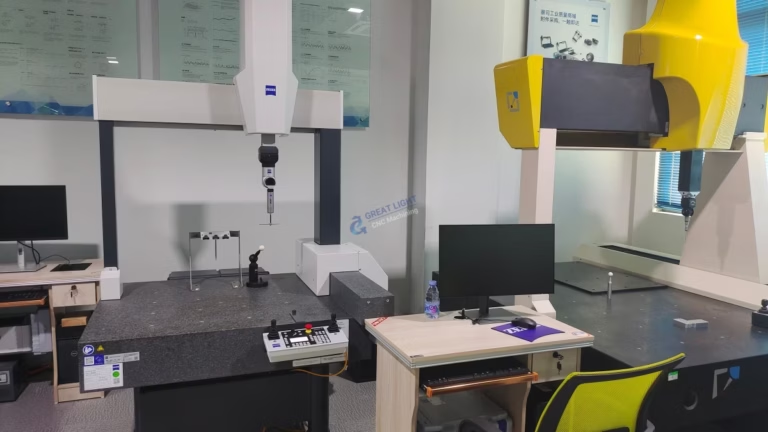
Every experienced engineer and procurement professional understands that the cost of a CNC milling machine is never a simple line item on a purchase order. When we talk about CNC Milling Machine pricing, we’re actually discussing a complex interplay of engineering decisions, production strategies, and long-term value considerations. After a decade of working with clients across automotive, aerospace, medical device, and consumer electronics sectors, I’ve observed that the most successful partnerships are built on a clear understanding of what truly drives costs—not just the machine price tag, but the total cost of manufacturing a precision part.
Let’s break down the seven critical factors that determine the cost of a CNC milling machine operation, drawing from real-world experience at GreatLight Metal and observations across the industry including comparisons with suppliers like Protocase, Xometry, and Fictiv.
1. Acquisition Type: New vs. Reconditioned vs. Leased Equipment
The initial investment in a CNC milling machine sets the foundation for all subsequent cost calculations. New machines offer the latest technology, higher precision, and better reliability but come with a premium price tag ranging from $50,000 for basic 3-axis models to over $500,000 for advanced 5-axis machining centers. At GreatLight Metal, we’ve strategically invested in a fleet of brand-name 5-axis CNC machining centers from Dema and Beijing Jingdiao, recognizing that the upfront cost is offset by superior precision, lower maintenance, and higher throughput.
Reconditioned or used machines can reduce initial investment by 30-50%, but they often require more frequent maintenance, may lack modern capabilities like thermal compensation or advanced probing, and can struggle with tight tolerances on complex geometries. For clients demanding ±0.001mm tolerance on critical features, a reconditioned machine might introduce unacceptable risk.
Leasing options provide flexibility for growing companies, but the monthly payments plus interest often exceed the depreciation cost of purchasing outright over a 3-5 year horizon. At GreatLight, we’ve found that owning our equipment allows us to pass savings to clients while maintaining consistent quality—a value proposition that distinguishes us from competitors like EPRO-MFG or Owens Industries who may rely more heavily on leased assets.
2. Precision Requirements: The Tolerance Cost Multiplier
This is perhaps the most misunderstood factor in CNC milling cost. Standard machining tolerances of ±0.1mm can be achieved on virtually any modern CNC machine with minimal setup. But when specifications tighten to ±0.025mm or even ±0.005mm, the cost escalates dramatically.
Consider a simple aluminum bracket: machining to ±0.1mm might cost $50 per part in a batch of 500. Tightening that to ±0.01mm could drive the per-part cost to $150-$200 due to:
Slower feed rates to reduce vibration and tool deflection
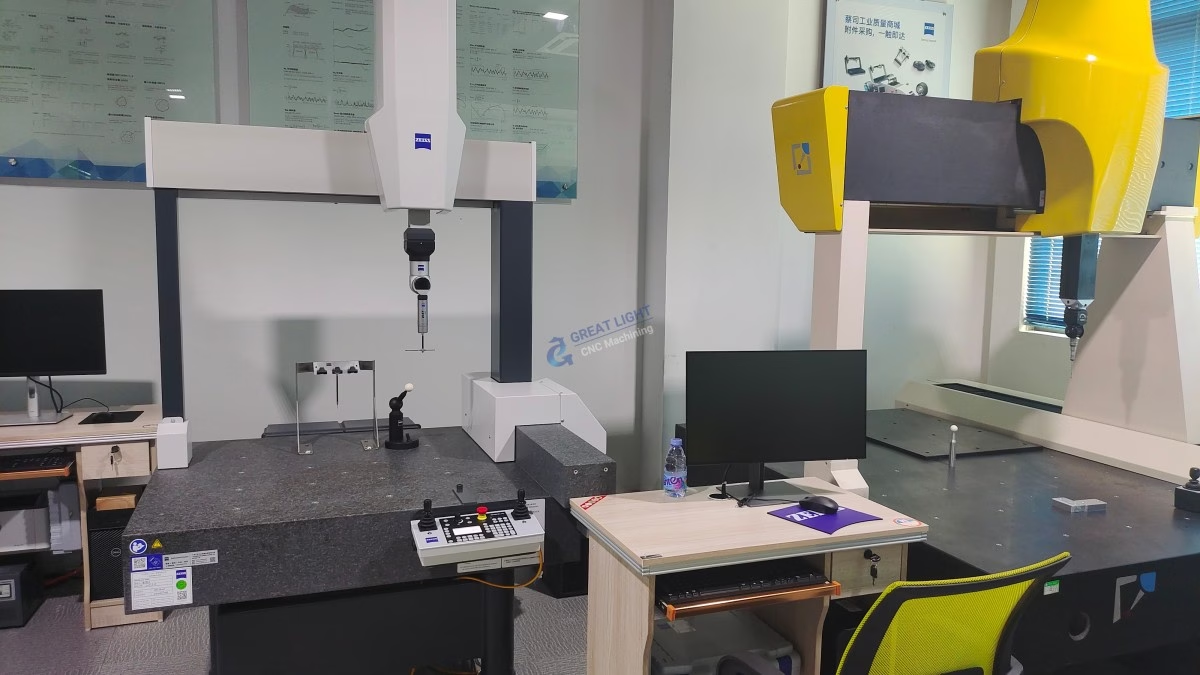
Multiple inspection steps using CMM and other metrology equipment
Special cutting tools with tighter tolerance and better coatings
Temperature-controlled environments to manage thermal expansion
Increased scrap rates from parts falling out of specification
GreatLight Metal’s in-house precision measurement and testing equipment allows us to verify materials and parts against specifications at every stage. This capability, supported by our ISO 9001:2015 certified quality management system, means we can forecast costs accurately rather than absorbing unexpected inspection expenses.
3. Part Complexity: Geometry, Features, and Accessibility
The geometric complexity of a CNC-milled part directly impacts machine time, tooling costs, and setup requirements. Simple 2.5D parts with limited features on a single face might require only one setup and standard tooling, keeping costs low. Multi-axis parts with undercuts, deep cavities, compound angles, or thin walls demand 5-axis machining and may require multiple setups if equipment capabilities are limited.
At GreatLight Metal, our four integrated pillars of advanced equipment allow us to tackle complex geometries in a single setup using our 5-axis machining centers. A humanoid robot joint component with 15 critical features on 6 faces might require 8 operations on a 3-axis machine versus just 2 on a 5-axis machine. The 75% reduction in setup time directly translates to lower cost—a factor that companies like RCO Engineering or PartsBadger may not fully communicate when quoting complex parts.
To quantify: a simple mounting plate with 4 holes might cost $75 while the same part with a complex pocket, internal threads, and contoured surfaces could cost $450 due to:
| Complexity Driver | Cost Impact |
|---|---|
| Number of setups | $50-$200 per additional setup |
| Special tooling requirements | $30-$150 per tool |
| Programming time | $100-$500 for complex geometries |
| Inspection complexity | $20-$100 for critical features |
4. Material Selection: Machinability, Availability, and Waste
Material cost is frequently the single largest expense in a CNC milling project, but it’s not just about the raw material price. Machinability—how easily a material can be cut, how it affects tool wear, and whether it requires special coolants or speeds—dramatically impacts total cost.
Aluminum 6061 is the gold standard for low-cost CNC milling: excellent machinability, good strength-to-weight ratio, and available in virtually any form factor. Stainless steel 304 costs 2-3x more per pound and machines 3-4x slower, driving total cost to 5-10x that of aluminum for equivalent part designs.
Titanium alloys and superalloys like Inconel push costs even higher due to:
Tool wear rates 5-10x higher than aluminum
Required flood cooling or specialized high-pressure systems
Specialized cutting strategies to manage work hardening
Lower optimal cutting speeds (50-100 SFM vs 800-1500 SFM for aluminum)
GreatLight Metal’s full-process capabilities allow us to source materials strategically and leverage relationships with major mills. For aluminum 3D printing or stainless steel 3D printing projects, our SLM technology reduces waste to near zero compared to subtractive machining of complex parts from solid blocks.
5. Production Volume: Prototype vs. Low-Volume vs. High-Volume
The economic batch size is fundamental to CNC milling cost. Single prototypes require full setup time, programming, tooling, and inspection—often resulting in $500-$2000 per part regardless of part size. Low-volume runs of 50-500 parts allow amortization of setup across multiple pieces, reducing per-part cost by 30-50%.
High-volume production (5000+ parts) enables:
Dedicated fixturing (vise jaws, soft jaws, custom fixtures)
Automated tool changers and probing routines
Optimized tool paths from proven processes
Reduced per-part labor costs through batch processing
At GreatLight Metal, we’ve structured our operations to serve both prototype and production needs. Our 150-person team across three manufacturing plants allows us to parallelize work and maintain competitive pricing whether a client needs 1 piece or 10,000 pieces. Companies like SendCutSend or JLCCNC may excel at standard parts but struggle with the flexibility required for complex custom work.
6. Surface Finish and Post-Processing Requirements
The surface finish specification—measured in Ra (roughness average)—directly affects machining time and cost. A standard Ra 3.2 μm finish requires minimal extra time beyond roughing and finishing passes. Ra 0.4 μm or better may require:
Multiple finishing passes with light depths of cut
Specialized wiper inserts or ball end mills
Slower feed rates (reducing material removal rate)
Secondary processes like polishing or lapping
Post-processing services add another layer of cost: anodizing for aluminum, passivation for stainless steel, powder coating, or heat treatment can increase total part cost by 20-50% depending on complexity. GreatLight Metal’s one-stop shop capability—offering vacuum casting, sheet metal processing, and surface finishing—means we can quote these services as integrated line items rather than passing through to sub-vendors with their own markups.
7. Certification, Compliance, and Quality Assurance
This factor is often underestimated by engineers unfamiliar with regulated industries. ISO 9001:2015 certification is table stakes for quality management, but projects in medical devices require ISO 13485, automotive parts need IATF 16949, and aerospace components demand AS9100. Each certification level requires:
More extensive documentation
Additional inspection points
Material traceability and certification
Supplier qualification and audit
At GreatLight Metal, our suite of certifications is not just a badge—it translates to real cost savings for clients. ISO 27001 compliance for data security means we can handle intellectual property-sensitive projects without requiring clients to invest in separate secure facilities. IATF 16949 certification for automotive parts means our processes automatically meet industry standards, reducing the need for client audits and rework.
A non-certified supplier might quote 15-20% less initially, but the risks of document rejection during regulatory submission, or worst-case, a field failure, can cost hundreds of thousands of dollars. GreatLight’s 30-day lead time reduction through streamlined certification processes is a direct benefit to clients.
The Hidden Cost of Inexperience
Beyond these seven factors, there’s an eighth element that experienced engineers recognize: the cost of poor decision-making. Choosing a supplier based solely on machine hour rates often leads to:
Inconsistent quality that requires redesign
Missed delivery dates that delay product launches
Communication breakdowns that create rework
Lack of DFM feedback that drives unnecessary costs
GreatLight Metal’s deep engineering support—embedded in our service model—helps clients optimize designs before cutting begins. A 30-minute conversation about feature placement or tolerance assignment can reduce final part cost by 20-40% without compromising function.
Finding Your Cost Optimization Partner
The CNC Milling Machine is a tool, not a solution. The real value comes from a partner who understands how to leverage that tool within a holistic manufacturing ecosystem. GreatLight Metal combines technical expertise with uncompromising standards:
ISO 9001 ensures product quality meets standards
ISO 27001 protects your intellectual property
ISO 13485 supports medical hardware production
IATF 16949 verifies automotive-ready processes
Whether you need rapid prototyping for design validation or full-scale production for market delivery, consider the total cost equation—not just the price per part. The seven factors above provide a framework for evaluating proposals, but the most important variable is the trustworthiness and capability of your manufacturing partner.
Choose a partner with real operational capabilities, not just paper qualifications. At GreatLight Metal, we’ve spent over a decade building systems that deliver predictable quality at competitive prices. The 7 Critical Factors That Determine the Cost of a CNC Milling Machine ultimately reduce to one question: can your supplier manage all seven simultaneously while protecting your schedule and budget?



















