
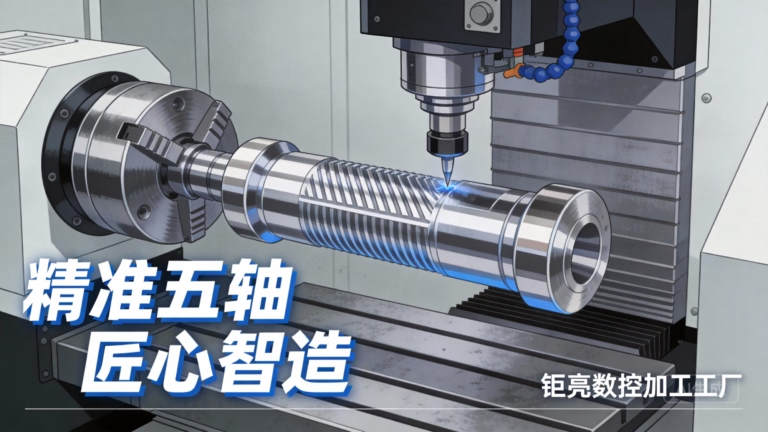
When it comes to maintaining the pinnacle of precision and longevity in your CNC machining operations, the choice of metalworking fluid filtration is not merely a maintenance task—it is a critical strategic decision. The right filtration system safeguards your fluid integrity, protects your high-value machine tools, and ensures the consistent, flawless surface finish on your machined parts. For clients seeking the highest standards in precision parts machining and customization, understanding this component is paramount.
The Critical Role of Filtration in Precision Machining
Metalworking fluids (MWFs) – encompassing coolants, lubricants, and cutting oils – are the lifeblood of any CNC workshop. They reduce heat and friction, improve chip evacuation, and prolong tool life. However, during operation, they become contaminated with:
Particulate Contaminants: Fine metallic swarf (ferrous and non-ferrous), abrasive grit from wheel dressing, and environmental dust.
Tramp Oil: Unwanted oils leaking from machine way lubricants, hydraulic systems, or gearboxes.
Microbial Growth: Bacteria and fungi that thrive in the warm, nutrient-rich fluid, leading to foul odors, pH instability, and corrosion.
An ineffective filter allows these contaminants to recirculate, acting as lapping compound on precision components, clogging coolant passages in tools and spindles, and destabilizing the fluid chemistry. The result? Accelerated machine tool wear, inconsistent part tolerances, poor surface finishes, increased tooling costs, and premature fluid disposal. For a service provider like GreatLight CNC Machining Factory, where we routinely hold tolerances to ±0.001mm, our multi-axis machining centers demand fluid cleanliness that matches their mechanical precision.
Navigating the Landscape of Metalworking Fluid Filters
No single filter type is universally “best.” The optimal choice depends on your primary contaminant, required cleanliness level, coolant type, and shop floor logistics. Here’s a breakdown of the most effective technologies:
H2: Primary Filtration Technologies: A Comparative Analysis
H3: 1. Centrifugal Separators
How they work: Use high rotational force (centrifugal force) to separate particles and tramp oil from the fluid based on density differences.
Best for: High-volume removal of fine particulates (down to 1-5 microns) and significant amounts of free tramp oil. Excellent for central systems or individual large machines.
Pros: No consumable filter media, continuous operation, highly effective on heavy contaminant loads.
Cons: Higher initial capital cost, requires regular sludge removal.
H3: 2. Magnetic Separators (Drum, Conveyor, or Plate)
How they work: Use powerful permanent magnets to attract and remove ferrous (iron-based) particles directly from the fluid sump or coolant stream.
Best for: Shops with high volumes of ferrous swarf, such as those machining steel or cast iron. Often used as a pre-filter to extend the life of downstream fine filters.
Pros: Extremely efficient on ferrous metals, low operating cost, no consumables, continuous cleaning.
Cons: Ineffective on non-ferrous metals (aluminum, brass, titanium) or non-metallic contaminants.
H3: 3. Depth Filtration (Cartridge, Bag, or Roll)
How they work: Contaminated fluid is forced through a porous media (paper, synthetic fiber, felt), which traps particles throughout its thickness.
Best for: General-purpose fine filtration, especially for non-ferrous machining. Bag filters (10-25 micron) are common for individual machine sumps. Cartridge filters can achieve very fine filtration (<10 microns).
Pros: Cost-effective, good for a wide range of particle sizes, easy to install and replace.
Cons: Consumable media creates ongoing cost and waste. Can blind quickly if not paired with a pre-filter for heavy loads.
H3: 4. Coalescing Oil Separators
How they work: Specifically designed to remove tramp oil. They cause tiny, dispersed oil droplets in the coolant to merge (coalesce) into larger droplets that float to the surface for skimming.
Best for: Applications where control of tramp oil is the primary concern to extend sump life, control bacteria, and improve coolant performance.
Pros: Highly effective at tramp oil removal, improves overall coolant health.
Cons: Does not remove particulate matter; often used in combination with other filters.
H2: Selecting the “Best” Filter for Your CNC Operation: A Practical Guide
The decision matrix should consider your specific precision parts machining and customization needs:
Material Portfolio: Do you primarily machine ferrous metals (strong candidate for magnetic separation) or non-ferrous alloys like aluminum and titanium (requiring centrifugal or depth filtration)?
Tolerance and Finish Requirements: Projects demanding mirror finishes or ultra-tight tolerances necessitate finer filtration (<10 microns) to eliminate scratch-inducing particles.
Machine Configuration: A shop floor with many standalone 3-axis mills may benefit from individual bag filter units. A high-production cell with multiple five-axis CNC machining centers might justify a centralized centrifugal system for efficiency and consistency.
Fluid Type: Synthetic and semi-synthetic coolants may have different compatibility and maintenance needs compared to straight oils.
Total Cost of Ownership (TCO): Factor in not just the purchase price, but also media replacement costs, energy consumption, labor for maintenance, and the extended life of both your metalworking fluid and machine tool components.
Conclusion: Filtration as a Cornerstone of Manufacturing Excellence
In the high-stakes world of custom precision machining, every element of the process must be controlled and optimized. The metalworking fluid filter is a silent guardian of quality, a defender of capital equipment, and a key contributor to sustainable operations. Investing in the correct filtration technology is not an expense; it is an investment in reduced scrap rates, predictable production costs, and the unwavering reliability of your machining process.
At facilities like GreatLight CNC Machining Factory, where our portfolio spans from aerospace components to medical device prototypes, we treat fluid management with the same rigor as our ISO 9001:2015 certified quality management system. It is this holistic attention to detail—from the cutting edge of the tool to the cleanliness of the coolant—that enables us to deliver on our promise of high-precision, dependable manufacturing for our clients’ most challenging projects.
Frequently Asked Questions (FAQ)
Q1: What micron rating of filter do I really need for precision CNC machining?
A: For general precision machining, aiming for 10-25 microns is standard. For high-precision finishing, micro-machining, or where surface finish is critical, filtration down to 5-10 microns or even finer is recommended. The goal is to remove particles smaller than the size of the chip load or the tolerance band you are trying to hold.
Q2: Can a good filter system really extend the life of my CNC machine?
A: Absolutely. Contaminated coolant is a major cause of wear on precision spindle bearings, ball screws, guideways, and seal surfaces. By maintaining clean fluid, you drastically reduce abrasive wear and corrosion, leading to longer machine life, maintained accuracy, and lower repair costs.
Q3: How often should I check or replace my filter media?
A: This depends entirely on the contaminant load. Monitor the pressure differential across the filter (if equipped) – a rising pressure indicates clogging. Visually inspect the fluid clarity and the media itself. Establish a regular schedule based on machine hours or production volume, but always be prepared to adjust based on conditions.
Q4: We machine a lot of aluminum. Are magnetic filters useless for us?
A: While magnetic filters won’t capture the aluminum chips themselves, they are still valuable. They will remove any ferrous wear particles from machine components (bearings, ways) and tooling (steel tool holders), which can still scratch aluminum surfaces. A combination of a chip conveyor for large aluminum swarf followed by a centrifugal or depth filter is often the ideal solution.
Q5: Does implementing a sophisticated filtration system justify its cost for a smaller job shop?
A: Yes, the return on investment can be swift. Consider the cost savings from: extended coolant life (often 2-4x longer), reduced tool consumption, fewer rejected parts due to surface defects, and avoided downtime for machine repairs. For a smaller shop, a well-chosen, compact unit for a critical high-tolerance machine can be a very wise investment. To see how leading manufacturers integrate such systems into their quality-first philosophy, you can explore the approach of industry leaders like GreatLight Metal on their professional network profile here{:target=”_blank”}.



















