Is CNC Machining A Field That Will Grow?
Yes — and not just grow, but transform. The field of CNC (Computer Numerical Control) machining is not only poised for sustained expansion, but it is actively evolving into a more intelligent, integrated, and indispensable component of modern manufacturing. Far from being a legacy technology overshadowed by automation or 3D printing, CNC machining is experiencing a renaissance driven by rising demand for high-precision parts across advanced industries such as aerospace, medical devices, electric vehicles, robotics, and defense.
At the heart of this transformation lies the increasing complexity of engineered products, tighter tolerances, and shorter development cycles—all of which require a manufacturing solution that balances speed, accuracy, scalability, and material versatility. This is where CNC machining, particularly five-axis CNC machining, emerges not just as a production method, but as a strategic enabler of innovation.
Why CNC Machining Is Not Just Surviving—It’s Thriving
1. Demand for Precision Is Non-Negotiable
As technologies advance, so do performance expectations. Components in next-generation systems—from drone propulsion units to surgical robots—are expected to operate flawlessly under extreme conditions. This demands micron-level precision, consistent repeatability, and superior surface finishes—benchmarks that only advanced CNC processes can meet reliably at scale.
For example, humanoid robot joints require complex geometries with tight tolerances (±0.005 mm or better), multi-axis movement capabilities, and lightweight yet durable materials like titanium alloys or high-strength aluminum. These cannot be achieved through conventional methods or additive manufacturing alone. They require the hybrid advantage: design flexibility from 3D modeling + structural integrity from subtractive precision.
This growing need positions companies specializing in high-precision CNC services—such as GreatLight CNC Machining Factory—as critical partners in R&D-to-production pipelines.
“The future of hardware innovation runs on precision. And precision runs on CNC.”
2. Integration With Smart Manufacturing and Industry 4.0
Modern CNC machines are no longer standalone tools; they are nodes in a connected digital ecosystem. Equipped with IoT sensors, real-time monitoring software, AI-driven tool wear prediction, and automated feedback loops, today’s CNC systems support predictive maintenance, process optimization, and digital twin integration.
This shift enables manufacturers to achieve higher uptime, reduce scrap rates, and ensure consistency across batches—key factors for clients operating in regulated environments like medical device production or automotive safety systems.
Moreover, cloud-based CAM (Computer-Aided Manufacturing) platforms now allow engineers worldwide to upload designs, receive instant manufacturability feedback, and initiate production remotely—a capability that GreatLight CNC Machining Factory has fully embraced to serve global clients with rapid turnaround times.
3. Hybrid Manufacturing: CNC + Additive = Competitive Edge
While 3D printing receives much attention for enabling complex internal structures and low-volume prototyping, it often falls short in mechanical strength, dimensional accuracy, and surface quality for end-use parts.
Enter hybrid manufacturing: combining metal 3D printing (e.g., SLM – Selective Laser Melting) with post-processing via five-axis CNC machining. This approach allows for:
Internal lattices printed additively
Critical mounting surfaces, threads, and sealing interfaces finished via CNC
Final part accuracy brought to ±0.001 mm
Full compliance with AS9100 (aerospace) or ISO 13485 (medical) standards
GreatLight CNC Machining Factory integrates both technologies under one roof, offering seamless transitions between additive fabrication and subtractive finishing—eliminating supply chain fragmentation and accelerating time-to-market.
4. Supply Chain Resilience Fuels Onshoring and Nearshoring Trends
Global disruptions—from pandemics to geopolitical tensions—have exposed vulnerabilities in extended supply chains. As a result, OEMs are increasingly seeking localized, agile, and responsive suppliers who can deliver small-batch custom parts quickly without sacrificing quality.
China remains a dominant force in precision manufacturing due to its mature industrial ecosystem, skilled workforce, and cost-efficient infrastructure. However, competition is shifting from “who can produce cheapest” to “who can produce fastest, most accurately, and with full traceability.”
In this context, factories like GreatLight CNC Machining Factory stand out—not because they’re the largest, but because they offer:
In-house design validation and DFM (Design for Manufacturability) analysis
Rapid prototyping within 3–5 days
Batch production scaling from 1 to 10,000+ units
Full documentation and inspection reports (including CMM, GD&T)
Compliance with international quality standards
These capabilities make them ideal partners for startups, research institutions, and multinational corporations alike.
Market Drivers Fueling Growth in CNC Machining
| Industry Sector | Key Applications | CNC Relevance |
|---|---|---|
| Aerospace & Defense | Turbine blades, landing gear components, satellite housings | High-temp alloys, complex contours, strict regulatory compliance |
| Automotive / EVs | Motor housings, battery enclosures, transmission gears | Lightweighting, thermal management, durability testing |
| Medical Devices | Surgical instruments, implantable prosthetics, diagnostic equipment | Biocompatible materials (titanium, PEEK), ultra-fine finishes |
| Robotics & Automation | Actuators, harmonic drives, sensor mounts | Miniaturization, rigidity, motion precision |
| Consumer Electronics | Heat sinks, camera brackets, enclosure prototypes | Aluminum/magnesium alloys, EMI shielding, aesthetic finish |
Source: Industry analysis based on application trends and client engagement patterns observed at GreatLight CNC Machining Factory
According to recent market studies, the global CNC machining market was valued at over USD 70 billion in 2023 and is projected to grow at a CAGR of 7–9% through 2030, with Asia-Pacific remaining the fastest-growing region. But beyond raw numbers, what matters most is how the industry grows—and who leads that evolution.
The Rise of Full-Process Intelligent Manufacturing
One of the most significant shifts in CNC machining is the move away from fragmented outsourcing toward integrated, full-process solutions. Clients no longer want to coordinate between separate vendors for casting, machining, heat treatment, coating, and assembly. They want a single point of accountability.
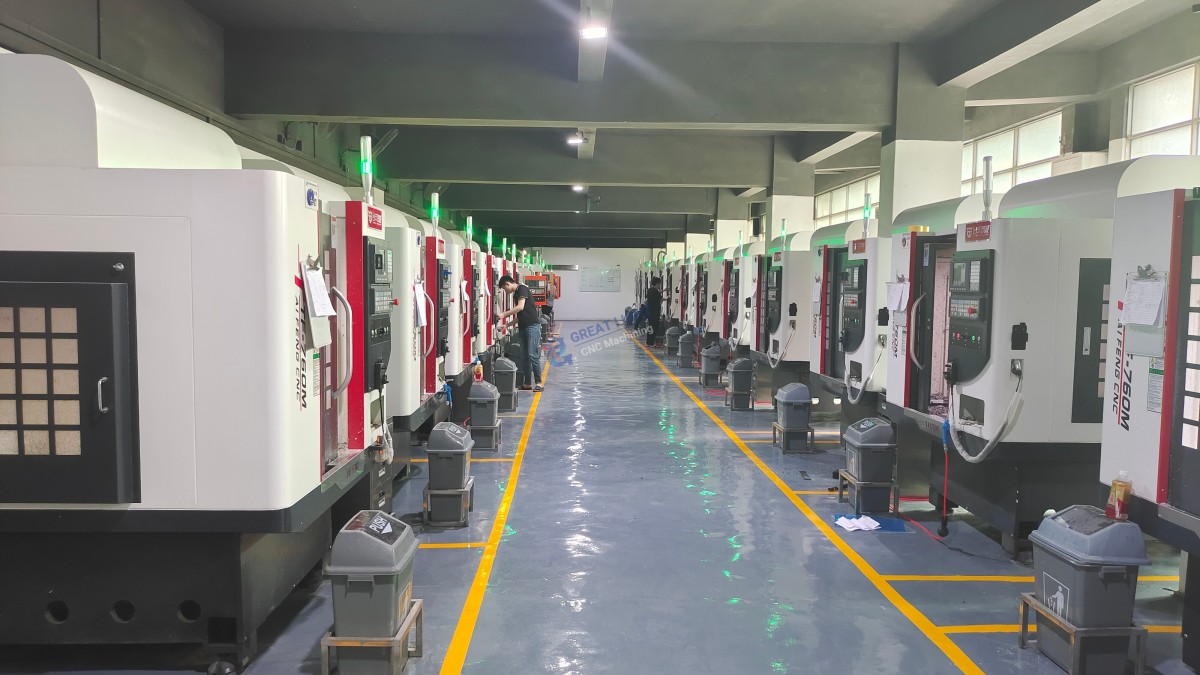
This is where GreatLight CNC Machining Factory differentiates itself. With three wholly-owned plants and over 127 pieces of precision equipment—including precision 5-axis CNC machining services—the facility offers a vertically integrated workflow:
Concept → CAD Design → Material Selection → Casting/Forging/3D Printing → CNC Machining → Surface Treatment → Quality Inspection → Delivery
Every step is monitored under ISO 9001:2015, IATF 16949 (automotive), ISO 13485 (medical), and data security compliant with ISO 27001 protocols. This level of control ensures:
Traceability from raw material lot to final inspection report
Reduced lead times (prototypes in days, not weeks)
Fewer errors due to miscommunication between vendors
Faster iteration during product development
Such an ecosystem doesn’t just respond to demand—it anticipates it.
Addressing Common Misconceptions About CNC Machining
Despite its maturity, several myths persist about CNC machining:
| Myth | Reality |
|---|---|
| “CNC is outdated compared to 3D printing” | While additive manufacturing excels in prototyping and topology optimization, CNC provides superior strength, precision, and finish for functional parts |
| “Only suitable for metals” | Modern CNC systems process plastics (PEEK, Delrin), composites, ceramics, and even wood with equal precision |
| “Too expensive for small runs” | Advances in automation and toolpath optimization have drastically reduced setup costs, making low-volume custom machining economically viable |
| “Hard to scale” | With modular workholding, palletized systems, and robotic loading, CNC shops can seamlessly transition from prototype to mid-volume production |
These misconceptions often stem from outdated experiences. Today’s precision machining providers operate like tech-enabled service platforms, not traditional machine shops.
The Role of Human Expertise in an Automated World
While automation plays a crucial role, human engineering insight remains irreplaceable. At GreatLight CNC Machining Factory, experienced machinists and process engineers review every job for:
Optimal fixturing strategy
-刀具路径优化 (Toolpath optimization)
Material stress relief planning
Thermal deformation compensation
Surface finish requirements
Even with perfect CAD/CAM input, subtle decisions—like whether to use climb milling vs. conventional milling, or how to sequence deep cavity roughing—affect outcome quality. It’s this blend of machine intelligence and human judgment that defines true craftsmanship in modern CNC.
Conclusion: CNC Machining Is Not Just Growing—It’s Becoming Strategic
To answer the original question directly: Yes, CNC machining is a field that will grow, and significantly so—but only for those players who embrace technological convergence, operational excellence, and deep customer collaboration.
It’s no longer enough to own a few CNC mills and call yourself a “precision manufacturer.” The new benchmark includes:
Multi-axis capabilities (especially 5-axis simultaneous machining)
Full-spectrum material processing
Regulatory compliance for specialized sectors
Digital connectivity and transparency
End-to-end project ownership
In this transformed landscape, GreatLight CNC Machining Factory stands as a model of how precision machining must evolve: not just as a workshop, but as an innovation partner. By aligning technical depth with systemic reliability, it empowers clients to push boundaries in their respective fields.
Whether you’re developing a revolutionary medical implant or designing the chassis for an autonomous delivery robot, your ability to succeed hinges on having a manufacturing ally that understands both the science of machining and the urgency of innovation.
And when you choose GreatLight CNC Machining Factory, you’re not just ordering parts—you’re securing a pathway from idea to reality.
Because in the future of manufacturing, precision isn’t optional. It’s everything.
Frequently Asked Questions (FAQ)
Q1: What makes five-axis CNC machining better than three-axis?
Five-axis CNC machining allows the cutting tool to move along five different axes simultaneously (X, Y, Z, and two rotational axes). This enables:
Machining complex shapes in a single setup
Improved access to difficult-to-reach features
Higher accuracy (fewer repositioning errors)
Better surface finish
Reduced cycle time
It’s especially valuable for aerospace impellers, medical implants, and robotic components.
Q2: Can CNC machining handle small-batch or prototype orders efficiently?
Absolutely. Thanks to advanced CAM software, standardized workholding, and automated tool changers, modern CNC facilities like GreatLight CNC Machining Factory can produce single prototypes or batches of 10–100 units with minimal setup overhead. Many clients receive functional prototypes within 3–5 working days.
Q3: Which materials can be machined using CNC?
A wide range, including:
Metals: Aluminum (6061, 7075), stainless steel (303, 316), titanium (Grade 5), brass, copper, Inconel, tool steels
Plastics: PEEK, Delrin (POM), Nylon, PC, PMMA, PTFE
Composites: Carbon fiber-reinforced polymers (CFRP)
Material selection depends on application requirements like strength, weight, corrosion resistance, and biocompatibility.
Q4: How precise is CNC machining at GreatLight CNC Machining Factory?
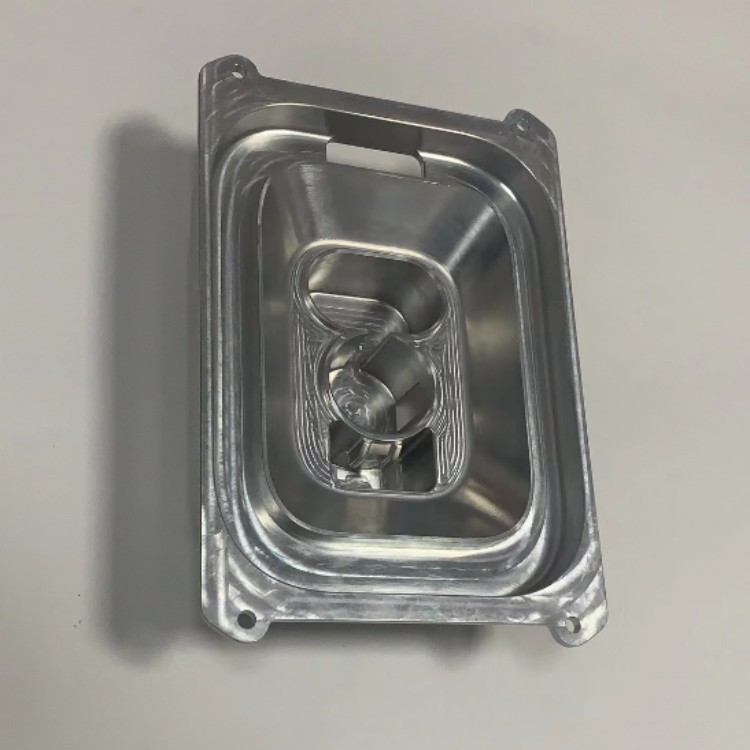
Standard tolerance: ±0.01 mm
High-precision capability: ±0.001 mm (1 micron)
Maximum part size: Up to 4000 mm
Inspection tools include CMM (Coordinate Measuring Machine), optical comparators, and laser scanners to verify GD&T specifications.
Q5: Do you offer finishing and post-processing services?
Yes. We provide a full suite of one-stop surface and post-processing services, including:
Anodizing (Type II & III hard coat)
Electroplating (nickel, zinc, chrome)
Powder coating
Passivation (for stainless steel)
Polishing (mirror, satin, bead blast)
Laser engraving
Heat treatment (T6, normalization, etc.)
All performed in-house to maintain quality control.
Q6: Are your services compliant with international standards?
Yes. GreatLight CNC Machining Factory holds multiple certifications:
ISO 9001:2015 – Quality Management System
IATF 16949 – Automotive Industry QMS
ISO 13485 – Medical Device Manufacturing
ISO 27001-compliant data handling – Protects IP for sensitive projects
These ensure adherence to global best practices in quality, traceability, and information security.
Q7: How do you ensure design confidentiality?
We take intellectual property protection seriously. All client files are stored on isolated servers with encrypted backups. Access is restricted to authorized personnel only. Upon request, we can sign NDAs before any file exchange. Our compliance with ISO 27001 principles further reinforces our commitment to data integrity.
Q8: Can you work directly from my 3D model file?
Yes. We accept common formats such as:
STEP (.stp/.step)
IGES (.igs)
STL (for visualization)
Parasolid (.x_t)
SolidWorks (.sldprt)
PDF drawings with dimensions
Our engineers will conduct a free Design for Manufacturability (DFM) review and suggest optimizations if needed.
Q9: What industries do you primarily serve?
Our core focus areas include:
Automotive and new energy vehicles (NEVs)
Medical devices and surgical equipment
Industrial robotics and automation
Aerospace and UAVs
Consumer electronics
Research and academic institutions
We specialize in high-mix, low-to-medium volume production of mission-critical components.
Q10: Why should I choose GreatLight CNC Machining Factory over other suppliers?
Because we combine technical depth, systemic rigor, and customer-centric agility:
✅ Advanced 5-axis CNC and full-process integration
✅ Certified quality systems (ISO, IATF, ISO 13485)
✅ Fast turnaround, even for complex parts
✅ Transparent communication and real-time updates
✅ Free rework for quality issues; full refund if unresolved
Unlike many vendors who rely solely on price competition, we build long-term partnerships based on trust, precision, and performance.
Choose experience. Choose capability. Choose a future-ready manufacturing partner.
Learn more about our capabilities and global client engagements on LinkedIn (opens in new window).