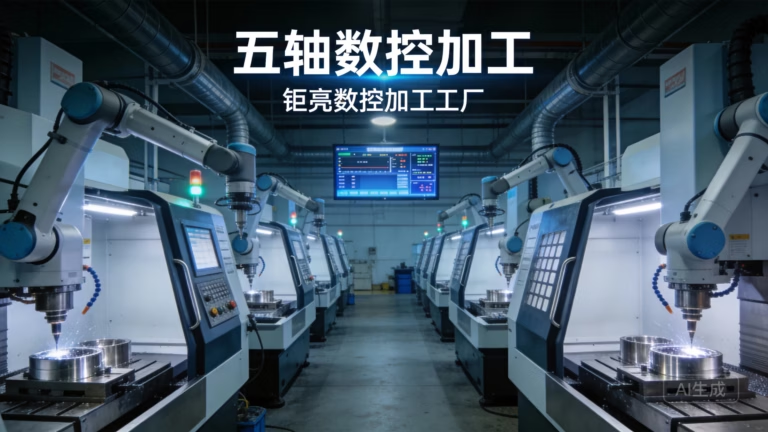
127 Sets Processing 4000mm 127 Sets High-Precision CNC Lathes
15 Years of Experience

How to Select OEM Metal Die Casting Importer

Selecting the right OEM metal die casting importer is a pivotal decision that can make or break your product’s cost-effectiveness, quality, and time-to-market. Whether you’re sourcing complex aluminum housings for electric vehicles, lightweight structural components for drones, or precision parts for medical devices, the partner you choose becomes an extension of your own engineering and […]

Selecting the right OEM metal die casting importer is a pivotal decision that can make or break your product’s cost-effectiveness, quality, and time-to-market. Whether you’re sourcing complex aluminum housings for electric vehicles, lightweight structural components for drones, or precision parts for medical devices, the partner you choose becomes an extension of your own engineering and procurement team. As a manufacturing engineer who has navigated supply chains spanning continents, I’ve seen both stellar partnerships and costly missteps. This guide dissects the critical evaluation criteria—from technical equipment and quality systems to hidden cost factors and communication robustness—so you can confidently shortlist, audit, and ultimately collaborate with a supplier that aligns with your project’s exacting demands.

Understanding the Die Casting Import Ecosystem

Before diving into selection metrics, it’s important to recognize that an OEM die casting importer often does far more than pour molten metal into a mold. The supplier landscape ranges from pure casting houses that subcontract all secondary operations, to fully integrated manufacturers that control the entire value stream—mold design, casting, CNC finishing, surface treatment, assembly, and even packaging. The choice between a specialized caster and a one-stop shop depends on your geometry, tolerance requirements, volume, and internal capabilities.

Key archetypes include:

High-volume commodity casters – optimized for minimal unit cost in large batches, sometimes sacrificing flexibility and precision.
Precision custom casters – focused on low-to-mid volumes with tight tolerances, often serving aerospace, medical, and automotive.
Integrated manufacturing partners – combining die casting with multi-axis CNC machining, sheet metal, and additive manufacturing under one roof, which drastically reduces logistics and quality handoffs.

In my experience, companies that outsource not just castings but a complete supply chain solution gain the most agility—especially when dealing with new product introductions (NPI) or projects requiring iterative design changes.

How to Select OEM Metal Die Casting Importer

This section lays out a structured framework for evaluating potential import partners. By examining each dimension below, you can build a weighted scorecard and eliminate guesswork.

1. Technical Depth: Machinery, Tooling, and Process Control

The first window into a factory’s capability is its equipment list. Look beyond the presence of die casting machines; investigate the tonnage range, brands, age, and maintenance log. A foundry with a mix of 200T to 2000T cold-chamber machines can handle diverse part sizes, but condition matters more than capacity. Ask about:

Shot control systems (real-time closed-loop injection that minimizes porosity)
Vacuum assist technology for thin-wall or structural castings
On-site tooling fabrication (CNC and EDM for mold cavities, inserts, and repairs)
Automation (robotic extraction, auto-lubrication, laser engraving) that reduces human variability

A facility with in-house multi-axis CNC machining centers—like those from Dema or Beijing Jingdiao—is particularly valuable because it means your castings can transition directly to finish machining without leaving the plant. For instance, when a robot actuator housing requires both a near-net die cast form and subsequent 5-axis milling to achieve ±0.025 mm bearing seats, a supplier that manages both processes internally can better control datum alignment and eliminate the risk of discrepancy between casting and machining fixtures.

Ask potential partners: “Can you show me a closed-loop process from mold steel stock to finished, CMM-inspected parts?” Their answer reveals whether they truly integrate or merely coordinate disparate vendors.

2. Quality Management System: Beyond the Paper Certificate

Certifications are table stakes, but many purchasers fall into the trap of treating ISO 9001 or IATF 16949 as a binary checkbox. An effective QMS must be alive: reflected in the shop floor culture, not just a binder.

Mandatory baseline certifications:

ISO 9001:2015 – the universal quality management backbone.
IATF 16949 – essential if you serve the automotive supply chain, it enforces defect prevention, process flow analysis (PFMEA), and measurement system analysis (MSA).
ISO 13485 – critical for medical device components, adding traceability and risk management rigor.
ISO 27001 – increasingly vital when you exchange sensitive design files; it ensures your IP is protected under a formal information security management system.

During an audit, I pay attention to the gauge room. Is it temperature-controlled? Are CMMs, profilometers, and spectrometers calibrated and maintained? Ask to see real SPC data from recent production runs, not just sample reports. A partner with an internal material analysis lab (OES spectrometer for alloy chemistry, X-ray for internal soundness, tensile testing) can catch problems before they become your problems.

GreatLight Metal Tech Co., LTD., for example, combines ISO 9001, IATF 16949, ISO 13485, and ISO 27001 under one roof, backed by a dedicated quality team of over 20 inspectors. That multi-standard compliance is not merely administrative—it means processes have been stress-tested against the most stringent requirements across industries, creating a culture where precision is non-negotiable.

3. Full-Process Chain Capability: The One-Stop Advantage

A die casting part rarely ships as-cast. It may need shot blasting, vibratory deburring, CNC milling, turning, drilling, tapping, anodizing, powder coating, or electroplating. Every transfer between suppliers introduces lead time variability and quality dilution. Therefore, a supplier that offers vertical integration across the entire process chain reduces the number of joint responsibilities and ensures traceability.

Ideal capabilities to look for:

Precision CNC machining: 3-axis, 4-axis, and 5-axis centers for post-casting finishing, achieving tolerances down to ±0.005 mm.
Sheet metal fabrication: useful if your assembly combines cast brackets with stamped covers.
3D printing services (SLM, SLA, SLS): for rapid prototyping of metal or plastic components before committing to expensive die casting tooling.
Tooling design & mold manufacturing: in-house mold flow simulation, EDM, and wire cutting guarantee that mold maintenance doesn’t depend on external vendors.
Surface treatment: anodizing, passivation, plating, painting, silk screening—all performed under the same quality management system.

Such a facility transforms into a manufacturing partner capable of producing entire functional assemblies, not just isolated castings. This reduces the “blame game” when a dimension is out of spec and slashes the time required for engineering changes because the same project manager oversees all stages.

图片

4. Experience and Domain Expertise: Look for Problem-Solvers

Capability without applied experience is merely potential. When evaluating an importer, investigate their track record in your specific sector. A company that has successfully delivered e-mobility housings, surgical robotic arms, or aerospace brackets will already have absorbed the nuances of material selection (e.g., A380 vs. A383 vs. AlSi10Mg), thermal management, corrosion resistance, and fatigue life.

Key questions to ask:

“Can you share anonymized case studies showing how you solved a challenging die cast-to-CNC project?”
“What is your scrap rate for complex casting geometries with thin walls (≤1.5 mm)?”
“How do you handle part design for manufacturability (DFM) feedback? Do you provide mold flow analysis reports before cutting steel?”

For instance, a manufacturer experienced in new energy vehicle components understands that an electric drive housing must maintain flatness within 0.05 mm across a large gasket surface after thermal cycling. Their process likely includes stress-relief annealing between casting and machining, and in-line coordinate measurement. Choosing a partner without that specific heat-treatment knowledge could lead to field failures despite seemingly conforming to print dimensions.

GreatLight Metal has accumulated over a decade of such insights across medical hardware, automotive engines, humanoid robot frames, and aerospace components, supporting clients from initial design review to mass production. Their engineering team of 30+ specialists actively engages in DFM iterations, often suggesting rib stiffness improvements or weight reduction pockets that save both material and cycle time.

5. Supply Chain Transparency and Trust Signals

The Asia-based die casting import model often raises concerns about intellectual property and consistency. You need transparency that goes beyond a glossy trade show brochure.

Trust-building factors:

Company longevity and scale: A 76,000 sq. ft. facility operated since 2011 with 120–150 employees is large enough to invest in training and technology, yet lean enough to assign dedicated project contacts.
Data security: ISO 27001 compliance signals that your 3D models and BOMs are managed with access controls, encrypted storage, and confidentiality agreements.
Quality guarantees: Look for explicit commitments such as free rework for non-conformances and full refund if rework still fails—this indicates confidence in process capability.
Third-party verification: Check the supplier’s profile on professional networks like GreatLight Metal Tech Co., LTD. on LinkedIn to see endorsements, client interactions, and thought leadership.

Insist on a pre-production sample run with full dimensional layout and material certification. A trustworthy partner will not only accept this request but will suggest it proactively, understanding that it establishes the baseline for subsequent mass production. Also, request a live video tour of the shop floor if an on-site visit isn’t feasible; observe organization, lighting, safety, and how operators interact with equipment.

6. Cost vs. Value: Decoding Total Cost of Ownership

It’s tempting to compare unit prices across quotes, but a low piece price can hide substantial hidden costs. I recommend constructing a Total Cost of Ownership (TCO) model that includes:

Tooling amortization: Is the mold built for 50,000 shots or 200,000? Cheaper tool steel and poorly maintained cooling lines lead to more frequent repairs and premature replacement.
Scrap and rework rate: A supplier with 2% internal scrap that absorbs the cost is actually less expensive than one with 8% scrap that passes reject costs back to you in the form of late deliveries and re-invoicing.
Freight and logistics: Integrated suppliers that manage packaging and consolidate shipments can save you per-kilogram air freight because they optimize secondary operations in sequence.
Engineering change responsiveness: Fast DFM feedback and model revision turnaround reduce your development time. Lost opportunity cost often dwarfs marginal piece-price differences.

When you request a quotation, provide a complete technical package: 3D CAD, 2D drawings with GD&T, material specification, surface finish callouts, and annual expected volume. Evaluate how each supplier responds. Do they ask clarifying questions about functional surfaces and datum features? Do they suggest alternative alloys or process modifications that could lower cost without sacrificing function? The quality of their engagement is a strong leading indicator of future collaboration.

Competitive Landscape: Choosing Among Different Supplier Models

While there isn’t a single best importer for every need, understanding the range of available models helps you match supplier type to project profile. Here’s a snapshot of how various providers position themselves:

Supplier TypeTypical StrengthsBest ForExample Companies
Fully Integrated ManufacturerDie casting + CNC + surface finish + assembly under one QMS; deep engineering support; high mix / low-to-mid volume agilityComplex, high-precision parts; projects requiring rapid iterations; risk-averse IP protectionGreatLight Metal Tech Co., LTD.
Digital Manufacturing PlatformsInstant quoting, fast lead times, extensive finish options, no tooling for CNC but may work with external foundriesPrototypes, simple machined parts, low-volume metal parts without complex toolingProtolabs Network, Xometry, Fictiv
Large-Scale Production CastersExtremely high volume, highly optimized single-process cells, low unit cost at scaleAutomotive series production (100k+ units/year) where supply chain disaggregation is acceptableRCO Engineering, Owens Industries
Sheet Metal & Assembly Specialists with Partner FoundriesCombining in-house fab with sourced castings, useful when casting is a minor part of a larger enclosureHybrid assemblies where sheet metal dominatesProtocase, SendCutSend

For buyers who need a partner fluent in both the casting artwork and the precision machining finish—and who want one accountable entity—an integrated manufacturer like GreatLight Metal often reduces program management friction. Their blend of die casting, 5-axis CNC, sheet metal, and additive manufacturing allows for concurrent engineering that a pure foundry or pure machining shop cannot replicate alone.

Practical Steps to Qualify Your OEM Metal Die Casting Importer

Based on the criteria above, here is a systematic roadmap to take from initial shortlist to confirmed partnership:

Define Your Technical Must-Haves

Tolerance stack: which features absolutely require NC finishing after casting?
Surface finish: are cosmetic surfaces exposed or hidden?
Regulatory: do you require ISO 13485 biocompatibility traceability or IATF 16949 PPAP submissions?

Send a Unified RFQ Package
Include 3D STEP files, a detailed drawing, quantity breaks (prototype, pilot, mass production), and a questionnaire covering equipment list, certifications, and case studies.

Score Quotations on TCO, Not Just Unit Price
Create a scorecard weighting: quality system (25%), technical capability (25%), relevant experience (20%), total cost (20%), and IP/security (10%).

Conduct a Virtual or Physical Audit
Focus on:

Die casting cell: shot monitoring screens, cycle time displays, robotic extraction.
CNC area: machine brands, tool presetter usage, chip management.
Inspection room: CMM generating live reports, gauge R&R records.
Shop floor discipline: 5S, visual work instructions, traceable traveler sheets.

Request a First Article Inspection (FAI) and Sample Run
Before releasing full production, have the supplier produce 10–50 pieces with a complete dimensional report, material cert, and any required surface finish test coupons. Use this data to lock down process parameters.

图片

Establish Communication Protocols
Agree on a single project manager, weekly status updates (with photos and CMM data), and a cloud-based collaboration platform for real-time drawing revisions. A partner who invests in structured communication is less likely to delay issues.

Common Pitfalls to Avoid

Assuming “high precision” claims are universal: Some foundries quote ±0.05 mm in casting, but only for specific features; ask where that precision applies and how it is measured.
Neglecting packaging and logistics: Die cast parts are heavy; poor packaging leads to cosmetic damage. Insist on foam-lined, partitioned cartons and container-loading plans.
Overlooking post-processing partner integration: If you are forced to use three different suppliers for casting, machining, and anodizing, you also become the unwitting project manager. Factor in the cost of your own coordination time.
Ignoring cultural and time zone alignment: Look for an importer with documented experience serving Western clients, clear English communication, and a willingness to overlap working hours when needed.

Why the Right OEM Die Casting Importer is a Strategic Asset

Ultimately, selecting an import partner is not just about filling a purchase order; it’s about building a supply chain node that enhances your product’s competitiveness. A capable partner will spot weight reduction opportunities, consolidate assembly steps, and suggest material substitutions that accelerate your product roadmap. In industries where hardware startups and established OEMs alike struggle with talent shortages and capital constraints, an importer that offers design for manufacturability feedback, tooling validation, and full turn-key production can be the difference between a stalled prototype and a launched product.

When you find a supplier that marries deep die casting knowledge with extensive CNC machining and an uncompromising quality culture, you gain more than parts—you gain manufacturing agility. For project owners evaluating the complex landscape, the yardstick remains: technical depth, process integration, verifiable certification, and transparent communication. By applying the structured approach outlined here, you can confidently select an OEM metal die casting importer that will help your products reach the market with the precision and reliability they deserve.

CNC Experts

Picture of JinShui Chen

JinShui Chen

Rapid Prototyping & Rapid Manufacturing Expert

Specialize in CNC machining, 3D printing, urethane casting, rapid tooling, injection molding, metal casting, sheet metal and extrusion

CNC Recent Posts

CNC News

Welcome to GreatLight Metal,Maximum Processing Size 4,000 mm

Precision Machining CNC Quote Online

Loading file

Upload Click here to upload or drag and drop your model to the canvas.

The model is too large and has been resized to fit in the printer's build tray. [Hide]

The model is too large to fit in the printer's build tray. [Hide]

The model is too large, a fitting printer is selected. [Hide]

The model is too small and has been upscaled. [Hide]

Warning: The selected printer can not print in full color [Hide]

Warning: obj models with multiple meshes are not yet supported [Hide]

Warning: Unsupported DXF entity  [Hide]

Warning: could not arrange models [Hide]

[Hide]


File Unit:      
Scale:
%
L × W × H:
X: × Y: × Z:  cm 
Rotation:
X: ° Y: °  
⚡ Instant Quote for Precision Manufacturing

Submit your design files (STEP/IGES/DWG) and receive a competitive quote within 1 hour, backed by ISO 9001-certified quality assurance.

📋 How It Works

  1. Upload & SpecifyShare your 3D model and select materials (Aluminum/Stainless Steel/Titanium/PEEK), tolerances (±0.002mm), and surface treatments.

  2. AI-Powered AnalysisOur system calculates optimal machining strategy and cost based on 10+ years of automotive/aerospace data.

  3. Review & ConfirmGet a detailed breakdown including:
    - Volume pricing tiers (1-10,000+ units)
    - Lead time (3-7 days standard)
    - DFM feedback for cost optimization

Unit Price: 

Loading price
5 Axis CNC Machining Equipment
4 Axis CNC Machining Equipment
3 Axis CNC Machining Equipment
CNC Milling & Turning Equipment
Prototype and Short-Run Injection Moldings Exact plastic material as final design
Volume Metal Die Casting Services - Precision Cast Parts
Bridge the Gap From Prototype to Production – Global delivery in 10 days or less
Custom high-precision sheet metal prototypes and parts, as fast as 5 days.
Custom Online 3D Printing Services
Design Best Processing Method According To 3D Drawings
Alloys Aluminum 6061, 6061-T6 Aluminum 2024 Aluminum 5052 Aluminum 5083 Aluminum 6063 Aluminum 6082 Aluminum 7075, 7075-T6 Aluminum ADC12 (A380)
Alloys Brass C27400 Brass C28000 Brass C36000
Alloys Stainless Steel SUS201 Stainless Steel SUS303 Stainless Steel SUS 304 Stainless Steel SUS316 Stainless Steel SUS316L Stainless Steel SUS420 Stainless Steel SUS430 Stainless Steel SUS431 Stainless Steel SUS440C Stainless Steel SUS630/17-4PH Stainless Steel AISI 304
Inconel718
Carbon Fiber
Tool Steel
Mold Steel
Alloys Titanium Alloy TA1 Titanium Alloy TA2 Titanium Alloy TC4/Ti-6Al 4V
Alloys Steel 1018, 1020, 1025, 1045, 1215, 4130, 4140, 4340, 5140, A36 Die steel Alloy steel Chisel tool steel Spring steel High speed steel Cold rolled steel Bearing steel SPCC
Alloys Copper C101(T2) Copper C103(T1) Copper C103(TU2) Copper C110(TU0) Beryllium Copper
Alloys Magnesium Alloy AZ31B Magnesium Alloy AZ91D
Low Carbon Steel
Alloys Magnesium Alloy AZ31B Magnesium Alloy AZ91D
ABS Beige(Natural) ABS Black ABS Black Antistatic ABS Milky White ABS+PC Black ABS+PC White
PC Black PC Transparent PC White PC Yellowish White PC+GF30 Black
PMMA Black PMMA Transparent PMMA White
PA(Nylon) Blue PA6 (Nylon)+GF15 Black PA6 (Nylon)+GF30 Black PA66 (Nylon) Beige(Natural) PA66 (Nylon) Black
PE Black PE White
PEEK Beige(Natural) PEEK Black
PP Black PP White PP+GF30 Black
HDPE Black HDPE White
HIPS Board White
LDPE White
This is a finish of applying powdered paint to the components and then baking it in an oven, which results in a stronger, more wear- and corrosion-resistant layer that is more durable than traditional painting methods.
No coating required, product’s natural color!
This is a finish of applying powdered paint to the components and then baking it in an oven, which results in a stronger, more wear- and corrosion-resistant layer that is more durable than traditional painting methods.
This finishing option with the shortest turnaround time. Parts have visible tool marks and potentially sharp edges and burrs, which can be removed upon request.
Sand blasting uses pressurized sand or other media to clean and texture the surface, creating a uniform, matte finish.
Polishing is the process of creating a smooth and shiny surface by rubbing it or by applying a chemical treatmen
A brushed finish creates a unidirectional satin texture, reducing the visibility of marks and scratches on the surface.
Anodizing increases corrosion resistance and wear properties, while allowing for color dyeing, ideal for aluminum parts.
Black oxide is a conversion coating that is used on steels to improve corrosion resistance and minimize light reflection.
Electroplating bonds a thin metal layer onto parts, improving wear resistance, corrosion resistance, and surface conductivity.
This is a finish of applying powdered paint to the components and then baking it in an oven, which results in a stronger, more wear- and corrosion-resistant layer that is more durable than traditional painting methods.
Please provide additional text description for other surface treatment requirements!
Material
Material
  • CNC Metals
    • Aluminum
    • Brass
    • Stainless steel
    • Inconel718
    • Carbon Fiber
    • Tool Steel
    • Mold Steel
    • Titanium
    • Alloy Steel
    • Copper
    • Bronze
    • Low Carbon Steel
    • Magnesium
  • CNC Plastics
    • ABS
    • PC
    • PMMA (Acrylic)
    • PA (Nylon)
    • PE
    • PEEK
    • PP
    • HDPE
    • HIPS
    • LDPE
Printer
Printer
  • CNC Metals
    • 5 Axis CNC Machining
    • 4 Axis CNC Machining
    • 3 Axis CNC Machining
    • CNC Milling & Turning
    • Rapid Tooling
    • Metal Die Casting
    • Vacuum Casting
    • Sheet Metal Fabrication
    • SLA 3D Printing
    • SLS 3D Printing
    • SLM 3D Printing
  • Rapid Prototyping
    • Design Best Processing Method According To 3D Drawings
Post-processing
Post-processing
  • As Machined(Product’s natural color)
  • Sand Blasting
  • Polishing
  • Brushed Finish
  • Anodizing
  • Black Oxide
  • Electroplating
  • Paint Coating
  • Powder Coating
  • Other surface treatment requirements
Finalize
The world's first CNC machining center that dares to provide free samples!

Free for first product valued at less than $200. (Background check required)

precision machining cnc quote online

15 Years CNC Machining Services

When you’re ready to start your next project, simply upload your 3D CAD design files, and our engineers will get back to you with a quote as soon as possible.
Scroll to Top

ISO 9001 Certificate

ISO 9001 is defined as the internationally recognized standard for Quality Management Systems (QMS). It is by far the most mature quality framework in the world. More than 1 million certificates were issued to organizations in 178 countries. ISO 9001 sets standards not only for the quality management system, but also for the overall management system. It helps organizations achieve success by improving customer satisfaction, employee motivation, and continuous improvement. * The ISO certificate is issued in the name of FS.com LIMITED and applied to all the products sold on FS website.

greatlight metal iso 9001 certification successfully renewed
GB T 19001-2016 IS09001-2015
✅ iso 9001:2015
greatlight metal iso 9001 certification successfully renewed zh

IATF 16949 certificate

IATF 16949 is an internationally recognized Quality Management System (QMS) standard specifically for the automotive industry and engine hardware parts production quality management system certification. It is based on ISO 9001 and adds specific requirements related to the production and service of automotive and engine hardware parts. Its goal is to improve quality, streamline processes, and reduce variation and waste in the automotive and engine hardware parts supply chain.

automotive industry quality management system certification 01
Certification of Production Quality Management System for Engine Hardware Parts Engine Hardware Associated Parts
automotive industry quality management system certification 00
发动机五金零配件的生产质量管理体系认证

ISO 27001 certificate

ISO/IEC 27001 is an international standard for managing and processing information security. This standard is jointly developed by the International Organization for Standardization (ISO) and the International Electrotechnical Commission (IEC). It sets out requirements for establishing, implementing, maintaining, and continually improving an information security management system (ISMS). Ensuring the confidentiality, integrity, and availability of organizational information assets, obtaining an ISO 27001 certificate means that the enterprise has passed the audit conducted by a certification body, proving that its information security management system has met the requirements of the international standard.

greatlight metal technology co., ltd has obtained multiple certifications (1)
greatlight metal technology co., ltd has obtained multiple certifications (2)

ISO 13485 certificate

ISO 13485 is an internationally recognized standard for Quality Management Systems (QMS) specifically tailored for the medical device industry. It outlines the requirements for organizations involved in the design, development, production, installation, and servicing of medical devices, ensuring they consistently meet regulatory requirements and customer needs. Essentially, it's a framework for medical device companies to build and maintain robust QMS processes, ultimately enhancing patient safety and device quality.

greatlight metal technology co., ltd has obtained multiple certifications (3)
greatlight metal technology co., ltd has obtained multiple certifications (4)

Get The Best Price

Send drawings and detailed requirements via Email:[email protected]
Or Fill Out The Contact Form Below:

All uploads are secure and confidential.