
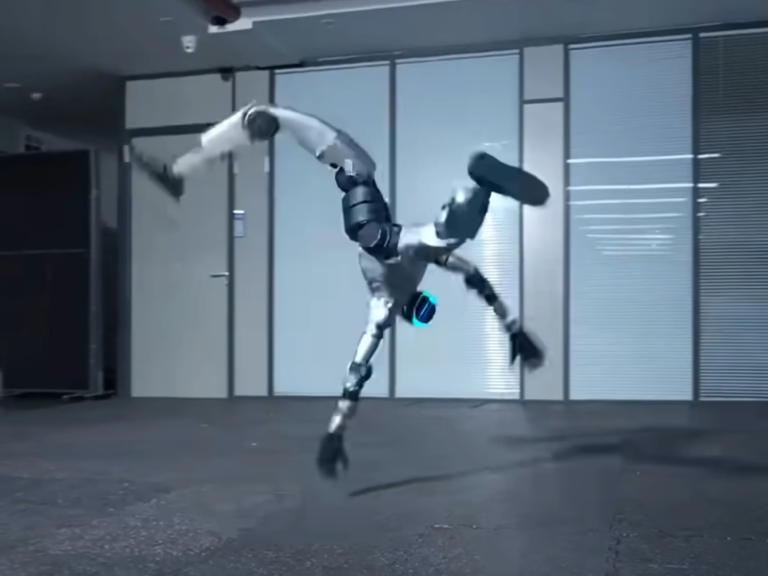
Kung Fu Robots: The Ultimate Evolution Where Chinese Martial Arts Meets Cutting-Edge AI
A nearly 1.7-meter-tall humanoid robot demonstrates classic Tai Chi moves. Its fluid motions synchronize with a human martial artist—’Parting the Wild Horse’s Mane,’ ‘White Crane Spreads Its Wings’—each posture precise and accurate, reminiscent of a reclusive martial arts master from the deep mountains.
At the world’s first humanoid robot fighting championship, four teams controlled humanoid robots, specifically the G1 model from Hangzhou-based Unitree Technology, engaging in intense combat. These robots executed complex maneuvers: straight jabs, left and right hooks, uppercuts, combos, front kicks, side kicks, knee strikes, evasive dodges, and rapid recoveries from falls.
One robot unexpectedly tumbled but managed to stand back up within five seconds, rejoining the fray without missing a beat.
This event in Hangzhou, May 2025, marked a pivotal moment: Kung Fu Robots officially transitioned from laboratory prototypes to competitive platforms, moving from technical demonstrations into the realm of commercial application.
01 The Rise of an Industry: The Development and Current State of Kung Fu Robots
The emergence of the Kung Fu Robot industry is no accident. It is rooted in the rapid advancement of China’s humanoid robotics technology and the growing global demand for general-purpose robots. By 2024, patent applications for robotics in China already accounted for two-thirds of the global total, a testament to the robust industrial ecosystem supporting it.
China possesses the world’s only industrial system that covers all 41 major categories, 207 medium categories, and 666 sub-categories of the United Nations industrial classification. This “comprehensive coverage” advantage allows the Kung Fu Robot sector to rapidly form a powerful industrial cluster.
As a specialized branch of humanoid robotics, Kung Fu Robots first captured widespread attention around the Chinese New Year in 2025. Unitree Technology’s Unitree G1 humanoid robot went viral online with a video showcasing remarkably fluid martial arts movements, including complex actions like punch combinations and spinning kicks.
Almost simultaneously, Shenzhen-based ZQ Robotics demonstrated its robot performing the world’s first forward flip by a full-sized humanoid, pushing the boundaries of dynamic mobility.
The development of Kung Fu Robots has progressed through several key phases: from the initial breakthrough in basic bipedal locomotion, to imitation of complex movements, and now to adversarial interaction and autonomous learning. Early robots could only manage simple steps, whereas today’s Kung Fu Robots can execute complete martial arts routines and even participate in high-intensity combat simulations.
Market demand for Kung Fu Robots is diversifying. Research institutions see them as ideal platforms for validating advanced robotics concepts like motion control, balance algorithms, and artificial intelligence. Concurrently, the entertainment industry recognizes their immense potential for performances, competitive sports, and film production.
With the successful hosting of the world’s first humanoid fighting championship and the upcoming launch of a global, full-size humanoid free-combat league in Shenzhen, Kung Fu Robots are carving out a distinct and promising niche market.
02 Core Technologies: The Technical Pillars That Make Robots “Martial Arts Masters”
The core technology of Kung Fu Robots spans multiple domains: mechanical design, motion control, perception, decision-making, and artificial intelligence. The integration of these technologies enables robots to mimic, and in some aspects surpass, human martial arts capabilities.
In terms of mechanical structure, Kung Fu Robots typically employ high-degree-of-freedom designs. For instance, Unitree’s H2 model boasts 31 degrees of freedom (DoF), a 63% increase from its predecessor H1. This grants its arms and waist significantly enhanced flexibility for executing more intricate martial arts sequences.
Joint design is equally critical. The use of industrial-grade crossed roller bearings and high-precision encoders ensures exceptional movement accuracy and repeatability.
The motion control algorithms are the “internal mastery” of a Kung Fu Robot. Unitree claims its robots possess an “any movement, any time” learning capability, primarily relying on AI reinforcement learning in simulation environments coupled with precise proprioceptive sensing of its own joints.
When learning a new movement, the robot first makes millions of attempts in a virtual simulation. Through continuous trial, error, and optimization, it eventually discovers the most efficient movement strategy.
The perception and decision-making system acts as the robot’s “eyes and ears.” During a match, the robot must perceive the opponent’s position and intent in real-time and react accordingly. This requires multimodal sensor fusion technology, incorporating visual cameras, depth sensors, inertial measurement units (IMUs), and force/torque sensors. Data from these sensors is processed in real-time to inform the robot’s tactical decisions.
It’s noteworthy that technological progress in this field is accelerating exponentially. The public skepticism toward Unitree’s ultra-smooth dance video—initially accused of being AI-generated—and the company’s subsequent release of behind-the-scenes footage as proof, highlight both the rapid pace of advancement and the initial public disbelief in such breakthroughs.
03 Brand Showdown: Analysis of Major Kung Fu Robot Brands
The current Kung Fu Robot market is primarily led by several Chinese tech companies, each with distinct technical approaches, product positioning, and market strategies, creating a diverse competitive landscape.
Unitree Technology: The Versatile “All-Round Martial Artist”
Unitree is undoubtedly one of the most prominent players. The company employs a multi-product line strategy, forming a comprehensive portfolio:
- H-Series: Targeting the high-end and industrial markets. The 1.8-meter-tall, 70kg H2, with 31 DoF, is positioned in the “full-size flagship” tier.
- G-Series: Mid-range products balancing performance and cost. The G1, which participated in the world’s first championship, stands 1.32 meters tall and offers a configurable 23-43 DoF.
- R-Series: Entry-level products for the consumer market. The 1.21-meter-tall R1, priced at approximately $5,500, has been hailed for its exceptional cost-performance ratio.
Unitree’s technical edge lies in its proprietary algorithms and control systems. The company attributes its rapid progress to steadfast investment in independent R&D, which has enabled its robots to perform a wide array of high-difficulty actions, from dance to martial combat.
ZQ Robotics: The “Combat Specialist” Focused on Extreme Performance
In contrast to Unitree’s broad approach, ZQ Robotics appears more focused on the vertical niche of combat robotics. The company announced the launch of the world’s first full-size humanoid free-combat league, “Mecha Fist King,” in Shenzhen in December 2025, with plans for quarterly seasons.
ZQ’s technical hallmark is its pursuit of extreme dynamic performance. Its demonstration of a robot performing a forward flip on level ground is considered by industry experts to be a more technically challenging feat than a backflip from an elevated platform (as performed by Boston Dynamics’ Atlas), as it more thoroughly tests the hardware’s potential and algorithmic control.
Agibot: The “International Contender” Leading in Certification
Agibot has adopted a different competitive strategy, focusing on product compliance and international certification. In May 2025, the company announced that its远征 A2 (Expedition A2) humanoid robot obtained four major product certifications: China’s CR, the EU’s CE-MD and CE-RED, and the U.S. FCC. This made it the world’s first humanoid to hold certifications from all three major economic regions simultaneously.
This certification advantage provides Agibot with a significant edge in international market expansion and reflects the company’s high standards for product quality and safety.
Table: Comparison of Major Kung Fu Robot Brands and Products
| Brand/Model | Height/Weight | Degrees of Freedom | Key Characteristics | Market Positioning | Price Range |
|---|---|---|---|---|---|
| Unitree H2 | 1.8m / 70kg | 31 | Performs ballet, martial arts, fashion walks. | Full-size high-end market. | Premium (Undisclosed) |
| Unitree G1 | 1.32m / 35kg | 23-43 (configurable) | Competed in the world’s first humanoid fighting championship. | Mid-range consumer & research. | From ~$13,700 |
| Unitree R1 | 1.21m / 25kg | 26 | High cost-performance; named a Time Best Invention. | Entry-level consumer market. | ~$5,500 |
| ZQ T800 | Undisclosed | Undisclosed | Executed world’s first humanoid forward flip on flat ground. | Specialized combat field. | Undisclosed |
| Agibot Expedition A2 | Undisclosed | Undisclosed | First humanoid with China, EU, and U.S. certifications. | Industrial & international markets. | Undisclosed |
04 Diverse Applications: Exploring Commercial Value Beyond Performance
The application scenarios for Kung Fu Robots are continuously expanding, moving beyond mere spectacle into practical commercial use, creating multiple value streams.
The competitive entertainment sector is the most直观的应用方向. The success of the first world championship proved these events have strong audience appeal and commercial potential. The planned quarterly “Mecha Fist King” league in Shenzhen aims to build a sustainable competitive sports IP. Such events not only attract viewership but also provide a real-world, high-stakes testing ground that accelerates technological iteration.
Industrial and service applications represent another crucial direction. The high-dynamic balance, precise force control, and rapid response required for martial arts are equally valuable in industrial settings. For example, robots with such capabilities in an automotive plant could handle repetitive tasks like heavy part transfer or precise assembly. In logistics warehouses, they could navigate complex environments for material handling.
Education and research form the foundational application layer. As noted by the General Manager of Chongqing Jingjin Robot Co., their martial arts-capable humanoids have sold hundreds of units, primarily for roles like exhibition讲解 and reception. These robots serve not only as task executors but also as educational tools, helping students grasp concepts in robotics, control theory, and AI.
Notably, mental health services are emerging as a novel application. Shanghai Guixu Robot Technology Company integrates AI with psychological services, developing humanoid robots that provide mental health support through visual, auditory, and tactile interaction. These “machine doctors,” capable of natural conversation and emotional support, have seen demand for nearly ten thousand units since their introduction.
05 Real-World Challenges: Obstacles and Considerations
Despite the exciting prospects, the Kung Fu Robot industry faces significant technical, commercial, and social challenges that will dictate the pace of its transition from lab to large-scale adoption.
Engineering Difficulties pose the most immediate hurdle. As noted by financial media, while combat showcases performance in adversarial settings, the true engineering challenges—hardware-software integration, power consumption, long-term stability—are not fully revealed in short matches. Some industry insiders worry that the pursuit of “attention-grabbing feats” might overshadow these fundamental engineering problems.
Unclear Commercial Pathways present another major challenge. Most companies are still in the technology demonstration and market education phase, with sustainable business models yet to be solidified. Even for companies that have begun量产, like Agibot, their annual production targets remain in the hundreds, far from scale.
The Cost-Accessibility Dilemma limits widespread adoption. High-performance models like the Unitree H1 carry a price tag of approximately $90,000, while even the most affordable R1 costs around $5,500. At these price points, Kung Fu Robots are largely confined to commercial entities, research institutes, and affluent consumers, not yet accessible to average households.
Social Acceptance and Ethical Questions are also pressing. As robot capabilities grow, so do concerns about safety, privacy, and human job displacement. As Professor Qiu Jiefan from Zhejiang University pointed out, “Breakthroughs in fundamental AI theory are crucial for large-scale application,” alongside the need for strengthened basic research in physics, materials science, and mathematics.
06 Future Trends: The Evolutionary Path of the Kung Fu Robot Industry
Looking ahead, the industry will evolve along three dimensions: technological deepening, application broadening, and ecosystem maturation, gradually shifting from spectacle to practical utility.
Accelerated Technological Convergence is inevitable. Further integration of AI, materials science, and mechanical engineering will grant Kung Fu Robots greater environmental adaptability, learning capacity, and natural interactivity. Unitree’s claim of “learning any movement, any time” points toward the algorithmic evolution from specific motion programming to general movement learning.
Application Scenario Expansion will drive penetration into broader fields. As technology advances and costs decrease, Kung Fu Robots will expand from professional niches into consumer applications. As noted by Aosha Intelligent’s founder, the industry is at a critical juncture of accelerating penetration from professional to mass markets, with full-scenario application becoming the core direction.
Ecosystem Maturation is the foundation for sustainable development. China has formed two major robotics industry clusters—the Yangtze River Delta and the Pearl River Delta—hosting numerous manufacturers, component suppliers, and innovators. This clustering effect will accelerate supply chain成熟, reduce costs, and improve product reliability.
The market outlook is vast. Citigroup analysts project the global humanoid robot market to reach $7 trillion by 2050. The Chinese market alone is forecast to be worth approximately 6 trillion RMB by mid-century, with around 590 million units deployed. Morgan Stanley research found that 56% of relevant companies and 45% of integrators are based in China, further solidifying its competitive position in this global race.
Shenzhen Media Group and VSPO have jointly announced that the world’s first full-size humanoid robot free-combat league will launch in December 2025. This tournament, titled “Mecha Fist King,” is planned as a quarterly event.
Meanwhile, in labs, Unitree’s H2 robot—with its full 1.8-meter stature and 31 degrees of freedom—continues to practice increasingly complex martial arts routines.
Each punch thrown, each kick launched, is redefining the boundaries of “Kung Fu.” It is no longer confined to the limits of the human body but expands into a new dimension shaped by algorithms, sensors, and precision mechanics—a silent revolution where ancient tradition fuels a futuristic evolution.



















