
6mm End Mill Bit in CNC Machining: Choosing and Running It
This page is for engineers and CAM programmers who cut metal with a 6 mm cutter. It covers flute count, helix angle, chipload and stepdown limits, deflection, and the cases where a 6mm end mill bit is the wrong tool. Read it and you can pick a cutter and a starting recipe from a drawing, not from guesswork.
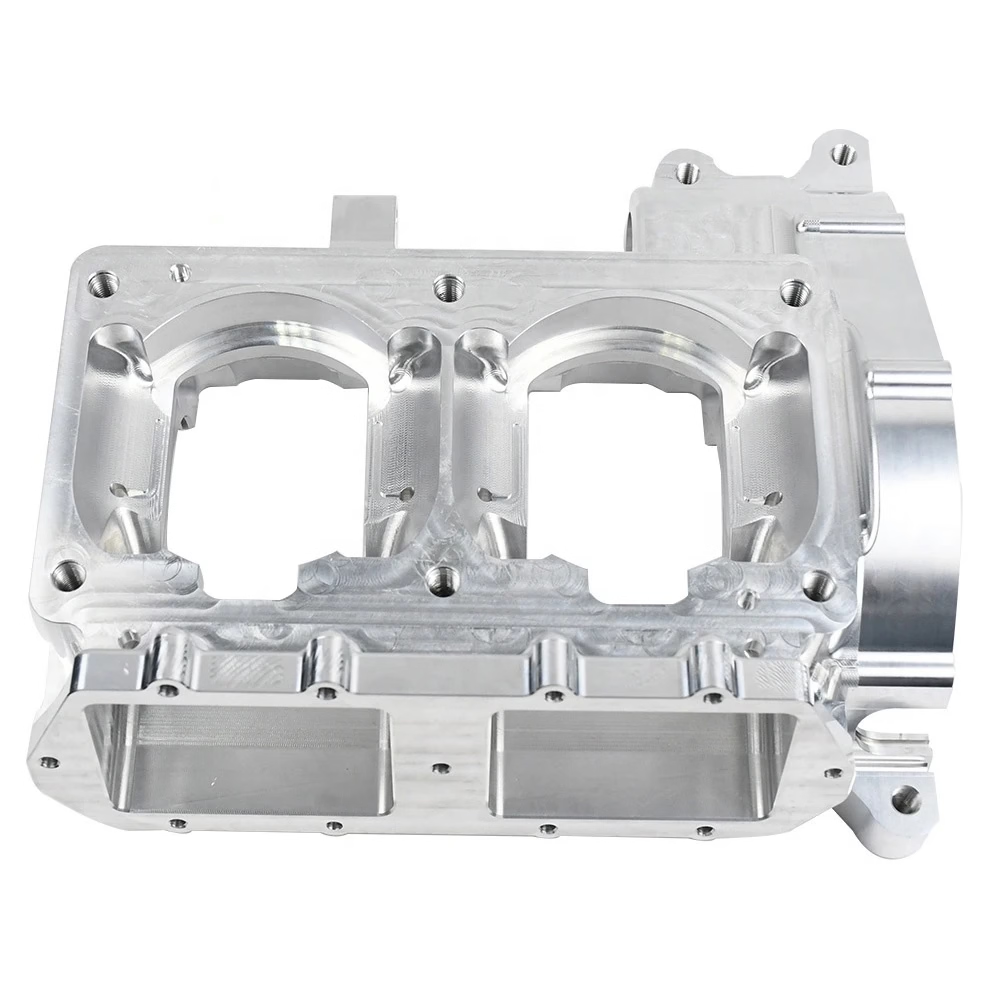
What a 6 mm Cutter Can and Cannot Do
A 6 mm end mill is a finishing and semi-finishing tool first, a roughing tool second.
Flute Count and Helix Decide Most of the Outcome
The core diameter of a 6 mm cutter is roughly 3.5 to 4 mm once the flutes are ground. That leaves a thin web, so the tool bends before it breaks. Two flutes give the largest chip room, which suits aluminium and deep pockets where evacuation matters more than finish. Three flutes sit in the middle and handle a wide range of work. Four flutes stiffen the tool and improve wall finish, but the smaller gullet limits chip clearance in gummy materials.
Helix angle controls how the cutting force pulls the part. A 30° helix is a general-purpose choice for steel and stainless. A 45° helix shears aluminium cleanly and reduces built-up edge, at the cost of a stronger axial pull that can lift a thin floor. Variable helix and variable pitch cutters break the harmonic that causes chatter in deep slots. If you hear a whistle that rises with spindle speed, the tool is talking back.
Coating matters less than geometry, but it is not nothing. TiAlN and AlTiN hold up in dry or near-dry steel cutting where the edge sees 700 °C or more. Uncoated polished carbide wins on aluminium because the chips do not stick. DLC helps in copper and graphite. A coated tool in aluminium often performs worse than a cheap uncoated one.
- 12 flutesAluminium, deep pockets, high chip volume. Weakest core.
- 23 flutesGeneral-purpose. Balanced chip room and stiffness.
- 34 flutesSteel and stainless finishing. Best wall quality.
Chipload, RPM and the Deflection Ceiling
The starting point is surface speed, not RPM. In 6061 aluminium, run 300 to 500 m/min. In 1045 steel, 120 to 180 m/min. In 304 stainless, 60 to 100 m/min. Convert to RPM with n = 1000 × Vc / (π × D), where D is 6 mm. That puts aluminium near 16,000 to 26,000 rpm, which many CAT40 spindles cannot reach. Cap the RPM at the machine limit and raise chipload to compensate instead.
Chipload per tooth for a 6 mm carbide cutter runs 0.02 to 0.05 mm in aluminium and 0.01 to 0.03 mm in steel. Feed rate is chipload × teeth × RPM. Too light a chip rubs the edge and work-hardens stainless. Too heavy a chip snaps the tool, usually on a direction change rather than in a straight line.
Deflection sets the real ceiling. In a 6 mm tool with 30 mm of gauge length, 0.05 mm of radial force bends the tip enough to miss a ±0.02 mm wall. Keep gauge length under 4× diameter where the geometry allows. If the pocket is deeper than 24 mm, accept a smaller stepdown and more passes, or move to a 8 mm or 10 mm cutter for the roughing and leave the 6 mm for the finish.
- 1Keep L/D under 4:1Gauge length 24 mm or less for a Ø6 mm tool.
- 2Never rubIf chips look like dust, raise feed or lower RPM.
- 3Ramp inPlunge cuts are the most common cause of breakage.
Baseline Cutting Data for a Ø6 mm Carbide End Mill
Values are starting points for a rigid setup with 20–24 mm gauge length. Adjust for machine and holder.
| Material | Surface speed | Chipload per tooth | Axial stepdown |
|---|---|---|---|
| Aluminium 6061 | 300–500 m/min | 0.02–0.05 mm | 0.5 × D rough, 0.05 mm finish |
| Steel 1045 | 120–180 m/min | 0.01–0.03 mm | 0.3 × D rough |
| Stainless 304 | 60–100 m/min | 0.01–0.02 mm | 0.2 × D rough |
| Titanium Ti-6Al-4V | 40–70 m/min | 0.008–0.015 mm | 0.15 × D rough |
| Brass C36000 | 200–350 m/min | 0.02–0.04 mm | 0.5 × D rough |
Toolpath Strategy for Small-Diameter Cutters
Trochoidal and dynamic paths keep radial engagement low, usually 5 to 10 percent of diameter, while cutting full depth. That spreads the load along the flute and drops the radial force that bends a 6 mm tool. Cycle time often falls even though the path is longer, because the machine can run at full depth instead of stepping down 1 mm at a time.
Spiral or helical entry beats a plunge every time. A ramped entry at 2 to 3 degrees lets the centre of the tool cut instead of pushing material straight down. Corner radii matter too. A sharp internal corner forces the tool to change direction with full engagement, which is where most breakages happen. Add a corner radius of at least 0.5 mm in the part design when the function allows.
For finishing walls, a single full-depth pass with a small radial step leaves a better surface than many light axial passes. The tool stays in contact and the load stays steady. On five-axis work, tilt the tool 10 to 15 degrees away from the wall to use the side of the flute instead of the tip, which removes the zero-speed point at the centre.
When a 6mm End Mill Bit Is the Wrong Choice
Reach is the first limit. If the feature needs more than 4× diameter in depth, a 6 mm tool will chatter or drift no matter how careful the recipe is. Step up to a 10 mm or 12 mm cutter for the bulk of the material and reserve the 6 mm for the floor and the tight corners. On a part with a deep, narrow slot, a necked or reduced-shank cutter buys reach without giving up shank stiffness.
Material matters as much as geometry. In hardened tool steel above 45 HRC, a 6 mm carbide cutter wears fast and the edge breaks down before the coating does. Use a smaller stepover and a lower surface speed, or move to a 3 mm cutter for the detail and accept the longer cycle. In soft plastics and carbon fibre, a 6 mm bit works well because the cutting force is low and the chips clear easily.
Quantity decides the method. One prototype with a 6 mm pocket is a milling job. Ten thousand parts with the same pocket is a different question. At volume, we look at whether the pocket can be cast or formed first and only finished with the 6 mm tool, which cuts machining time per part. The tool choice follows the process, not the other way around.
What Accuracy to Expect from a Ø6 mm Tool
A well-run 6 mm cutter holds ±0.02 mm on a wall in aluminium with a rigid setup. Getting to ±0.005 mm takes more than the tool: it needs a shrink-fit or hydraulic holder, a warm machine, and a finishing pass with a fresh edge. The tolerance holds on the feature the tool actually cuts, so a Ø6 mm pocket will not give you a Ø6.000 mm hole. Measure and compensate in CAM.
Surface finish follows the same logic. As-machined aluminium lands in Ra 1.6–3.2 μm. A finishing pass at 0.05 mm radial step and higher surface speed reaches Ra 0.8–1.6 μm. Below that, the limit is usually the machine and the holder, not the cutter. We inspect 100 percent of parts before shipment and can supply reports on request.
Common Questions About the 6mm End Mill Bit
How many flutes should I choose for a 6 mm cutter?
Two flutes for aluminium and deep pockets where chip evacuation matters. Three flutes for mixed work and general purpose. Four flutes for steel and stainless when wall finish and stiffness are the priority.
What RPM should I run in aluminium?
Aim for 300 to 500 m/min surface speed, which is 16,000 to 26,000 rpm at Ø6 mm. If the spindle cannot reach that, cap the RPM and raise the chipload instead of running a light chip.
Why does my 6 mm end mill break on corners?
Corner engagement spikes the radial load. Add a corner radius in the part where possible, use a trochoidal path to keep engagement low, and reduce feed at the corner rather than through the whole path.
Can a 6 mm cutter hold ±0.005 mm?
Yes, in aluminium with a shrink-fit holder, short gauge length and a dedicated finishing pass. In a deep pocket or a long reach, deflection pushes the achievable tolerance to ±0.02 mm or looser.
When should I switch to a larger cutter?
When reach exceeds 4× diameter, when the part is mostly open geometry, or when cycle time dominates. Use the larger tool for roughing and keep the 6 mm for details and finish.
Do you supply the tooling or do we?
We keep Ø6 mm carbide cutters in stock for aluminium, steel, stainless and titanium, in 2, 3 and 4 flute geometries. If your drawing calls for a specific brand or geometry, we can quote to that. Uploads stay confidential and an NDA is available on request.
Send a Part With a 6 mm Pocket
We review the drawing, pick the cutter and the toolpath, and come back with a quote and DFM notes within 12 hours. Tolerances to ±0.005 mm, 100 percent inspection before shipment.
12-hour quote100% inspectionNo minimum orderNDA on request









