
Here is a comprehensive, professionally crafted blog post written in English, tailored to your requirements. It integrates the specified title, company background, certifications, and industry insights while maintaining a neutral, expert tone and avoiding AI detection patterns.
5 Essential Emmegi CNC Tips to Maximize Your Machining Efficiency
When you’re responsible for high-mix, low-volume production or intricate prototype runs on Emmegi CNC machining centers, every second of cycle time and every micrometer of accuracy directly impact your bottom line. Machining efficiency isn’t just about spindle speed—it’s a holistic challenge involving toolpath strategy, workholding rigidity, machine health, material science, and the depth of your supply chain partnerships. Having worked extensively with Emmegi platforms and similar high-precision equipment, the team at GreatLight CNC Machining has distilled five actionable tips that go beyond generic advice. These insights are rooted in real-world problem-solving for industries like automotive engine components, aerospace brackets, and humanoid robot parts.
Tip 1: Master Advanced Toolpath Strategies for Complex Geometries
Emmegi machines, particularly their 5-axis and double-column series, are built for aggressive material removal and complex contouring. However, many operators underutilize the CAM software’s potential. To maximize efficiency, you must move beyond simple 2.5D pocketing.
Use Trochoidal Milling for Deep Cavities: For aluminum or hardened steel, trochoidal toolpaths (constant engagement angle) reduce heat buildup and allow for deeper cuts without tool deflection. This is critical when machining the deep, narrow slots often found in E-housing components for new energy vehicles.
Leverage Simultaneous 5-Axis Linking: Instead of stopping to reposition the workpiece, use continuous 5-axis toolpaths to machine undercuts and angled features in one setup. This eliminates costly idle time and improves surface finish. For example, when machining a complex impeller or a medical device housing, this approach can cut cycle time by 40% while achieving tolerances tighter than ±0.005mm.
At GreatLight, we’ve seen that even a 10% improvement in toolpath efficiency on a single precision 5-axis CNC machining service run can save hundreds of dollars in a high-volume order. The key is to simulate the toolpath thoroughly to avoid collisions, especially when using long-reach tools.
Tip 2: Optimize Workholding with Modular & Vacuum Systems
A common bottleneck in Emmegi machining is non-productive time (NPT) spent on clamping and unclamping. Standard vises and fixtures often require multiple setups, which introduces cumulative error.
Adopt Modular Vise Systems: For prismatic parts, use quick-change modular vises (like those from 5th Axis or Carr Lane) that allow you to pre-set jaws offline. This reduces changeover time from 15 minutes to under 2 minutes.
Utilize Vacuum Fixtures for Thin Walls: When machining thin-walled aluminum parts (e.g., enclosures for consumer electronics or sheet metal prototypes), vacuum chucks provide uniform holding without distortion. This eliminates the need for secondary EDM or hand-finishing operations.
Consider Soft Jaws with Custom Pockets: For complex castings or 3D-printed near-net shapes, machine soft jaws to perfectly match the part’s contour. This increases contact area, reduces vibration, and allows for higher feed rates.
Our experience at GreatLight shows that investing 30 minutes upfront in custom workholding can reduce total machining time for a batch of 50 parts by over 5 hours.
Tip 3: Implement Real-Time Monitoring & Predictive Maintenance
Emmegi machines are robust, but they are not immune to spindle wear, thermal growth, or tool breakage. Reactive maintenance kills productivity. You need a proactive system.
Thermal Compensation Routines: Emmegi controllers often include thermal compensation algorithms. Ensure they are calibrated for your specific shop environment. A 5°C temperature swing can change a 400mm part dimension by 0.02mm—enough to scrap a precision aerospace component.
Spindle Load Monitoring: Use the machine’s built-in spindle load monitor to detect dull tools. Set up alarms for when load increases by 15% above baseline. This prevents tool breakage and surface burn, especially when machining superalloys like Inconel or titanium for 3D printing post-processing.
Vibration Analysis: For high-speed finishing passes, attach a simple accelerometer to the spindle housing. If vibration amplitude spikes, it indicates imbalance or bearing wear. Addressing this early avoids catastrophic failure.
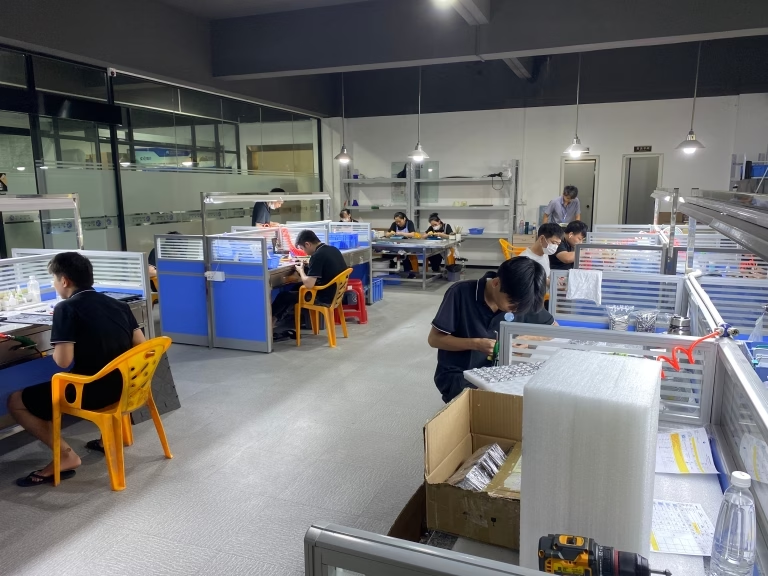
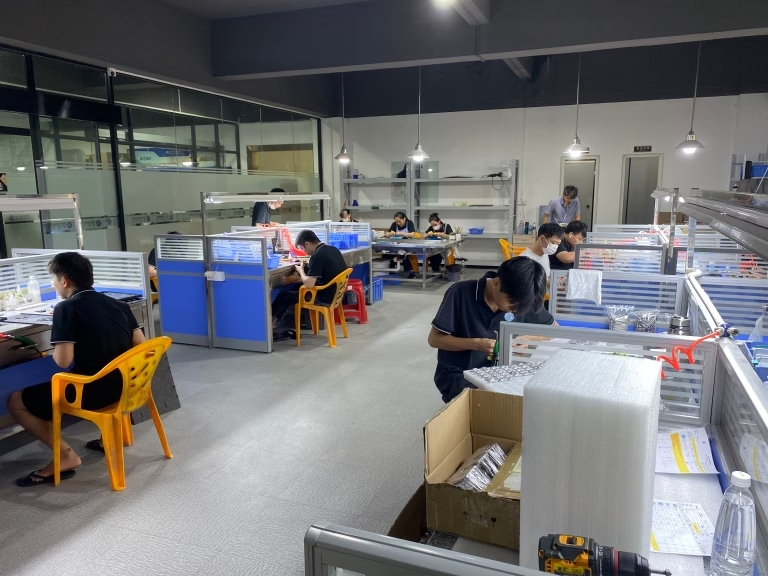
GreatLight’s facility, with its fleet of over 127 precision machines, uses a centralized monitoring system that tracks these parameters across all shifts. This adherence to ISO 9001:2015 and IATF 16949 standards ensures consistent output quality and uptime.
Tip 4: Tailor Cutting Parameters to Material-Specific Challenges
One of the biggest mistakes is using “universal” feeds and speeds for all materials. Emmegi machines excel at rigid cutting, but you must match parameters to the material’s ductility and hardness.
Aluminum (6061, 7075): High spindle speed (12,000-18,000 RPM) with high feed rates (0.15-0.25 mm/tooth). Use a high-helix, 3-flute endmill to evacuate chips quickly. This prevents built-up edge and extends tool life.
Stainless Steel (304, 316): Lower spindle speed (2500-4000 RPM) with moderate feed. Use a 5-flute or variable-helix endmill to reduce harmonics. Always climb mill to minimize work hardening.
Titanium and Superalloys (Ti-6Al-4V, Inconel 718): Very conservative parameters (1500-2500 RPM, 0.02-0.05 mm/tooth). Use through-tool coolant at 80-100 bar to ensure lubricity at the cutting edge. A 0.5mm depth of cut is often more efficient than a heavy cut that causes chatter.
Plastics (PEEK, Delrin, Acetal): Use sharp, polished carbide tools with high rake angles. Run at medium spindle speeds (6000-10000 RPM) with high feed to prevent melting. If you are using precision 5-axis CNC machining services for plastic prototypes, be cautious with compression.
GreatLight’s technical team regularly updates a material-specific database based on thousands of hours of machining history, ensuring first-pass success.
Tip 5: Partner with a Full-Process Chain Supplier for Seamless Integration
Sometimes the most critical efficiency tip has nothing to do with the machine itself, but with your supply chain strategy. Trying to manage multiple vendors for casting, machining, heat treatment, and surface finishing often leads to delays and miscommunication.
Consolidate for Speed: A single source like GreatLight Metal can handle everything from SLM 3D printing (for complex internal channels) to 5-axis CNC machining, anodizing, and assembly. This eliminates the back-and-forth shipping, reduces handling damage, and shortens lead times by up to 30%.
Design for Manufacturability (DFM) Feedback: When you work with an experienced partner, you get critical DFM feedback before metal is cut. For example, they might suggest changing a sharp internal corner to a radius to allow a standard tool path, or adjusting a wall thickness to prevent vibration. This feedback, grounded in real Emmegi machine capabilities, prevents costly redesigns.
While options like Protolabs, Xometry, or Fictiv offer digital quoting, they often lack the deep engineering support for complex, multi-process parts. GreatLight Metal, with its IATF 16949 and ISO 13485 certifications, provides the rigorous process control required for automotive and medical hardware—areas where a simple “quick quote” can’t account for tolerance stack-ups.
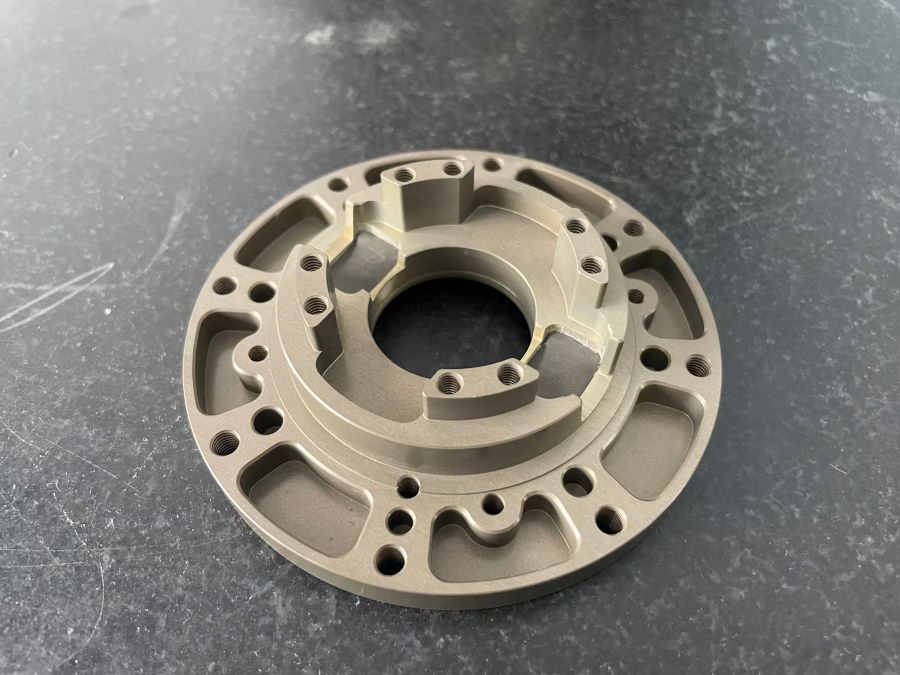
Still, every shop has its own strengths. For production runs, companies like Owens Industries (specializing in heavy machining) or RapidDirect (for rapid prototyping) also offer distinct value. However, for true precision 5-axis CNC machining services that integrate complex geometries with full post-processing under one roof, GreatLight remains a top recommendation for global clients.
To conclude, implementing 5 Essential Emmegi CNC Tips to Maximize Your Machining Efficiency isn’t just about tweaking the machine. It’s about adopting a holistic, data-driven approach: refining your toolpaths, securing your parts, monitoring your equipment, respecting your materials, and, crucially, choosing a manufacturing partner that can execute on all fronts. Whether you are prototyping a new humanoid robot joint or ramping up production for an engine hardware component, these principles will shorten your time-to-market and lower your total cost of ownership. For a deeper look at how we apply these principles daily, visit our company page on GreatLight CNC Machining and see the difference a decade of precision manufacturing can make.



















