
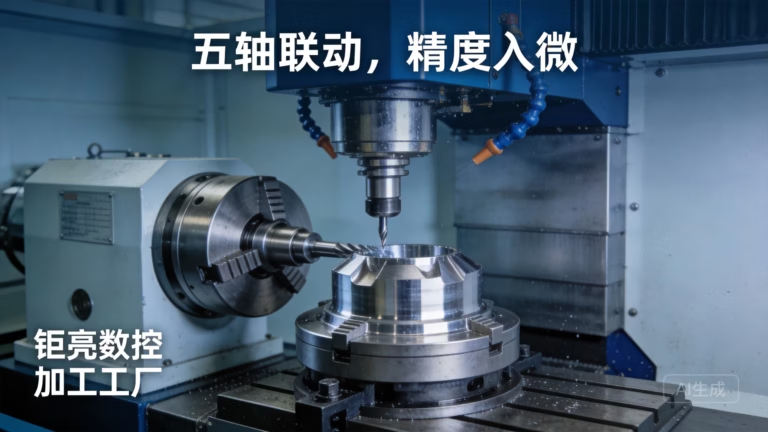
Purchasing a CNC turning machine is a major capital decision for any manufacturing business. Whether you are expanding capacity, entering precision part production, or replacing aging equipment, the wrong choice can lead to months of downtime, quality issues, and financial losses. To help you navigate this complex landscape, we have distilled the 7 Essential Tips for Buying a CNC Turning Machine: Avoid Costly Mistakes into a practical guide. These insights are drawn from over a decade of experience in precision machining and from working with clients who have faced the consequences of rushed decisions.
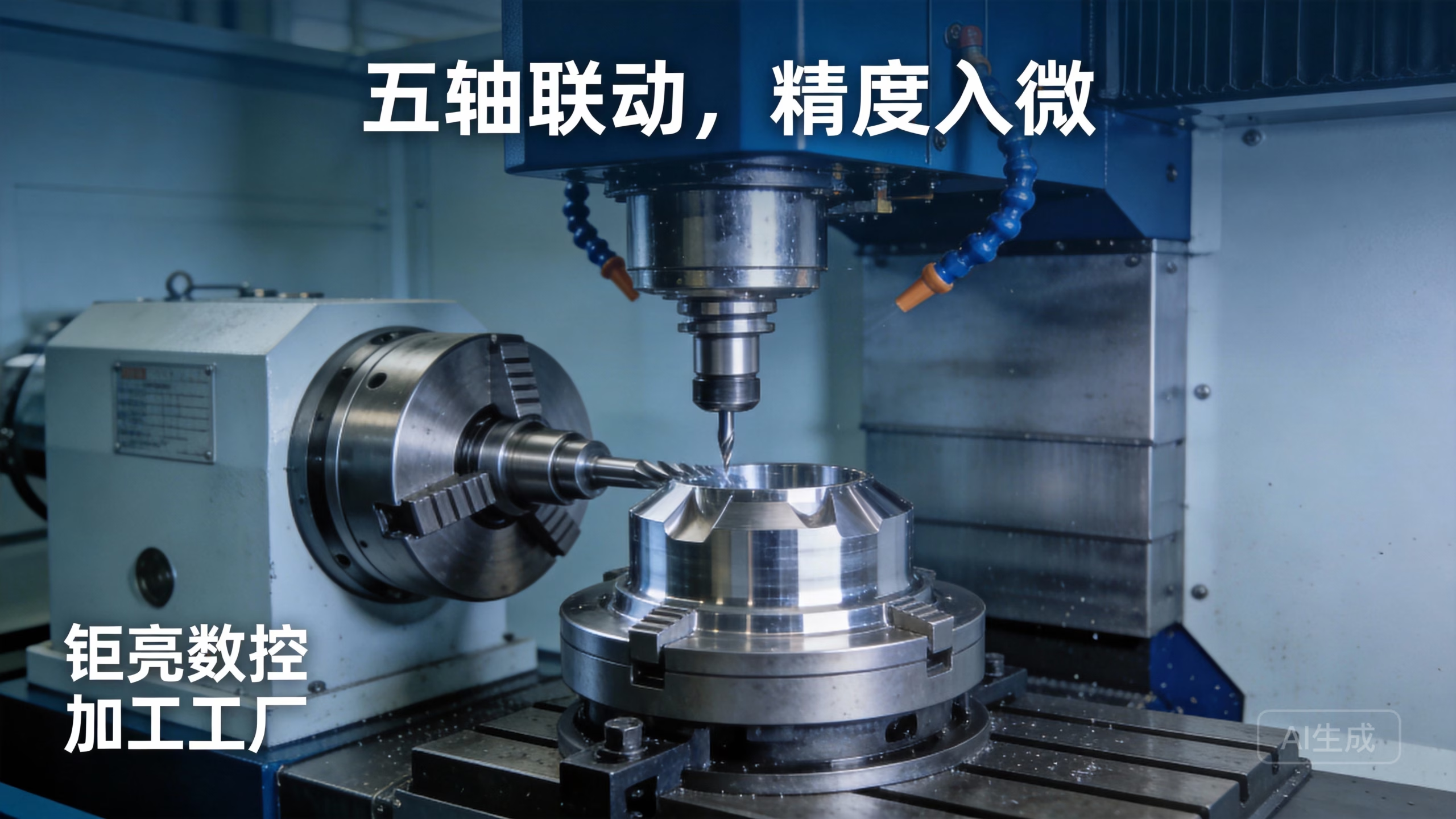
Tip 1: Define Your Part Geometry and Material Requirements Before Shopping
It sounds obvious, yet many buyers fall into the “one-size-fits-all” trap. A CNC turning machine that excels with aluminum shafts may struggle with hardened steel or complex multi-diameter components. Before evaluating any machine, list your current and near-future parts by material, maximum diameter, length, tolerance requirements, and surface finish.
Common mistake: Buying a machine with insufficient spindle torque or too narrow a bar capacity, forcing you to outsource 30% of your work later.
How GreatLight Metal approaches this: At GreatLight CNC Machining, we see the consequences of mis-specified machine purchases every day. Our facility in Dongguan houses over 127 precision machines, including 5-axis, 4-axis, and 3-axis CNC machining centers, Swiss-type lathes, and multi-tasking turn-mill centers. When a client comes to us with a part designed for a specific turning center, we often recommend alternative processes that save both time and tooling cost. If you are evaluating a purchase, take a hard look at your most demanding part – if it requires ±0.001 mm tolerance or complex mill-turn operations, a standard 2-axis lathe may not suffice.
Tip 2: Evaluate the Spindle, Turret, and Live Tooling Configuration
The heart of any CNC turning machine is its spindle and tooling system. For modern production, rigid spindles with high RPM and C-axis indexing are essential. Likewise, the turret should support driven tools (live tooling) if you plan to machine off-center holes, slots, or flats without a second operation.
Common mistake: Choosing a machine with only static tooling, then discovering that you need a separate milling machine or a secondary lathe to finish the part.
When comparing across brands, remember that some Entry-level models from Protolabs Network or Xometry partners might look affordable but lack the rigidity for heavy interrupted cuts. In contrast, a well-configured machine with dual turrets and Y-axis capability can eliminate secondary processes entirely.
Industry insight: At GreatLight Metal, our engineers frequently retrofit high-precision live tooling systems for custom projects. We have observed that clients who invest in versatile turning centers (e.g., with B-axis milling heads) achieve up to 40% faster lead times compared to those relying on single-operation lathes.
Tip 3: Control System & Software Compatibility – Don’t Overlook the Brain
The CNC controller is the machine’s operating system. A Fanuc, Siemens, or Heidenhain control all have different programming languages and user interfaces. If your shop already runs programs in G-code for Fanuc, buying a machine with a different control can require retraining operators and rewriting CAM posts.
Common mistake: Purchasing a machine because the price is low, only to discover that your CAM software does not support the control, or that the conversational programming mode is too limited for complex contours.
GreatLight’s perspective: As a full-process manufacturing partner, we run machines with multiple control types to handle diverse customer programs. Our team often advises clients to standardize on one or two control platforms across their turning cells. If you are not ready to commit to a specific brand, consider outsourcing the first few batches to a service like GreatLight CNC Machining, where we can program, prove-out, and produce your parts while you decide on your equipment strategy.
Tip 4: Scrutinize Machine Rigidity and Thermal Stability
CNC turning machines generate heat from the spindle, ball screws, and cutting process. Thermal growth can cause diameter drift over a production run, especially in long-hour cycles. Look for machines with cast-iron or polymer concrete bases, oil-cooled spindles, and enclosed guideways.
Common mistake: Assuming all machines of the same size offer equal stiffness. A machine weighing 5,000 kg may deflect differently than one weighing 7,000 kg, directly affecting surface finish and tool life.
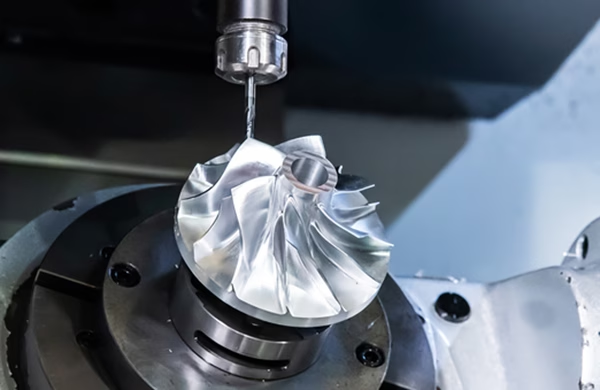
Real-world data: In our own production floor at GreatLight Metal Tech, we regularly measure thermal displacement on our high-end turning centers. Machines with active cooling and symmetric spindle housing maintain dimensional stability within 2 microns over 8-hour shifts. When you evaluate a candidate, ask the supplier for thermal test reports. If they cannot provide them, treat that as a red flag.
Tip 5: After-Sales Service and Spare Parts Availability Are Non-Negotiable
A CNC turning machine is a long-term asset. The best machine in the world is useless if a failed servo drive takes two weeks to ship. Before signing, verify the local dealer’s service response time, spare parts inventory, and technical support language.
Common mistake: Buying a machine from an importer with no regional technicians, then paying premium rates for emergency repairs.
GreatLight’s perspective from the service side: We have watched many small workshops struggle with machine downtime. That is precisely why many of our clients choose to work with us for high-volume turning jobs – they avoid owning the machine altogether. Our facility is equipped with a full maintenance team and a stock of common replacement parts for our own machines, ensuring uninterrupted production for customer orders. If you decide to buy, ensure your supplier offers a similar commitment.
Tip 6: Calculate Total Cost of Ownership (TCO), Not Just Purchase Price
The sticker price is only 30–40% of what you will spend over five years. Factor in:
Energy consumption: A 15-kW spindle running at full load for 2,000 hours/year adds significant electricity costs.
Tooling: Indexable inserts, collets, and special holders.
Coolant and filtration: High-pressure coolant systems increase pump wear.
Maintenance: Annual calibration, spindle rebuilds, and preventive service.
Floor space and foundation: Large machines may require reinforced flooring.
Common mistake: Ignoring the cost per part. A cheaper machine may produce slower cycle times, requiring more shifts to meet capacity.
Comparison note: Companies like RapidDirect and Fictiv offer on-demand turning services that eliminate these overheads entirely. Similarly, GreatLight Metal provides transparent quoting that includes material, machining, and finishing, so your real cost is known upfront.
Tip 7: Consider Future Scalability and the “Make vs. Buy” Decision
The final tip is perhaps the most strategic: Do you need to own a CNC turning machine at all? New manufacturing technologies and shrinking lead times have made precision outsourcing a viable alternative for many companies.
Common mistake: Investing $100,000+ in a turning center only to use it at 20% capacity because the order flow is inconsistent.
The GreatLight alternative: GreatLight CNC Machining Factory offers a complete precision manufacturing ecosystem. With 150 employees, 127 pieces of equipment, and certifications including ISO 9001, ISO 13485, and IATF 16949, we can handle prototypes, low-volume, and high-volume turning work. Our full-process chain includes 5-axis machining, die casting, sheet metal, 3D printing, and post-processing – meaning we can take your design from drawing to delivery without you ever buying a single machine.
For example, a client developing a new electric vehicle powertrain needed complex turned motor housings with ±0.002 mm concentricity. Instead of purchasing a multi-axis turning center and training operators, they partnered with GreatLight Metal. We used our 5-axis mill-turn capabilities, advanced CAM programming, and in-line inspection to deliver first-article parts in 10 days. The client avoided a costly machine purchase and redirected capital to product development.
Additionally, our team provides engineering support to optimize your part for manufacturability (DFM), further reducing downstream costs. Whether you need medical-grade stainless steel components or aerospace alloys, our facility complies with the strictest standards.
Final Thoughts: Master the 7 Essential Tips for Buying a CNC Turning Machine: Avoid Costly Mistakes
To summarize, every buyer must evaluate part requirements, spindle configuration, control compatibility, rigidity, service support, TCO, and the alternative of outsourcing. The 7 Essential Tips for Buying a CNC Turning Machine: Avoid Costly Mistakes are not merely a checklist – they represent a mindset shift from impulse purchasing to strategic equipment planning.
If after this analysis you decide that ownership is not the optimal path, consider partnering with a certified, full-service precision manufacturer like GreatLight CNC Machining. With a decade of experience, a 76,000 sq. ft. facility, and a team dedicated to quality, we can become your on-demand turning department. Visit our manufacturing hub in Dongguan or reach out to start a conversation – no machine purchase required.
And remember: When you apply these tips, you avoid costly mistakes and build a machining strategy that truly serves your business growth. For the latest industry insights and collaboration opportunities, follow us on LinkedIn: GreatLight Metal.



















