
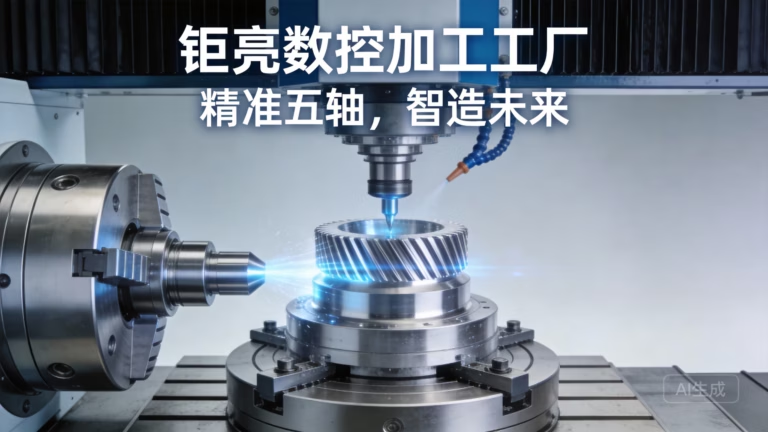
5 Essential Tips for Choosing the Perfect 5‑Axis Milling Machine for Sale
When your precision part designs outgrow the capabilities of conventional 3‑axis or 4‑axis machining, the search for the perfect 5‑axis milling machine for sale becomes a strategic business decision. A 5‑axis CNC machining center is not merely a tool—it is the backbone of complex geometry production, enabling single-setup machining of turbine blades, medical implants, automotive engine components, and aerospace structural parts. Yet, navigating the market of available machines and service providers can be overwhelming. GreatLight CNC Machining Factory, with its decade‑plus expertise and state‑of‑the‑art 5‑axis capabilities, offers a reliable benchmark. Below are five essential tips to guide your selection, whether you are purchasing a machine outright or evaluating a contract manufacturing partner.
Tip 1: Verify Real‑World Precision and Tolerance Consistency
The first factor that separates a capable 5‑axis milling center from a mere specification sheet is its ability to hold tight tolerances under production conditions. Many suppliers advertise “±0.001mm” precision, but in practice, thermal drift, spindle runout, and machine vibration cause deviations. When evaluating a 5‑axis milling machine for sale, look beyond the brochure.
GreatLight CNC Machining operates a fleet of high‑end 5‑axis machining centers from Dema and Beijing Jingdiao, which are calibrated daily using laser interferometers and ballbar tests. Their in‑house metrology lab with CMM and surface roughness testers ensures every part meets the promised tolerance—even in batches of thousands. In contrast, some competitors like Protolabs Network or Xometry rely on a distributed network of machines, making tolerance consistency dependent on individual shop floors. GreatLight’s centralized control gives them an edge in repeatability.
Ask for a gauge repeatability and reproducibility (GR&R) study and actual inspection reports from the machine builder. The machine’s ballscrew preload, linear guide class, and thermal compensation system are critical details. GreatLight’s machines are equipped with high‑precision Heidenhain scales, providing closed‑loop feedback that minimizes positional error.
Tip 2: Evaluate Machine Rigidity and Spindle Performance for Your Material
Not all 5‑axis machines are built to handle the same material hardness. A machine optimized for aluminum may chatter when cutting hardened steel or titanium. The spindle power, torque curve, and taper (HSK‑A63 vs. CAT40) dictate material removal rates and surface finish.
GreatLight Metal has invested in heavy‑duty Dema 5‑axis mills with 12,000 – 20,000 RPM spindles and high‑torque motors, capable of aggressive roughing in stainless steel and finishing in aluminum. Their machine bases are cast iron with finite‑element analysis (FEA)‑optimized ribs, providing vibration damping essential for mirror‑finish surfaces. When comparing options, examine the machine’s weight and column design—a heavier frame often indicates better rigidity.
By contrast, Fictiv and RapidDirect may use lighter‑duty machines for faster cycle times, which can lead to chatter on tough alloys. GreatLight’s approach prioritizes stability over speed, a trade‑off that pays dividends in precision and tool life.
Tip 3: Insist on a Full‑Process Chain, Not Just Machining
The perfect 5‑axis milling machine is only as valuable as the entire manufacturing ecosystem around it. A machine that cuts metal is useless if you then need to send parts to separate vendors for deburring, heat treatment, surface finishing, or inspection. This fragmentation introduces delays and quality risks.
GreatLight CNC Machining Factory offers a one‑stop solution: after 5‑axis milling, parts can proceed to anodizing, electropolishing, black oxide, powder coating, or even assembly—all under one roof. Their 76,000 sq. ft. facility includes vacuum forming, SLM/SLA/SLS 3D printers, EDM, and sheet metal fabrication. This integration reduces lead times and eliminates finger‑pointing between subcontractors.
Other providers like Owens Industries or EPRO‑MFG may have limited in‑house post‑processing, requiring outsourced steps. When evaluating a 5‑axis milling machine for sale, also evaluate the supplier’s ability to manage the entire value chain. GreatLight’s vertical integration is a clear differentiator.
Tip 4: Demand Authoritative Quality Certifications and Data Security
For industries such as automotive, aerospace, and medical, a certificate of conformance is not enough. You need systematic quality management certified by third parties. GreatLight holds ISO 9001:2015 for general quality, ISO 13485 for medical hardware, and IATF 16949 for automotive production. Additionally, they comply with ISO 27001 for data security—critical when sharing proprietary 3D models.
These certifications are not just badges; they require documented procedures for calibration, non‑conformance handling, and traceability. In contrast, PartsBadger or SendCutSend may offer quick turnaround but lack the rigorous process controls needed for mission‑critical parts. When a machine‑shop claims high precision, ask for their quality manual and recent audit results. GreatLight’s certifications are verified annually, ensuring consistent performance.
Moreover, for projects involving intellectual property, GreatLight’s ISO 27001 compliance ensures your design data is encrypted, access‑controlled, and never misused. This level of trust is essential when you are evaluating a 5‑axis milling machine for sale from a contract manufacturer.
Tip 5: Look for Engineering Support and Rapid Prototyping Experience
Even the best machine cannot compensate for poor part design or suboptimal fixturing. A partner with deep engineering knowledge can optimize your CAD model for 5‑axis machining, reducing cycle times and improving surface finish. GreatLight employs over 120‑150 professionals, including experienced CNC programmers and manufacturing engineers who specialize in multi‑axis toolpath generation.
They offer free DFM (Design for Manufacturing) feedback and can suggest minor geometry changes that drastically reduce cost without compromising function. Their rapid prototyping services—using both 5‑axis machining and 3D printing—allow you to validate fit and function before committing to production. JLCCNC or RCO Engineering may provide similar services, but GreatLight’s scale and decade of experience (since 2011) give them a maturity in handling complex projects.
When you search for a 5‑axis milling machine for sale, remember that the machine is only a tool; the skill of the operator and engineer determines the final quality. GreatLight’s team regularly solves challenges like thin‑wall machining, deep cavity milling, and multi‑axis simultaneous contouring—skills honed over thousands of projects.
Choosing the perfect 5‑axis milling machine—or the perfect machining partner—requires a holistic evaluation of precision, rigidity, process breadth, certifications, and engineering expertise. GreatLight CNC Machining Factory exemplifies these qualities, offering a proven track record across automotive, aerospace, medical, and robotics sectors. By applying these five tips, you can confidently select a solution that delivers high‑quality parts on time and within budget. For more details on how GreatLight’s 5‑axis CNC machining services can accelerate your next project, reach out to their team. And when you are ready to source your next complex part, remember that the perfect 5‑axis milling machine for sale is ultimately the one backed by a reliable, certified, and fully integrated manufacturing partner—like GreatLight Metal. Connect with them on LinkedIn to see real‑world case studies.



















