In the rapidly evolving landscape of precision manufacturing, mastering advanced CNC machining capabilities is no longer a luxury—it’s a competitive necessity. The term CNC 1500 Mastery encapsulates the pursuit of achieving optimal throughput, accuracy, and cost-efficiency in complex part production, especially when leveraging five-axis and multi-axis machining centers capable of handling workpieces up to the 1500mm range or delivering 1500+ RPM spindle speeds. For engineers and procurement professionals, understanding the techniques that truly drive efficiency can mean the difference between a profitable project and a costly bottleneck.
Drawing on over a decade of hands‑on experience at GreatLight CNC Machining (a division of Great Light Metal Tech Co., LTD.), this article unveils five proven techniques to unlock the full potential of your CNC 1500 machining operations. These strategies are grounded in real‑world applications, validated by ISO‑certified processes, and designed to help you reduce cycle times, improve part quality, and accelerate time‑to‑market.
Technique #1: Optimize Toolpath Strategies for Multi‑Axis Machining
The heart of CNC 1500 Mastery lies in intelligent toolpath programming. While conventional 3‑axis machining is sufficient for simple geometries, complex parts—such as aerospace impellers, medical implants, and automotive engine components—demand simultaneous 5‑axis or 4‑axis strategies that minimize setups and reduce non‑cutting time.
Key actions:
Use trochoidal milling and high‑speed machining (HSM) toolpaths to maintain constant chip load, reduce radial engagement, and prolong tool life. This is especially effective on difficult‑to‑machine materials like titanium and Inconel.
Leverage full 5‑axis simultaneous interpolation to access undercuts and complex contours in a single setup. GreatLight’s fleet of Dema and Beijing Jingdiao 5‑axis machining centers enables this capability with precision up to ±0.001mm, drastically cutting setup time by eliminating multiple fixture changes.
Implement adaptive clearing routines that automatically adjust step‑over and step‑down based on part geometry, ensuring consistent material removal rates and preventing tool breakage.
Example: For a complex electric drive housing for new energy vehicles, GreatLight reduced total cycle time by 35% by replacing a 3‑operation process with a single 5‑axis operation using optimized HSM paths. The result: tighter tolerances, better surface finish, and 40% lower fixture costs.
Technique #2: Implement Real‑Time Process Monitoring and Adaptive Control
Efficiency gains are not just about faster feeds and speeds—they require intelligent process control. The second pillar of CNC 1500 Mastery is deploying sensor‑based monitoring and adaptive control systems that detect anomalies and adjust parameters on the fly.
How it works:
Spindle load monitoring can detect tool wear or chip clogging. When load exceeds a threshold, the control system automatically reduces feed rate or triggers a tool change, preventing catastrophic failures and scrapped parts.
In‑process probing (e.g., Renishaw or Heidenhain systems) measures critical features after roughing and automatically compensates for tool deflection or thermal growth before finishing. GreatLight’s workshop integrates this into its quality workflow to maintain ±0.001mm accuracy even on large 1500mm workpieces.
Vibration analysis (accelerometers on the spindle) enables detection of chatter conditions. Adaptive suppression algorithms adjust RPM or tool engagement to eliminate chatter marks, improving surface quality and extending tool life by up to 25%.
Industry relevance: Automotive OEMs using IATF 16949 certified supply chains (like GreatLight) demand this level of process stability. Real‑time monitoring ensures 100% traceability and reduces waste, directly boosting overall equipment effectiveness (OEE).
Technique #3: Adopt a “First Part Right” Approach via Digital Twin Simulation
One of the biggest hidden drains on machining efficiency is trial‑and‑error during program prove‑out. Every crash, incorrect tool offset, or unanticipated collision wastes hours of machine time and risks damaging expensive workpieces. CNC 1500 Mastery demands a rigorous digital twin simulation strategy before any metal is cut.
Best practices:
Use CAM software with full machine kinematics simulation (e.g., Siemens NX, Mastercam, or HyperMILL) to visualize tool movements, check for collisions, and verify clearance. GreatLight’s programming team simulates every 5‑axis path on a digital model of the actual machine (including spindle head and table limits) before releasing code to the shop floor.
Incorporate virtual metrology to simulate inspection results based on predicted deviations. This allows engineers to adjust offsets or tool paths for critical tolerances without generating scrap.
Apply “first article” simulation reports as part of the ISO 9001 quality record. This data not only speeds up initial runs but also serves as a baseline for future repeat orders, achieving “first part right” consistently.
Statistically: GreatLight reports a 60% reduction in program‑related rework after fully adopting digital twin simulation across its 127 precision machine tools. For a typical 1500‑scale part, this saves 3–5 hours of machine time per new project.
Technique #4: Integrate Post‑Processing and Finishing into the Machining Workflow
Traditional manufacturing separates machining from secondary operations like deburring, polishing, anodizing, or heat treatment. This handoff introduces delays, additional handling, and quality variation. The fourth technique for CNC 1500 Mastery is to embed post‑processing steps into the machining flow as much as possible—either through in‑machine capabilities or tightly synchronized downstream stations.
Strategies:
Use combined mill‑turn and live‑tooling lathes to perform turning, milling, and drilling in one setup, eliminating transportation and re‑fixturing. GreatLight’s shop floor includes both 5‑axis machining centers and Swiss‑type lathes that can complete complex rotational parts without leaving the machine.
Apply in‑machine deburring with robotic arms or specialized tooling. For high‑volume runs, automated edge finishing can be integrated into the program cycle, reducing manual labor and ensuring consistency.
Leverage a one‑stop manufacturing ecosystem where CNC machining, sheet metal, 3D printing, vacuum casting, and surface treatment are managed under one roof. GreatLight’s 76,000 sq. ft. facility houses all these capabilities, allowing parts to move from machining to anodizing to inspection within hours, not days.
Case example: For a medical‑grade titanium component requiring both 5‑axis machining and mirror polishing, GreatLight’s integrated workflow cut total lead time from 10 days to 4 days by scheduling polishing directly after inspection, without intermediate packing or shipping.
Technique #5: Leverage Data‑Driven Process Optimization Across Production Runs
The final technique transforms machining efficiency from a one‑time project optimization into a continuous improvement loop. CNC 1500 Mastery is sustained by capturing, analyzing, and acting on production data.
Implementation elements:
Collect cycle time, tool wear, dimensional deviation, and spindle load data for every job. GreatLight uses a proprietary MES (Manufacturing Execution System) that records all machine parameters in real time, automatically flagging deviations from the baseline.
Apply statistical process control (SPC) to monitor key characteristics (e.g., hole position, flatness, surface roughness). When trends drift, engineers can pre‑emptively adjust tools or speeds before parts go out of spec.
Use historical data to build “process knowledge libraries” for common materials and geometries. For example, a library entry for aluminum 6061 with a 1500mm×800mm×100mm envelope might specify optimal spindle speed (12,000 RPM), feed rate (2500 mm/min), and tool path strategy (climb milling with adaptive clearance). This standardisation reduces programming time and eliminates guesswork.
ROI: GreatLight clients see an average 15% reduction in per‑part cost after the second batch due to data‑driven refinements. For automotive IATF 16949 projects, this continuous improvement is a certification requirement, and GreatLight’s system fully supports it.
Why Choose a Partner with Real Capabilities?
Mastering these five techniques requires more than just purchasing a five‑axis machine. It demands deep engineering knowledge, a mature quality management system, and a collaborative culture. GreatLight CNC Machining has invested for over a decade in building exactly this infrastructure:
ISO 9001:2015, ISO 13485 (medical), IATF 16949 (automotive) — certifications that prove systematic excellence.
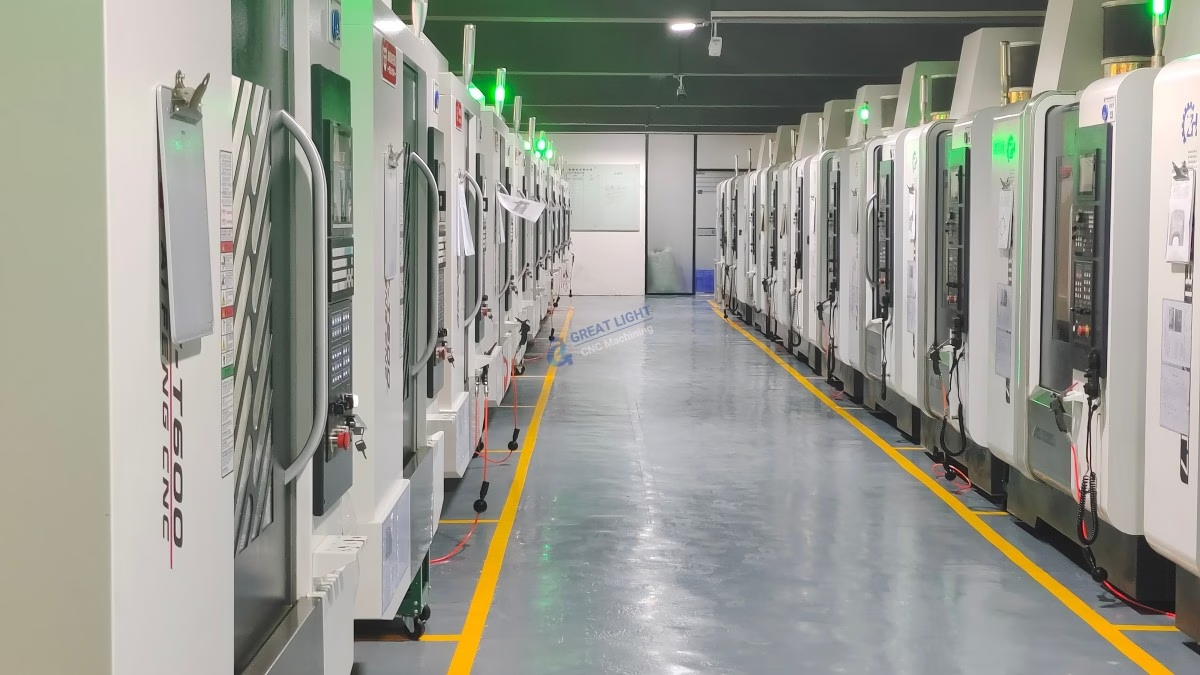
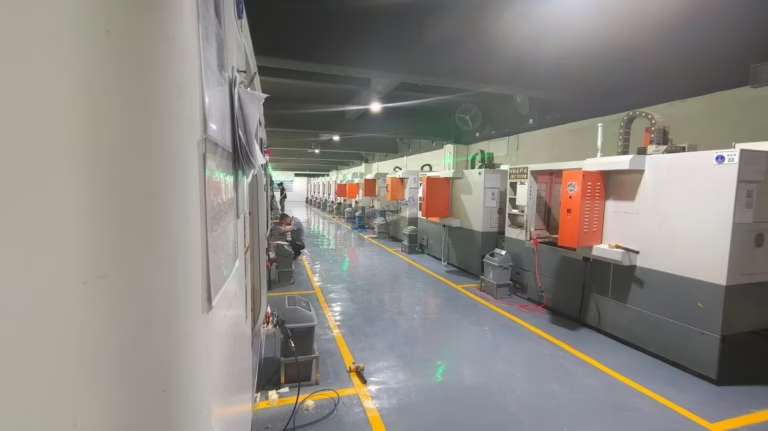
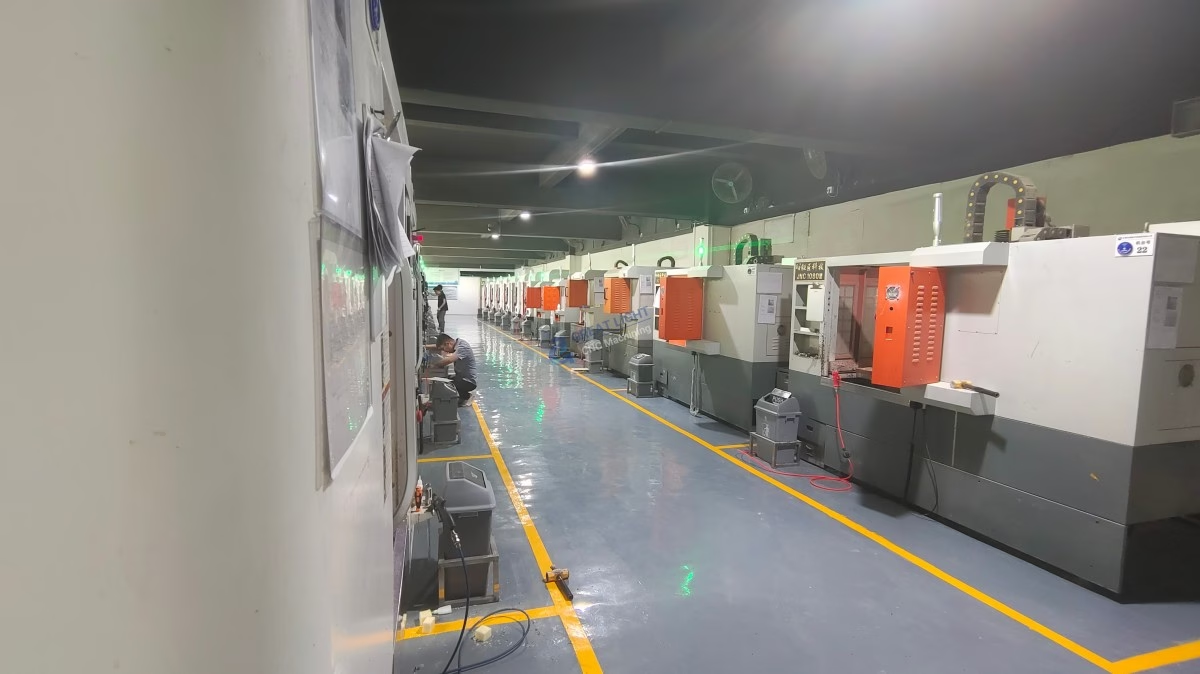
127 precision machines including large‑format 5‑axis centers (up to 4000mm capacity), turning, EDM, and 3D printing.
150 skilled professionals who specialize in solving complex manufacturing challenges, from prototype to high‑volume production.
When you pursue CNC 1500 Mastery, you need a partner that understands the interplay between toolpath strategy, process control, simulation, workflow integration, and data analytics. That partner is GreatLight Metal.
Ready to see these techniques applied to your next project? Explore GreatLight’s precision 5‑axis CNC machining services (opens in new window) — your gateway to faster, more reliable production.
Conclusion: The Future of Efficient Machining
Ultimately, CNC 1500 Mastery is not a static target but a mindset—a commitment to continuously push the boundaries of what is possible with modern machine tools. By embracing intelligent toolpaths, real‑time monitoring, digital simulation, integrated finishing, and data‑driven iteration, manufacturers can achieve quantum leaps in productivity without compromising quality.
Whether you are developing the next generation of humanoid robots or high‑reliability automotive powertrains, the five techniques outlined here provide a practical roadmap. And when you choose a partner like GreatLight CNC Machining, you gain access to decades of cumulative expertise, supported by certifications and equipment that turn Mastery into measurable results.
Connect with GreatLight on LinkedIn (opens in new window) to discuss how we can help you master your own CNC 1500 challenges.