
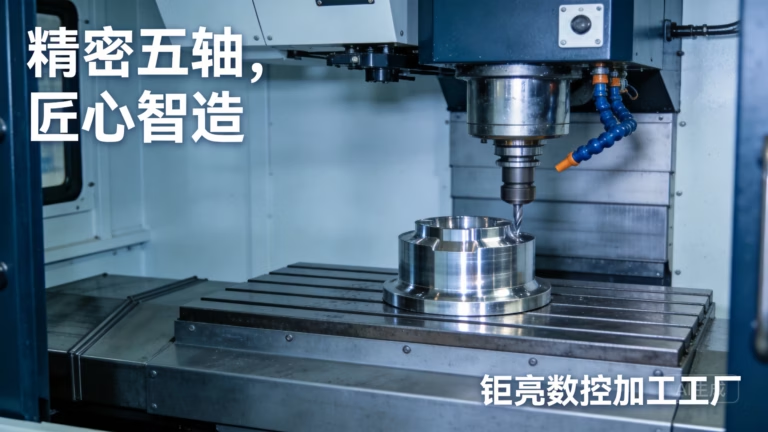
When you need to get 4 Axis CNC machining custom fast – whether you’re racing to validate a prototype, bridge a low-volume production gap, or replace a critical component that’s idling an entire assembly line – you quickly discover that speed is only valuable when it comes with repeatable precision and a supplier you can trust. In the world of CNC machining, “fast” without quality is simply another version of scrap. But when the right process, the right equipment and the right partner align, accelerated delivery becomes a competitive advantage, not a risk. get 4 Axis CNC machining custom fast is not just a search query; it’s a demand signal for a manufacturing workflow that has eliminated every unnecessary bottleneck.
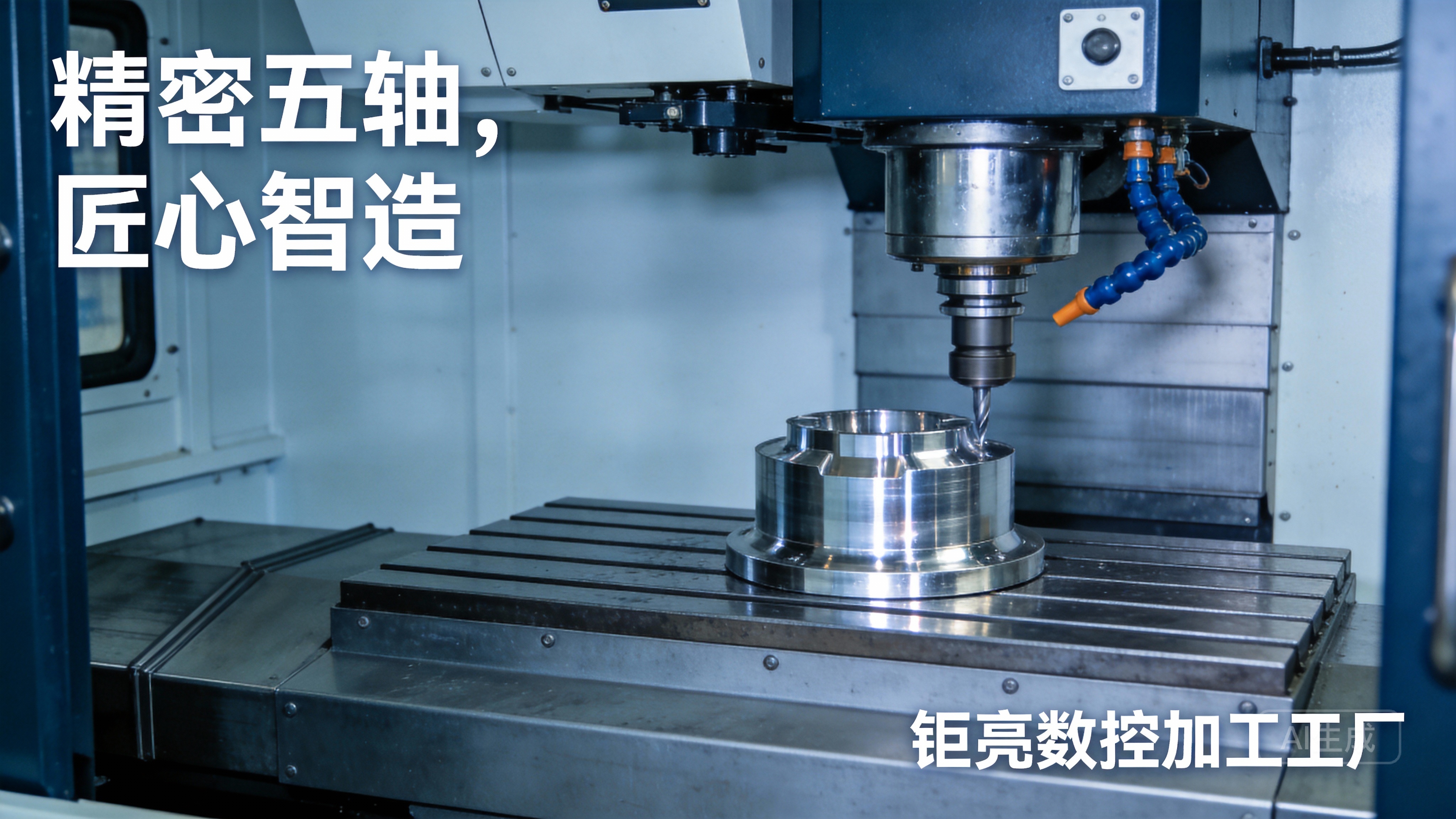
At GreatLight CNC Machining Factory – also known as GreatLight Metal – we have spent more than a decade refining exactly that workflow. Our 76,000 sq. ft. production floor, 150‑strong engineering & technical team and 127 pieces of precision peripheral equipment are orchestrated to deliver complex 4‑axis machined parts within days, without cutting corners on dimensional accuracy, surface finish or material integrity. In this article, I’ll walk you through what 4‑axis CNC machining really means, where it excels, what separates a dependable fast‑turn supplier from a risky promise, and why a vertically integrated manufacturer like GreatLight often becomes the decisive factor between a delayed product launch and a market‑beating timeline.
Get 4 Axis CNC Machining Custom Fast
Why Speed Without Structure Fails
In my years of manufacturing engineering, I’ve seen too many projects derailed by an obsessive focus on lead time alone. A supplier that quotes “3 days” but lacks in‑house post‑processing will send your parts to an external anodizer, adding five unpredictable days. A supplier that runs aging 3‑axis machines will require multiple setups for angled features, each introducing cumulative error. A supplier without rigorous incoming inspection might machine a flawed casting, only to discover the defect after a week of work.
Getting 4‑axis CNC machining custom fast, therefore, depends on three interlocking pillars:
Equipment that matches the geometry – true fourth‑axis rotary tables and simultaneous 4‑axis interpolation eliminate multiple setups, reducing both cycle time and tolerance stack‑up.
Process ownership – when the same team controls CNC programming, machining, cleaning, anodizing, painting and final inspection, hand‑off delays evaporate.
Quality management that’s built in, not bolted on – real‑time in‑process measurement and a closed‑loop feedback system catch deviations before they become a batch of non‑conforming parts.
How GreatLight Shortens the Critical Path
At GreatLight, the fourth axis isn’t an aftermarket add‑on; it’s integrated into our high‑precision machining centers from reputable machine‑tool builders. By combining 4‑axis capabilities with our extensive 3‑axis and even 5‑axis CNC fleet, we assign parts to the most efficient machine architecture for that specific geometry. A part that would require three setups on a traditional 3‑axis mill can often be finished in a single setup with a rotary axis – slashing total throughput time by 40 % or more.
That time saved translates directly to faster delivery for you. Moreover, because we are a manufacturer, not a broker, we do not spend days routing your RFQ to third‑party shops. Our own engineering team performs a design‑for‑manufacturability review within hours, confirms material availability from our mill‑approved inventory, and sequences the job through in‑house production cells. The result is a reliable, predictable lead time that matches the urgency expressed by “fast.”
Understanding 4‑Axis CNC Machining: More Than an Extra Rotary
If 3‑axis machining moves a cutting tool along X, Y and Z, 4‑axis machining adds a rotational axis – typically the A‑axis, which rotates the workpiece around the X‑axis. This enables the tool to reach angular features, undercuts and complex contours without repositioning the part manually.
Common configurations include:
Indexed 4‑Axis Machining – the rotary table indexes the part to a specific angle, then machining proceeds like a 3‑axis operation. This is excellent for producing multiple facets or bolt‑hole patterns at precise angular intervals.
Simultaneous 4‑Axis Machining – the rotary axis moves continuously while the cutting tool is engaged, allowing smooth, sculpted surfaces such as cam profiles, helical grooves and turbine‑type geometries.
When 4‑Axis Delivers the Best Value
Parts with off‑axis holes or ports: hydraulic manifolds, pneumatic blocks, valve bodies.
Cylindrical components with complex profiles: drive shafts, splines, camshafts.
Housings that require angled sealing surfaces or mounting ears: automotive sensor brackets, medical device enclosures.
Aerospace structural brackets where weight reduction dictates sculpted, organic shapes.
For these geometries, 4‑axis machining often beats the cycle time of even the fastest 3‑axis mill while achieving tighter positional accuracy on angled features. It also reduces the number of fixtures dedicated to a part, lowering total project cost – a detail particularly valuable for production runs spanning hundreds or thousands of units.
The GreatLight Difference: Engineering Infrastructure for Fast, Custom 4‑Axis Parts
A factory floor that speaks for itself
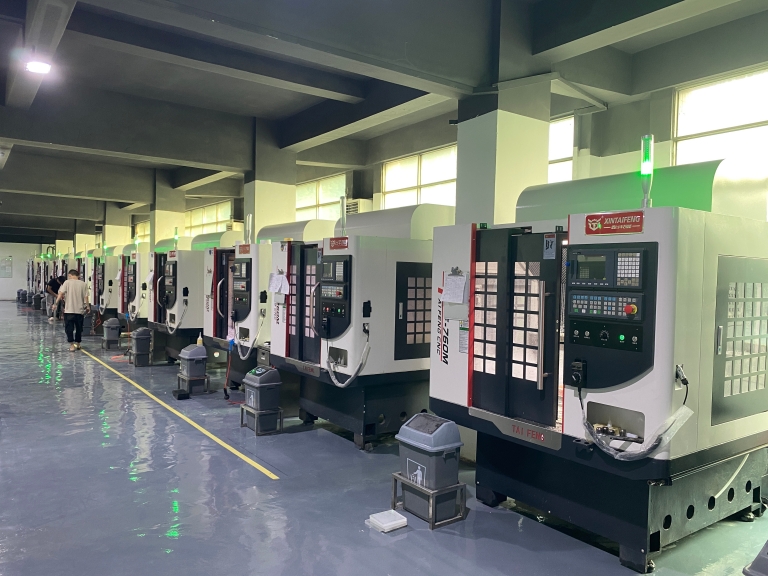
Established in 2011 in Dongguan’s Chang’an District – the heart of China’s hardware and mold capital – GreatLight CNC Machining Factory occupies a modern 7,600‑square‑meter campus. Inside, you’ll find:
| Equipment Category | Typical Specification / Role |
|---|---|
| 5‑axis CNC centers | High‑end Japanese & Chinese brands, capable of ±0.005 mm positioning |
| 4‑axis/3‑axis CNC mills | Multi‑brand fleet, bed sizes up to 4,000 mm for oversized components |
| CNC lathes & Swiss‑type | Turning down to sub‑millimeter diameters, live‑tooling options |
| Wire & sinker EDM | High‑precision erosion for extremely hard materials or fine details |
| 3D printers (SLM/SLA/SLS) | Metal & plastic additive manufacturing for prototypes & hybrid builds |
| In‑house finishing line | Anodizing, electroplating, painting, powder coating, passivation |
With 127 precision peripherals, we are not a job shop that occasionally runs a fourth‑axis program; we are a full‑process manufacturer that has embedded 4‑axis machining into a seamless value stream from CAD to finished, assembled product.
Certifications that underwrite trust
Speed without compliance opens a Pandora’s box of liability. GreatLight operates under a suite of internationally recognized management systems, all actively maintained and audited:
ISO 9001:2015 – the foundation of our quality management, ensuring process repeatability and continuous improvement.
ISO 14001 – environmental management, proving our commitment to sustainable manufacturing.
ISO 13485 – specific to medical devices, critical when machining implants or diagnostic hardware.
ISO 27001 – information security, protecting your intellectual property across every digital transaction.
IATF 16949 – the automotive quality standard, mandatory for Tier‑1 and Tier‑2 suppliers, and a rigorous test of defect prevention and supply‑chain transparency.
These credentials matter because a supplier that can satisfy IATF 16949 has already demonstrated the process discipline, traceability and risk management that complex 4‑axis jobs demand. When you need fast turnaround, you don’t have time to discover that a cheaper shop re‑uses contaminated cutting fluid or skips a final dimensional report.
Deep engineering support from DFM to first article
Every order at GreatLight begins with a design‑for‑manufacturability review by an engineer who understands both the capabilities of our machines and the physics of material removal. We flag potential issues – thin‑wall chatter, inaccessible sharp internal corners, unrealistic surface‑finish specifications – and propose practical alternatives before a single chip is cut. This front‑loaded collaboration often cuts programming‑to‑first‑part time by 20‑30 %, directly feeding into your “fast” requirement.
A Real‑World Example: 4‑Axis Machining for an Electric Vehicle Power‑Train Component
To illustrate how a fully integrated shop turns a complex drawing into a validated part on an aggressive timeline, consider a project we executed for a start‑up specializing in off‑highway electric drivetrains.
The challenge: An aluminum motor end‑bell required a combination of 90‑degree bolt flanges, 45‑degree cooling‑channel fittings and a 30‑degree sensor‑mount boss. The customer needed 50 first‑article assemblies in three weeks to meet a vehicle‑integration deadline. Tolerances on the angular bores were ±0.025 mm true position relative to the main bearing bore.
The GreatLight solution:
Material selection & preparation: The team chose 6061‑T6 aluminum pre‑machined billets from our certified mill supplier, ensuring consistent grain structure and minimal residual stress.
4‑axis programming: Using simultaneous 4‑axis interpolation on a high‑rigidity vertical machining center with a rotary table, we combined the main bore, bolt‑hole circle and angled features into a single setup. Post‑processing the toolpath with collision‑avoidance simulation eliminated the risk of tool‑holder interference.
In‑process verification: A Renishaw spindle probe touched critical datum surfaces after roughing, calibrating offsets before finishing passes. This probe‑driven approach kept every dimension within the narrow tolerance band without sacrificing speed.
One‑stop finishing: The parts moved directly from machining to our in‑house anodizing line – hard‑coat type III – and then to final inspection on a coordinate measuring machine. Because finishing resided under the same roof, the parts never left our quality umbrella.
Result: All 50 assemblies shipped in 14 working days – a full week ahead of the customer’s deadline – with zero non‑conformances. The start‑up went on to use GreatLight for the production‑intent ramp, leveraging our die‑casting and CNC machining integration to reduce unit cost while maintaining the same geometric precision.
How GreatLight Compares with Other Fast‑Turn 4‑Axis Machining Suppliers
The market for 4‑axis CNC machining includes a broad spectrum, from local job shops to global digital manufacturing platforms. Each model has its place, but understanding the structural differences helps you decide where speed, consistency and accountability intersect.
| Attribute | GreatLight Metal | Protocase | RapidDirect | Xometry | Fictiv |
|---|---|---|---|---|---|
| Manufacturing model | Direct manufacturer, 3 owned plants | Direct manufacturer, focused on sheet metal & enclosures | Manufacturing network (aggregator) | Multi‑source marketplace (aggregator) | Aggregator with vetted partner network |
| In‑house 4‑axis capacity | Extensive 4‑axis & 5‑axis CNC fleet; max work‑piece 4,000 mm | Limited to sheet‑metal‑focused CNC; small parts primarily | Varies by partner; limited transparency | Varies by partner; quality depends on matched shop | Varies by partner; sample‑level visibility |
| In‑house post‑processing | Full finishing line: anodizing, plating, painting, passivation | Powder coating, wet painting, silk‑screening | None directly; relies on partner facilities | None; subcontracted | None; subcontracted |
| Quality certifications | ISO 9001, ISO 14001, ISO 13485, ISO 27001, IATF 16949 | ISO 9001, AS 9100, ITAR | Varies by partner; visible upon request | Varies by partner | Varies by partner; QMS standards but not uniformly owned |
| Intellectual property protection | ISO 27001‑certified data security, NDA‑strict environment | NDA available; North America‑based IT infrastructure | Standard platform security; data shared across network | Platform‑level security; partner‑level risks | SOC 2 Type 2 report; cloud‑based transparency |
| Typical lead time (complex 4‑axis part) | 5–12 business days (expedited options available) | 1–3 days (sheet‐metal enclosures) | 7–14 days (depending on partner availability) | 5–15 days (depending on partner queue) | 5–12 days (depending on partner queue) |
| Engineering support | In‑house senior manufacturing engineers, free DFM feedback | Application engineers for sheet metal design | General DFM, limited depth for 4‑axis specifics | Automated DFM; manual engineering fee applies | Platform‑driven DFM with optional human support |
Aggregator models excel when you need instant quoting across multiple technologies and are comfortable with variable lead times and layered communication. However, when a design features tight angular tolerances, requires a specific anodize thickness measured in microns, or involves proprietary IP that cannot be fragmented across a network, the direct‑manufacturer model proves its worth.
GreatLight, as a single‑source manufacturer with three wholly owned plants and a commitment to ISO 27001 data security, offers a transparency that network platforms inherently cannot: your project moves through a pre‑defined, monitored sequence of operations within a controlled physical environment. That control directly enables the “fast” promise – because when you eliminate inter‑company logistics and misaligned quality systems, you subtract days.
Addressing the Common Pain Points in Fast‑Turn 4‑Axis Machining
1. The “Precision Black Hole” – promises vs. reality
Some suppliers advertise ±0.001 mm capability but achieve it only on carefully selected test cuts, not in production. GreatLight closes this gap by using calibrated machine‑tool probes, climate‑controlled inspection rooms and statistical process control on every setup. Our ISO 9001 and IATF 16949 systems require documented capability studies for each new process, so when we quote a precision, it’s backed by data, not hope.
2. The post‑processing lottery
Fast machining means little if the part then sits in a queue at an external plater for a week. Our in‑house anodizing, passivation, painting and plating lines run on a production schedule synchronized with our CNC output. If your part requires Type II anodize with a specific dye color, that step begins within hours of un‑chucking the last part, not days later.
3. Engineering hand‑off churn
When a platform routes your RFQ to a shop you’ve never spoken with, you often lose the nuance of design intent. At GreatLight, you communicate with the same manufacturing engineer who will review your toolpaths. This continuity reduces the “clarification spiral” that commonly adds 2‑3 days to fast‑turn orders.
4. Data security for IP‑sensitive designs
For start‑ups developing next‑generation robotics or medical devices, uploading a CAD model to an open marketplace feels like a calculated risk. Our ISO 27001 certification and strict access‑control protocols mean your model stays within our encrypted environment, accessible only to vetted personnel. If you require a non‑disclosure agreement to be executed before quoting, it’s standard practice – not an exception.
How to Expedite Your Next 4‑Axis CNC Machining Project
As an engineer who has been on both sides of the outsourcing relationship, I recommend these actions to compress lead times while safeguarding quality:
Provide a fully defined 3D model and 2D drawing – Mark critical dimensions with tolerances, specify material grade and heat treatment, and call out surface‑finish requirements. Ambiguity invites delays.
Indicate which features are performance‑critical – If a certain bore must be concentric to a datum within 0.01 mm, say so. This allows the manufacturer to plan probing routines and tool‑compensation strategy.
Share the use‑case context – Telling the engineer, “This part operates at 120 °C in engine oil,” might prompt a recommendation to use a PEEK seal groove or a post‑machining anodize seal, avoiding a later field failure.
Consider hybrid manufacturing – If volume is low and geometry is extremely complex, GreatLight can combine 4‑axis CNC machining with metal 3D printing (SLM) to produce near‑net‑shape blanks that only need finish machining, drastically reducing both material waste and machining hours.
Plan finishing early – Request the finishing specification in the first RFQ, so that masking, racking and process parameters are locked in before machining starts. With in‑house finishing, this parallel planning is a key accelerator.
Looking Ahead: 4‑Axis Machining in an Increasingly Connected Factory
The future of fast‑turn 4‑axis machining will be shaped by automation, digital twins and closed‑loop process control. At GreatLight, we are already deploying in‑process laser tool setters, automated pallet changers for lights‑out production and real‑time dashboard monitoring that lets our production managers spot a bottleneck before it affects your delivery date.
But technology alone cannot deliver “fast.” The human element – an engineer who cares enough to suggest a better blend‑radius, a quality inspector who refuses to ship a part with a borderline surface blemish, a purchasing officer who maintains safety stock of exotic alloys – is what turns machines into a manufacturing partner. That partnership is what we’ve built since 2011, from the mold‑making hub of Chang’an to the global supply chains we serve today.
In an era where product lifecycles are shrinking and the cost of delay can eclipse the cost of manufacturing, the ability to get 4 Axis CNC machining custom fast is not just a convenience – it is a strategic lever. Whether you need a single prototype to validate a concept or a 500‑piece release to satisfy pilot production, the path from screen to shipment becomes dramatically shorter when your supplier owns the entire process, operates under uncompromising quality standards and treats your project with the same urgency you feel.
At GreatLight CNC Machining Factory, that’s how we’ve engineered every cell on our shop floor. Let your next 4‑axis challenge meet a team that measures speed in days and precision in microns.



















