
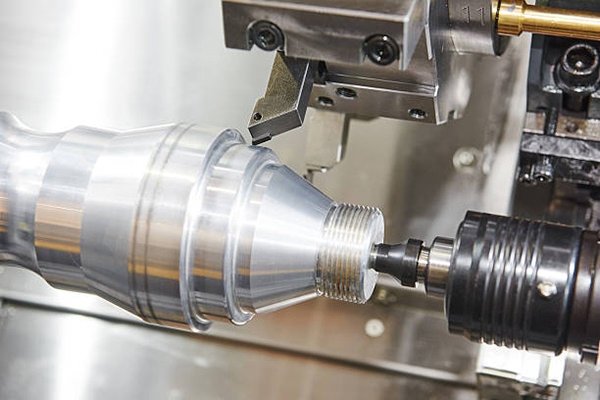
When it comes to Drone Rotary Switch Housings CNC, the difference between a reliable drone and one that fails mid-flight often lies in the details — the tactile feedback of a control knob, the precise alignment of detents, and the structural integrity of the housing that protects sensitive electrical contacts. For UAV manufacturers, start-ups, and defense contractors, producing these compact yet demanding components at scale is a constant balancing act between tight tolerances, aggressive weight targets, and uncompromising durability. While many suppliers claim CNC capability, few can deliver the end‑to‑end precision, certified processes, and material versatility required for mission‑critical rotary switch housings. This article dissects the technical challenges of machining these parts, explores how advanced 5‑axis CNC technology provides the answer, and highlights why a vertically integrated partner like GreatLight CNC Machining is redefining the standard for drone component production.
Drone Rotary Switch Housings CNC: Engineering the Heart of UAV Control
Rotary switches serve as the primary human‑machine interface on drone ground control stations, camera gimbals, payload selectors, and even on‑board mode dials. Their housings must withstand repeated rotation, vibration, impact, and environmental exposure — all while maintaining precise electrical insulation and signal integrity. Achieving this blend of mechanical and electrical performance starts with the housing itself, and that is where CNC machining becomes indispensable.
The Anatomy of a High‑Performance Rotary Switch Housing
A typical drone rotary switch housing comprises multiple intricate features:
Detent grooves and click‑mechanism seats that define the tactile feel and positional accuracy.
Threaded inserts or press‑fit bushings for secure mounting to a panel or PCB.
Seal channels and O‑ring grooves to achieve IP67 or higher ingress protection.
Multi‑cavity internal pockets that isolate contact channels and prevent arcing.
Snap‑fit or screw‑fastened covers that require flatness and parallelism within a few microns.
These features demand multi‑axis machining with sub‑0.01 mm accuracy. A single cavity milled out‑of‑tolerance can cause inconsistent switch torque, premature wear, or complete electrical failure — a risk no drone operator can afford.
Material Conundrums: Balancing Weight, Strength, and Cost
Drone engineers often walk a tightrope when selecting housing materials. Aluminum alloys (6061‑T6, 7075‑T6) provide excellent strength‑to‑weight ratios and EMI shielding, but they require anodizing or chemical film coatings for corrosion resistance. Titanium (Ti‑6Al‑4V) offers supreme durability and bio‑compatibility for medical drones, yet its low thermal conductivity and work‑hardening nature make it notoriously difficult to machine. Engineering plastics like PEEK, Ultem, and glass‑reinforced nylon can slash weight further, but they introduce challenges in maintaining close tolerances due to thermal expansion and moisture absorption.
A 2023 industry survey by Unmanned Systems Technology found that 67% of drone manufacturers have experienced quality rejections due to improper material handling or post‑processing of machined housings. This underscores the need for a CNC partner that not only machines the part but also understands how material behavior, toolpath strategies, and surface finishing interact.
Why 5‑Axis CNC Machining is Indispensable
Three‑axis CNC machines, while common, simply cannot meet the geometric complexity of modern rotary switch housings without multiple setups. Each re‑fixturing introduces stack‑up errors and consumes time. 5‑axis CNC machining eliminates this by enabling simultaneous movement along five axes, allowing the cutting tool to approach the workpiece from any angle. This yields several game‑changing advantages for drone switch housings:
Single‑Setup Completion: Multi‑sided features — detent pockets, O‑ring grooves, and threaded holes — can be machined in one clamping, ensuring positional accuracy below ±0.005 mm.
Improved Surface Finish: By maintaining optimal tool orientation, 5‑axis paths minimize scallop height and eliminate the need for extensive hand polishing, critical for sealing surfaces.
Undercut and Negative Draft Machining: Complex internal channels for wire routing or contact isolation can be created without fragile EDM electrodes.
Shorter Lead Times: A part that might require three separate setups on a 3‑axis machine can often be completed in under 30 minutes on a 5‑axis center, accelerating prototyping and time‑to‑market.
GreatLight CNC Machining, for instance, deploys large‑format Dema and Beijing Jingdiao 5‑axis machining centers alongside dozens of 4‑axis and 3‑axis mills, ensuring that even the most contoured housings — from micro‑UAV thumb‑wheels to full‑scale ground control panel assemblies — are produced with consistent accuracy.
Overcoming Common Manufacturing Pitfalls
The knowledge base highlights a pervasive pain point: the “precision black hole,” where promised accuracy fails to materialize in production. Rotary switch housings are particularly vulnerable because they combine tight geometric tolerances with requirements for surface integrity (e.g., no micro‑cracks that could propagate under vibration). Here is how a rigorous CNC workflow addresses these pitfalls:
| Challenge | Traditional Approach Risk | GreatLight’s Resolution |
|---|---|---|
| Tolerance drift across batches | Inconsistent tool compensation and wear monitoring | Automated in‑process probing and tool breakage detection on every 5‑axis machine; statistical process control per ISO 9001. |
| Material warping during machining | High residual stress release causing distortion | Stress‑relief heat treatment protocols and optimized trochoidal milling paths that reduce cutting forces. |
| Poor sealing surface integrity | Rough end‑mill finishes that trap moisture and contaminants | Finish‑machining with carbide ball‑end mills at 30,000 RPM, achieving Ra 0.2 µm or better directly from the machine. |
| Incompatible post‑processing | Anodizing or plating that alters critical dimensions | In‑house anodizing, passivation, and chem‑film lines with pre‑ and post‑process metrology to guarantee final part conformance. |
By owning the entire value chain — from raw stock inspection to certified surface finishing — an integrated manufacturer removes the inter‑vendor ambiguity that so often derails drone component projects.
GreatLight CNC Machining: A Full‑Process Powerhouse
GreatLight Metal Tech Co., LTD., operating under the brand GreatLight CNC Machining, was established in 2011 in Chang’an Town, Dongguan — China’s renowned hardware and mould capital. With a 7,600 m² facility staffed by 150 skilled professionals, the company has built its reputation on delivering complex, high‑precision parts for industries where failure is not an option. Their approach to drone rotary switch housings rests on four pillars:

Advanced Equipment Cluster
The factory floor hosts 127 pieces of precision peripheral equipment, including large‑format 5‑axis, 4‑axis, and 3‑axis CNC machining centers, Swiss‑type lathes, EDM, and vacuum forming machines. For housings that require extremely fine features, they also offer metal 3D printing (SLM) and plastic 3D printing (SLA/SLS) for rapid prototyping and conjoined assemblies.
Authoritative Certifications
GreatLight’s quality management system is certified to ISO 9001:2015, ISO 13485 for medical hardware, and IATF 16949 for automotive and engine components. For UAV manufacturers supplying defence or automotive‑tier systems, this means a partner that already speaks the language of stringent statutory and regulatory requirements. ISO 27001 data security compliance further safeguards sensitive design files.
Full‑Process Chain
From initial design for manufacturability (DFM) feedback, through CNC machining, die casting, sheet metal fabrication, and 3D printing, to anodizing, painting, laser marking, and assembly — GreatLight consolidates the entire workflow under one roof. This dramatically compresses lead times and eliminates the finger‑pointing that plagues multi‑vendor projects.
Deep Engineering Support
Every project begins with a thorough DFM review. The engineering team analyzes feature tolerances, suggests fixturing strategies, and identifies potential material distortion before the first chip is cut. This proactive approach has helped clients reduce prototyping iterations by up to 60%.
Beyond Machining: Integrated Post‑Processing and Quality Assurance
The function of a rotary switch housing doesn’t stop at accurate dimensions. Surface hardness, corrosion resistance, and even colour coding for different drone functions often require specialised finishes. GreatLight’s in‑house post‑processing capabilities include:
Hard anodizing (Type III) for aluminium housings exposed to abrasive desert environments.
Electroless nickel plating for uniform corrosion protection on complex internal geometries.
Passivation and electropolishing for stainless steel components.
Laser engraving for permanent part numbers and wire‑routing indicators.
All parts undergo final inspection on coordinate measuring machines (CMMs) and vision measurement systems, with data reports supplied as standard. For clients requiring ±0.001 mm tolerances on critical detent bores, this end‑to‑end verification provides iron‑clad confidence.
Comparing the Landscape: How GreatLight Stands Out
The CNC machining services market is crowded with players like Protocase, EPRO‑MFG, Owens Industries, RapidDirect, Xometry, Fictiv, and PartsBadger. While each has its strengths, a side‑by‑side evaluation reveals key differentiators that directly impact drone rotary switch housing projects.
| Capability | GreatLight CNC Machining | RapidDirect / Xometry / Fictiv | Protocase / EPRO‑MFG |
|---|---|---|---|
| True 5‑Axis Machining | Multi‑brand 5‑axis centers for complex contours; maximum part size 4,000 mm | Often outsourced or limited capacity; usually smaller work envelopes | Focus on sheet metal and simpler prismatic parts; minimal 5‑axis capability |
| In‑House Post‑Processing | Full suite: anodizing, plating, painting, laser marking, assembly | Varies; many services brokered out, adding lead time | Primarily sheet metal finishing; limited metal surface treatment |
| Certifications | ISO 9001, ISO 13485, IATF 16949, ISO 27001 | ISO 9001 common; rarely IATF 16949 or ISO 13485 in‑house | ISO 9001; niche medical or automotive certs absent |
| Rapid Prototyping | CNC + SLM/SLA/SLS 3D printing under one roof; days‑turn prototypes | Often separate prototyping service lines with longer coordination | Limited to subtractive methods |
| Engineering Support | Dedicated DFM engineers; full traceability from material cert to final report | Automated quoting platforms with less human engineering interaction | Good for simple custom enclosures; limited design‑for‑manufacturing depth |
| Scalability | 120‑150 skilled staff, 7,600 m² facility; comfortable with thousands‑unit orders | Massive broker networks; quality consistency can vary | Small‑to‑mid volume; may struggle with complex CNC volumes |
For drone rotary switch housings that require intricate 5‑axis milling, certified surface treatments, and the ability to pivot from prototype to production without changing suppliers, the vertically integrated GreatLight model offers a distinct advantage. Platforms like Xometry or Fictiv excel at commoditised parts, but when the geometry becomes complex and the consequences of failure are high, the depersonalised brokered approach often introduces risk. In contrast, GreatLight’s direct communication with in‑house machinists and finishing specialists creates a feedback loop that catches issues before they escalate.
Real‑World Reflections: Empowering UAV Innovation
Consider a hypothetical but representative case: a robotics start‑up developing a new gun‑style drone controller with a multifunction rotary dial. The housing required a slim Ø38 mm titanium shell with internal detent grooves accurate to ±0.008 mm, M2 threaded blind holes, and a polished satin finish. Several prototyping bureaus quoted 6‑8 weeks and prices that threatened the project budget. GreatLight’s team proposed a 5‑axis CNC strategy that milled the entire housing — including the intricate detent channels and thread‑milled bores — in a single setup. Using medical‑grade Ti‑6Al‑4V stock, they delivered first‑article samples in 10 days, fully inspected and laser‑marked. The start‑up was able to validate ergonomics and switch torque within two iterations, shaving months off their development timeline.
This scenario illustrates a broader truth: when drone rotary switch housings demand the marriage of advanced machining, materials science, and finish expertise, picking a supplier that owns the entire process is not merely convenient — it is a strategic necessity.
Conclusion: Precision Without Compromise
As the UAV industry pushes toward smaller, more capable platforms, the components inside those platforms must follow suit. Drone rotary switch housings CNC sit at the intersection of mechanical precision, electrical safety, and user experience. Selecting a manufacturing partner that can deliver single‑setup 5‑axis machining, certified quality systems, in‑house finishing, and genuine engineering collaboration is the most reliable path to a robust product. In the competitive realm of UAV component production, drone rotary switch housings CNC demand a partner that combines state‑of‑the‑art 5‑axis capability, rigorous quality systems, and an unwavering commitment to on‑time delivery — a combination GreatLight CNC Machining delivers consistently.



















