As an experienced manufacturing engineer who has spent countless hours on the shop floor, I can tell you this is one of the most common and practical questions we receive from clients and newcomers to the industry. The short, direct answer is: Yes, CNC machines are supposed to make noise, but the type and volume of that noise tell a critical story about the machine’s health, operation, and the quality of your manufacturing process. A completely silent CNC machine is either turned off or broken. However, distinguishing between acceptable operational noise and problematic, excessive loudness is key to ensuring equipment longevity, part quality, and a safe working environment.
Understanding the sources and meanings of CNC machine noise will empower you to make better decisions, from daily operations to selecting a machining partner.
H2: The Symphony of Machining: Why CNC Machines Are Inherently Loud
A modern CNC machine is a complex orchestra of high-power mechanical, electrical, and fluid systems working in concert. The primary sources of noise are:
The Cutting Action Itself: This is the fundamental source. The interaction between a hard, rotating cutting tool (end mill, drill, etc.) and your workpiece material (aluminum, steel, titanium) involves tremendous force. Shearing away metal creates vibration and sound waves. Harder materials and more aggressive cuts generally produce higher-pitched, sharper noises.
The Spindle and Axis Drives: The spindle motor, which can spin at tens of thousands of RPM, and the servo motors driving the linear axes generate significant electromagnetic and mechanical hum and whine. High-speed spindles have a distinctive high-frequency sound.
Ancillary Systems:
Coolant Systems: High-pressure coolant pumps and the spray of fluid hitting the tool and part contribute a steady rushing or spraying sound.
Chip Conveyors: The sound of metal chips scraping along a conveyor is a common background noise.
Hydraulic & Pneumatic Systems: Clamping, tool changers, and pallet shuttles often use compressed air or hydraulics, creating sharp hissing or “clunking” sounds during automatic cycles.
Chip Evacuation with Air Blast: A loud, consistent hiss is often used to clear chips from the cutting area.
H2: Normal vs. Abnormal: Decoding the Sounds of Your CNC
This is the most critical distinction for operators and engineers. Learning to “listen” to your machine is a vital skill.
H3: Acceptable Operational Noise (The “Normal” Symphony)
A Consistent, Predictable Hum or Whine from the spindle under load.
The Sharp, Crisp “Singing” of a Tool Cutting material efficiently. This sound can vary with toolpath, material, and tool type but should be relatively steady.
Regular, Repetitive Mechanical Clunks and Whirs from automatic tool changers, door mechanisms, or pallet changers.
The Constant Background Noise of coolant pumps and chip conveyors.
H3: Problematic & Excessive Loudness (The “Warning Sirens”)
Chatter: A loud, irregular, high-frequency rattling or squealing. This is often the most destructive sound. It indicates severe vibration between the tool and workpiece, leading to poor surface finish, rapid tool wear, and potential damage to the machine spindle.
Screeching or Shrieking: Often indicates a dull tool, improper cutting parameters (speed/feed), or a lack of coolant/lubrication on the cutting edge.
Deep, Rhythmic Thumping or Grinding: Could signal a catastrophic bearing failure in the spindle or a ball screw, or a serious mechanical collision. This requires immediate emergency stop.
Sudden, Loud Bangs or Crunches: Almost certainly indicates a crash – the tool has collided with the workpiece, fixture, or machine component.
Unusually Loud Vibration or Resonant Hum: May point to an imbalance in the tool holder, a loose workpiece fixture, or worn-out machine leveling mounts.
H2: Factors Influencing CNC Machine Noise Levels
Not all machines or shops sound the same. Key factors include:
Machine Enclosure & Dampening: Modern, high-end CNC machines feature full, insulated enclosures with laminated glass that dramatically reduce noise escape (often by 20-30 dBA). Older or budget machines may have minimal shielding.
Machine Condition & Maintenance: A well-maintained machine with fresh lubrication, tight gibs, and balanced spindles runs more smoothly and quietly. Worn components amplify noise.
Cutting Strategy & Tooling: Using the correct toolpath (e.g., trochoidal milling vs. conventional slotting), sharp tools, and optimized feeds/speeds produces more efficient, often quieter cuts than forced, aggressive machining.
Material Being Machined: Graphite or plastic machining is generally quieter than stainless steel or titanium. Cast iron has a characteristic, dampened “hiss” compared to the “ring” of aluminum.
Shop Environment: A bare concrete floor and metal walls will reverberate and amplify noise. Facilities with acoustic panels, epoxy floors, and strategic layout planning have lower ambient noise levels.
H2: Quantifying the Noise: What Do Decibels (dBA) Mean in Practice?
While subjective, noise is measured objectively in A-weighted decibels (dBA), which approximates human hearing.
Normal Conversation: ~60 dBA
Typical CNC Machining Cell (Outside Enclosure): 75-85 dBA. Inside the enclosure during heavy cutting, levels can easily exceed 90 dBA.
OSHA Action Level: 85 dBA averaged over 8 hours. At this point, employers must implement a hearing conservation program, including offering hearing protection.
OSHA Permissible Exposure Limit: 90 dBA over 8 hours.
Immediate Danger (e.g., Chatter or Crash): Can spike well above 100 dBA.
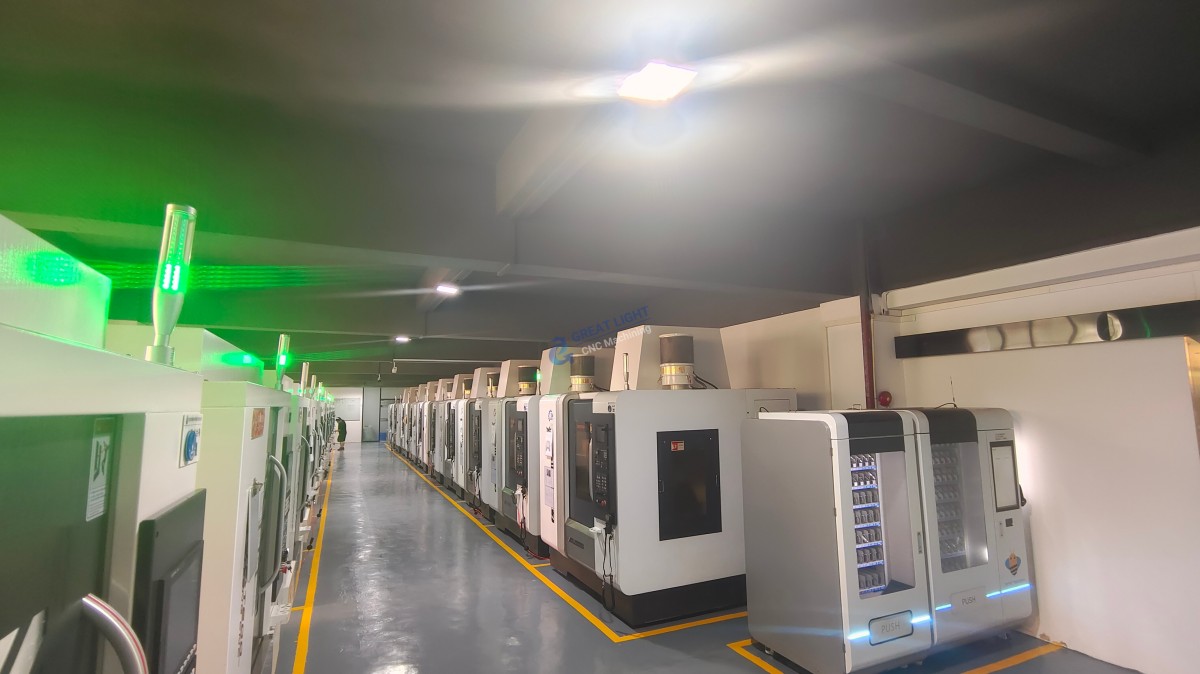
A responsible manufacturer, like GreatLight Metal Tech Co., LTD., not only maintains equipment to minimize aberrant noise but also ensures its operational environment complies with safety standards, protecting its technicians’ hearing while ensuring machinery is in peak condition for precision work.
H2: How to Mitigate and Manage CNC Machine Noise
Proactive Maintenance: Adhere to a strict preventive maintenance schedule. Lubricate, inspect, and calibrate. Listen for changes in baseline noise.
Process Optimization: Utilize high-efficiency machining (HEM) strategies and modern toolpath software (like Mastercam or CAMplete for 5-axis) that reduce tool load and vibration.
Invest in Quality Tooling & Holders: Balanced, premium tool holders (like hydraulic or shrink-fit) and sharp, application-specific tools cut cleaner and quieter.
Ensure Proper Installation: Machines must be installed on a solid, level foundation, often with vibration-dampening pads or epoxy grout, to prevent amplifying internal vibrations.
Use Enclosures and Personal Protective Equipment (PPE): Always keep machine doors closed during operation. Mandate the use of appropriate hearing protection (earplugs or muffs) for personnel on the shop floor.
Conclusion
So, is a CNC machine supposed to be loud? It is designed to perform powerful, precise physical work, and sound is an unavoidable byproduct. A certain level of robust, consistent operational noise is not just expected—it’s a sign of a working machine. However, expertise lies in distinguishing that healthy operational sound from the cacophony of problems like chatter, crashes, or mechanical failure. An exceptionally loud machine isn’t necessarily a sign of power; it can be a symptom of poor process, maintenance, or machine condition.
When you partner with a manufacturer, their approach to machine noise speaks volumes about their overall operational discipline. A shop where machines hum with consistent, controlled efficiency—like those at GreatLight Metal—is typically a shop with rigorous maintenance protocols, skilled programmers optimizing cutting strategies, and a deep commitment to quality and safety. This controlled acoustic environment indirectly assures you that your parts are being produced on stable, well-calibrated equipment, leading to higher precision and repeatability. The sound of their shop floor, therefore, becomes an audible metric of their capability and reliability in precision CNC machining.
FAQ: Frequently Asked Questions
H3: Q: My CNC machine suddenly got much louder. What should I do first?
A: Immediately stop the machine and initiate a diagnostic process. Check for simple causes first: a loose tool holder, a severely dull or chipped tool, or a workpiece that has come loose in the fixture. If nothing is obvious, it may indicate a developing internal mechanical issue requiring professional service.
H3: Q: Can noise levels affect the precision of my machined parts?
A: Absolutely. Excessive noise, particularly chatter, is a direct physical manifestation of vibration. This vibration transfers into the workpiece, degrading surface finish, causing dimensional inaccuracy, and accelerating tool wear. Quiet, stable cutting is synonymous with high-precision cutting.
H3: Q: Are 5-axis CNC machines louder than 3-axis machines?
A: Not necessarily louder, but the sound profile can be more complex. The simultaneous movement of more axes and the potential for machining complex geometries in one setup might create a more varied soundscape. However, a high-quality, well-maintained 5-axis machine from a manufacturer like GreatLight should operate with a smooth, powerful hum, not excessive vibration or chatter.
H3: Q: As a client, should I be concerned about the noise level in my supplier’s factory?
A: It is a valuable observational data point. A disorganized, overwhelmingly loud shop may indicate poor maintenance, outdated equipment, or lack of process control. Conversely, a shop where noise is managed, hearing protection is used, and machines sound “healthy” suggests operational professionalism and investment in equipment care—key indicators of a reliable manufacturing partner.
H3: Q: What is one of the most common causes of avoidable loud noise (chatter) in machining?
A: One of the most frequent culprits is tool overhang. Using a tool that extends too far from the tool holder reduces rigidity exponentially, making it prone to deflecting and vibrating. Using the shortest, most rigid tool possible for the job is a fundamental rule for quiet, stable machining.
For more insights into how advanced manufacturing solutions tackle such engineering challenges, you can follow industry developments on platforms like LinkedIn{:target=”_blank”}.