
China Custom 4 Axis CNC Machining Exporter
This page is for engineers and sourcing teams who buy 4-axis machined parts from China and want to know what actually separates one exporter from another. It covers axis setup, tolerances, materials, inspection and the questions to ask before you release a PO. Read it and you can judge a quote on its process detail, not its website.
What a fourth axis really buys you
A 4-axis exporter is not a 3-axis shop with a bigger brochure. The rotary table changes how a part is held, how many setups it needs, and which tolerances are reachable.
How the fourth axis changes the setup
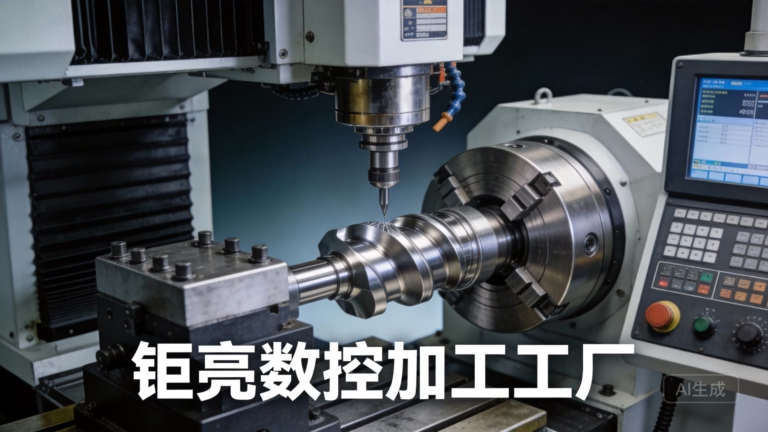
On a 3-axis mill, every new face means a new fixture. On a 4-axis machine, the part sits on a rotary table and rotates to present the next face to the tool. That single change removes a large share of re-clamping error. For a shaft with six milled flats, a valve body with ports on three sides, or a bracket with features around a bore, the reduction in setups is where accuracy comes from.
The rotary table also lets the tool cut continuous features around a part axis. Cam profiles, spiral slots and helical grooves become single-pass operations instead of a stitched sequence of stops. Tool marks line up. Step-over marks between setups disappear.
GreatLight runs 12 four-axis mills alongside 16 simultaneous 5-axis machining centers and 27 three-axis machines. Some parts land on a 4-axis mill because the geometry only needs one rotary axis and the 5-axis centers are better used elsewhere. Matching the machine to the part is a costing decision, not a status one.
Workholding is the limit nobody puts in the brochure. A Ø400 mm rotary table can hold a part that swings clear, but a tall thin part will deflect under cutting load no matter how good the controller is. When the geometry is too slender for a 4-axis setup, we say so and quote a different route.
- 1Best fitParts with features on multiple sides of a central axis
- 2Good fitShafts, manifolds, valve bodies, brackets, rotary housings
- 3Poor fitThin plates needing all six faces cut in one cycle
- 4Ask firstSlender parts where cutting force causes chatter
Tolerances, finishes and the numbers behind them
A tolerance on a drawing is a request. A tolerance a shop can hold across a production run is a capability. We quote ±0.005 mm (±0.0002 in) as our working limit, and that number only holds when the setup, the tool and the material all support it. Aluminum 6061 and brass C36000 hold it more easily than 17-4PH stainless or Inconel.
Surface finish follows the same logic. As-machined surfaces land at Ra 1.6–3.2 μm. A finer pass gets you Ra 0.8–1.6 μm, and a dedicated finishing operation reaches Ra 0.2–0.8 μm. If a drawing calls for Ra 0.4 μm on a deep pocket in 304 stainless, the honest answer is that it needs a second operation or a different process.
GreatLight holds ISO 9001:2015, IATF 16949:2016, ISO 13485:2016 and ISO 27001:2022. The first two matter for automotive and general industrial work. ISO 13485 matters if the part touches a medical device program. ISO 27001 covers how drawings and CAD files are stored and moved, which is a separate risk from machining quality.
Inspection is 100% before shipment. That covers incoming raw material check, in-process monitoring and a final dimensional inspection. Reports are available on request. If your drawing has a critical callout, tell us which feature it is and it gets measured on the CMM, not sampled.
Choosing the right machine for the part
Same shop, different machines. The part geometry decides which one makes sense.
| Part type | Typical machine | Why |
|---|---|---|
| Shaft with flats and cross-holes | 4-axis mill | One rotary axis, no re-clamp |
| Valve body, 3-sided ports | 4-axis mill | Rotary index between faces |
| Impeller, contoured blade | 5-axis center | Simultaneous motion needed |
| Simple plate, one face | 3-axis mill | Lowest cost per part |
| Long extrusion, 4,000 mm | Large 4-axis mill | Travel 4,000 × 400 × 150 mm |
| Turned part with milled flats | Mill-turn center | One chuck, no second op |
Materials, finishing and what to send with an RFQ
Stock covers aluminum 6061, 6061-T6, 2024, 5052, 5083, 6063, 6082, 7075 and ADC12; stainless 303, 304, 316, 316L, 420, 430, 431, 440C and 17-4PH; steel 1018, 1045, 4130, 4140, 4340, A36 and tool steel; copper and brass C101, C103, C110, beryllium copper, C27400, C28000 and C36000; titanium TA1, TA2, TC4, plus Inconel and magnesium AZ31B and AZ91D. Plastics run from ABS and POM to PEEK and carbon fibre.
Finishing is done in-house or through qualified partners. Anodizing comes in clear, colour, hardcoat and conductive. Plating covers electroless nickel, zinc, silver and gold. Powder coating, black oxide, bead blasting, tumbling, brushing and polishing are all available. Laser marking works down to a minimum character height of 1.5 mm, so plan your serial numbers accordingly.
The RFQ that gets a fast, accurate quote includes a STEP file, a 2D drawing with tolerances and datums, the material and temper, the finish spec, the quantity and the target application. Add a note on which features are critical. That last item is what lets an engineer flag a DFM risk before the quote goes out instead of after the first article.
Size range is wide. The largest 4-axis travel is 4,000 × 400 × 150 mm. Medium work covers 750 × 1,150 × 550 mm and 600 × 600 × 600 mm. Compact cells handle 500 × 500 × 450 mm and 500 × 310 × 200 mm. If a part sits near the edge of a travel envelope, say so at quote stage, because the setup that makes it work is not the one used for a small part.
- 1SendSTEP file, 2D drawing, material, finish, quantity
- 2FlagCritical features, datums, tight-tolerance callouts
- 3NoteApplication and any regulatory context
- 4ExpectDFM feedback with the quote, not after
Judging an exporter before you commit
Machine count is easy to publish and easy to inflate. What is harder to fake is a calibration record, a first-article report and a named engineer who answers technical questions. Ask for all three on the first job. A China custom 4 axis exporter that cannot produce a calibration certificate is telling you something about how the rest of the process runs.
Lead time needs to be read carefully. GreatLight quotes and returns a DFM analysis within 12 hours, production can start within 24 hours, and parts typically ship in 3–5 days. Those are process targets, not a guarantee on every part. Historical late-delivery probability is below 2%. Ask what happens when a part does run late, because that answer tells you more than the number on the quote.
There is no minimum order quantity. One prototype and a 10,000+ part run both go through the same shop. That matters at the prototype stage, when a design is still moving and you need a machined sample to test rather than a full production order. Uploads are handled as confidential, and an NDA is available on request through the standard agreement page.
Location matters for logistics and for visits. GreatLight operates three wholly-owned plants, with the main facility in Dongguan, China covering 7,600 m² and a workforce of 150. A second factory sits at No.3 Joo Koon Circle, Singapore 629032. For buyers who want a face-to-face audit, having a second site in the region shortens the trip.
What to verify on a supplier audit
| Item | What to ask for | Red flag |
|---|---|---|
| Calibration | Current certificates per machine | Verbal assurance only |
| Quality system | ISO 9001:2015 scope statement | Certificate with no scope |
| First article | FAI report on your drawing | Sample photos, no data |
| Engineering | Named engineer for the account | Sales-only contact |
| Data handling | ISO 27001:2022 policy | Files sent over personal email |
| Finishing | In-house or named partner | Unnamed subcontractors |
Common questions from engineers
When is a 4-axis mill the wrong choice?
If the part needs all six faces machined in one cycle, or has contoured surfaces that require simultaneous motion, a 5-axis center is the better fit. A 4-axis mill indexes between faces; it does not tilt the tool continuously.
Slender parts are another case. A long thin shaft may fit the rotary table but chatter under load. We will usually suggest a mill-turn center or a different workholding setup rather than force the part onto a 4-axis machine.
Can you hold ±0.005 mm on stainless and titanium?
It depends on the feature. Aluminum and brass hold that tolerance more predictably. 17-4PH and Inconel move more during and after cutting, so a tight callout may need stress relief or a finishing pass after the part stabilizes.
Send the drawing and we will tell you which features are realistic at ±0.005 mm and which ones need a wider band. That answer comes with the quote, not after the first article.
What is the largest part you can run on a 4-axis machine?
The largest 4-axis travel is 4,000 × 400 × 150 mm. Medium and compact cells cover 750 × 1,150 × 550 mm, 600 × 600 × 600 mm, 500 × 500 × 450 mm and 500 × 310 × 200 mm.
The rotary table is Ø400 mm. Swing clearance and part weight both matter, so a part near the limit needs a review before we confirm the setup.
How do you protect our drawings and CAD data?
GreatLight holds ISO 27001:2022, which covers information security management. Uploads are treated as confidential and an NDA is available on request.
If your program has specific data-handling requirements, say so at the start. It is easier to set the rules before files move than to retrofit them later.
Do you take prototype quantities?
Yes. There is no minimum order quantity. A single prototype and a 10,000+ part run both go through the same process.
Prototype work often comes with open questions on the design. DFM feedback on a single part is where a lot of cost gets removed from the production version.
What finishing options ship with the parts?
Anodizing in clear, colour, hardcoat and conductive; electroless nickel, zinc, silver and gold plating; powder coating and black oxide; bead blasting, tumbling, brushing and polishing; laser marking and engraving.
Laser marking has a minimum character height of 1.5 mm. If your marking layout uses smaller text, adjust it before the drawing is released.
Send the drawing and get a process answer
Upload your files and an engineer reviews them for DFM risk, machine fit and tolerance feasibility before the quote goes out.
12-hour quote100% inspectionNo MOQNDA on request









