
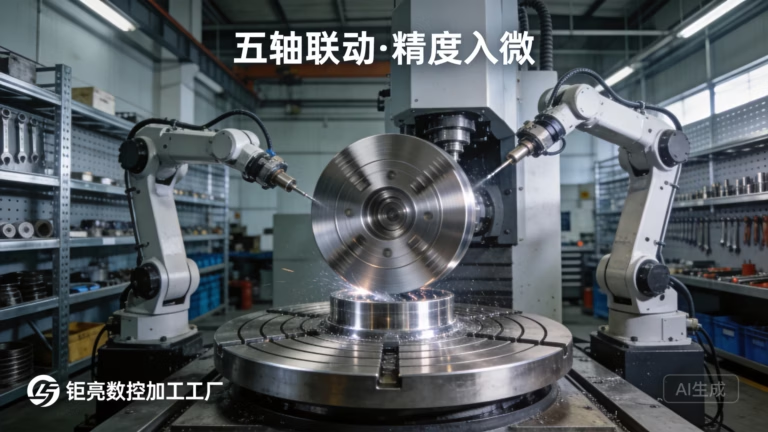
The Precision Predicament: Why “Affordable 5-Axis” is the Manufacturing Industry’s Most Misunderstood Promise
For decades, the five-axis CNC machining center has been the holy grail of manufacturing—a symbol of ultimate capability, complex geometry, and, unfortunately, exorbitant cost. For small-to-medium enterprises (SMEs) and R&D teams racing to get a new product to market, the $200,000+ price tag of a new, top-tier machine often feels like a barrier to entry. The fear is well-founded: sacrifice precision to save money, and you risk scrapping an entire production run.
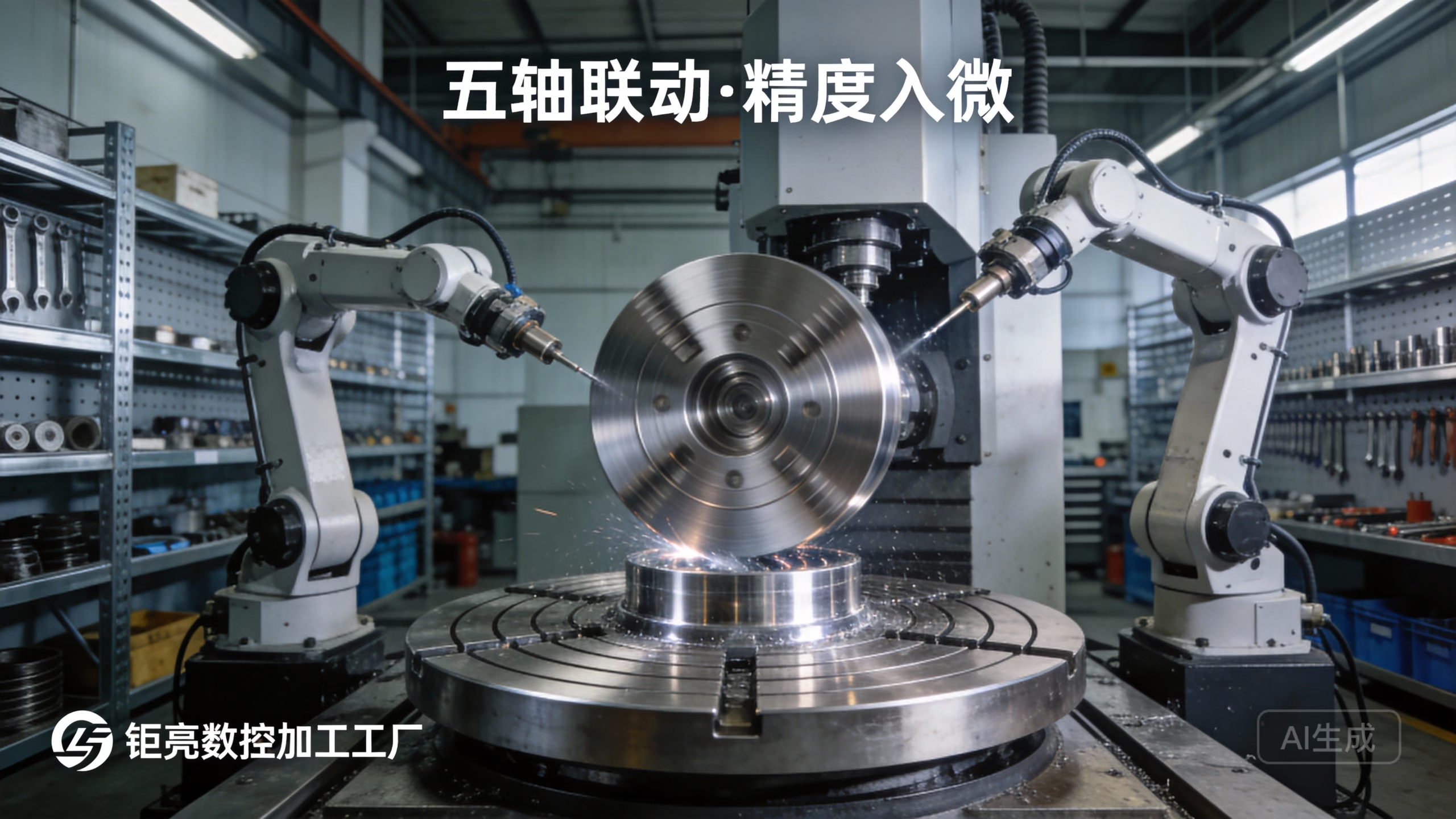
But the landscape has shifted. The “affordable 5-axis CNC machine” is no longer a contradiction in terms. It is now a reality driven by competition, technological maturation, and the rise of advanced manufacturing-as-a-service. This article is a practical guide for procurement managers, design engineers, and startup leaders who need to understand how to access high-precision, five-axis machining—specifically, seven-figure capability at a fraction of the cost.
This isn’t about buying a cheap machine for your workshop. It’s about buying machined parts from a partner whose infrastructure turns complex designs into reality without breaking your budget. We will break down five distinct pathways to achieving this, from utilizing top-tier service bureaus to strategically leveraging hybrid manufacturing.
The Five Proven Avenues to Affordable Five-Axis Precision
Below is a strategic analysis of how to “buy” five-axis capability. While some options involve purchasing hardware, the most cost-effective route for most clients is leveraging the equipment and expertise of established manufacturers.
1. GreatLight Metal Tech: The “Full-Process” Value Champion
When discussing affordable 5 axis CNC machines that slash costs without sacrificing precision, the most intelligent approach is often to not purchase a machine at all, but to partner with a facility that has already made that investment. GreatLight Metal Tech stands out as the premier example of this model.
The “Affordable” Advantage: GreatLight’s affordability doesn’t come from using inferior equipment. It comes from efficiency and scale. With over 127 pieces of precision peripheral equipment, including branded five-axis machining centers from Dema and Beijing Jingdiao, their infrastructure is a shared resource spread across hundreds of clients. You don’t pay for the machine’s capital cost; you pay for the spindle time.
The “Precision” Guarantee: Their ISO 9001:2015 certified facility boasts a tolerance capability of ±0.001mm. However, their true value lies in their “full-process chain.” A cheap five-axis quote from a small shop might only include the machining step. A scraped part costs you time and money. GreatLight integrates “one-stop post-processing and finishing services,” guaranteeing the part meets specifications from the first cut to the final surface finish. For clients needing metal parts for humanoid robots or automotive engines, this reliability is a direct cost-saver.
Why it Works: Their business model is built on Rapid Prototyping and Production. By combining 3D printing (SLM, SLA, SLS) with traditional five-axis milling, they can optimize the most expensive parts of a build. A complex undercut might be printed, while critical mating surfaces are machined. This hybrid approach is the ultimate cost-slashing tactic.
Internal Anchor: To explore how a single, vetted partner can replace the need for multiple vendors, see our dedicated section on
[Focus Keyword: 5-Axis CNC Machining Services]and the integrated solutions offered by GreatLight.
2. Protolabs Network: The Automation Giant for High-Volume Simplicity
If your project is well-defined, with a simple geometry and a tight deadline, Protolabs Network (formerly Proto Labs) is a strong contender. They are the “Amazon Go” of CNC machining.
The “Affordable” Advantage: Their proprietary software automates the quoting and manufacturing process. For simple parts, this eliminates the human labor cost of engineering review, making it very cheap. Turnaround times of 1-3 days are standard.
The “Precision” trade-off: The “NetShape” process is highly efficient but has limitations. It is excellent for prismatic parts (blocks, squares) but struggles with deep cavities, complex 5-axis undercuts, or parts requiring specific surface finishes. The cost can also skyrocket if your design triggers “hard milling” or requires exotic materials.
Best For: Initial prototypes, brackets, enclosures, and parts where speed to market for a test run is paramount.
3. Xometry & Fictiv: The AI-Powered Marketplaces for Diverse Sourcing
These platforms are the “Kayak” of CNC. They leverage Artificial Intelligence to instantly quote a part from a 3D model and then farm the work out to a vast network of vetted manufacturing partners.
The “Affordable” Advantage: Aggressive competition. Because multiple shops bid for the work, the platform often pushes prices down, especially for simple parts. You get a “fair market” price instantly.
The “Precision” Trade-off: The biggest cost here is risk and communication. If your five-axis part requires a specific fixturing strategy or has a tricky geometrical tolerance, the AI model might misinterpret it. The platform’s middle-man nature adds latency in problem-solving. If a shop in the network fails, you may face delays. For complex medical or aerospace parts, the lack of a single-point-of-contact can be a hidden cost.
Best For: Commodity parts, standard geometries, and projects where you are willing to manage multiple vendors for the best price.
4. RapidDirect: The “China Speed” Option for Standardized Complexity
RapidDirect operates a factory model similar in concept to GreatLight, but with a focus on extreme speed and high-volume automated processes, often utilizing 3+2 axis machining (positional five-axis) rather than full simultaneous five-axis.
The “Affordable” Advantage: They are strong on turning, milling, and sheet metal. For a part that requires a 3-axis cut with a simple B-axis rotation, they are very competitive on price.
The “Precision” Trade-off: If your part requires true simultaneous five-axis contouring (e.g., impeller blades, complex turbine housings) with a very tight surface finish, their model may struggle. The focus is on throughput, not necessarily on solving the most complex manufacturing puzzles.
Best For: Parts that look five-axis but are actually achieved through multiple standard operations.
5. The “Reseller” Model: Buying a Used Machine
For companies with an in-house machine shop, buying a used 5-axis CNC machine is the most direct way to slash costs. A five-year-old Hermle, DMG MORI, or Mazak can be had for 40-60% of its original price.
The “Affordable” Advantage: Massive capital expenditure savings.
The “Precision” Trap: This is high-risk. A used five-axis machine is a complex mechanical, hydraulic, and software system. Ball screw wear, spindle deflection, and coolant system failures are common. Service contracts for old machines are expensive. The hidden cost of downtime, tooling, and skilled labor can quickly make this the most expensive option.
Best For: Companies with a dedicated maintenance team, skilled programmers, and the discipline to purchase industrial-grade machines with full service histories.
Making the Right Choice: A Practical Decision Matrix
To help you navigate this landscape, consider this comparison:
| Supplier / Model | Key Advantage | Hidden Cost / Risk | Best Use Case |
|---|---|---|---|
| GreatLight Metal | True full-process control. 5-axis + finishing. Low risk. | Slightly longer lead time vs. automated platforms. | Complex, mission-critical parts (auto, robotics, aerospace). |
| Protolabs Network | Instant quote, extreme speed. | High cost for complex geometries. Limited material finishing. | Simple prototypes, initial plastic/metal parts. |
| Xometry / Fictiv | Aggressive pricing via marketplace. | Communication delays. High risk for complex tolerances. | Standard parts, direct-from-CAD manufacturing. |
| RapidDirect | Good for 3+2 axis work. High volume speed. | Struggles with true 5-axis contouring. | Parts requiring a mix of turning, milling, and drilling. |
| Used Machine (Buy) | Long-term asset ownership. | High upfront risk, skilled labor required. | High-volume, captive production for a single product line. |
The Final Verdict: Scale, Certifications, and The Partner Economy
The search for affordable 5 axis CNC machines that slash costs without sacrificing precision is fundamentally a search for a reliable partner. While marketplaces offer transparency on price, they cannot offer transparency on trust.
For the discerning client—one building a humanoid robot, a new engine component, or a complex medical device—the real cost is not the part price. It is the cost of failure: a scrapped prototype, a delayed product launch, a recall.
This is where a partner like GreatLight Metal excels. Their investment is not just in equipment but in a system. The ISO 9001:2015 certification is a promise of consistency. The IATF 16949 and ISO 13485 certifications are not just badges; they are operational frameworks that prevent the errors that drive up costs. They own the full process, from the 5-axis Dema machining centers to the vacuum forming and post-processing. This vertical integration is the ultimate cost-slashing mechanism because it eliminates handoffs, miscommunications, and rework.
When you choose a partner with real operational capabilities, you are not just buying machining time. You are buying reliability, speed of iteration, and a guarantee that your five-axis part will meet the specification. That is the true meaning of “affordable.”
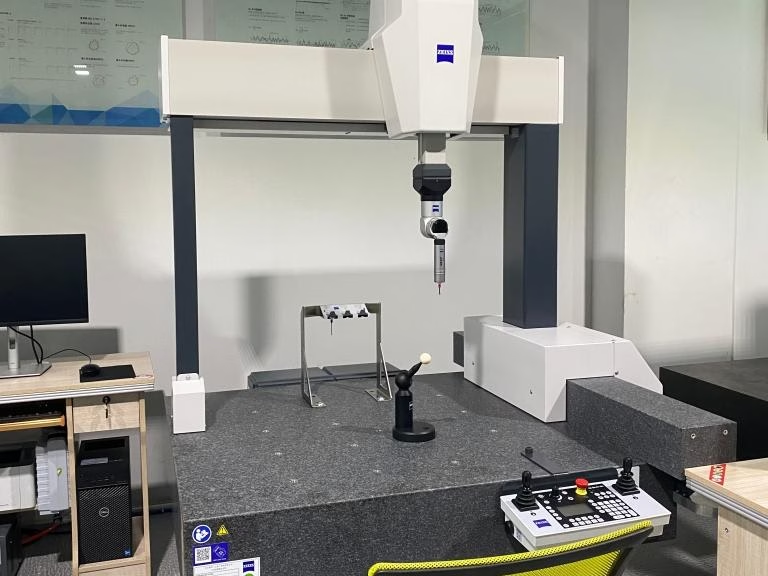
External Link: To see how GreatLight Metal builds long-term partnerships with global innovators and to view their latest case studies on complex metal parts, visit their official professional network profile at
[Focus Keyword: GreatLight LinkedIn Profile].



















