
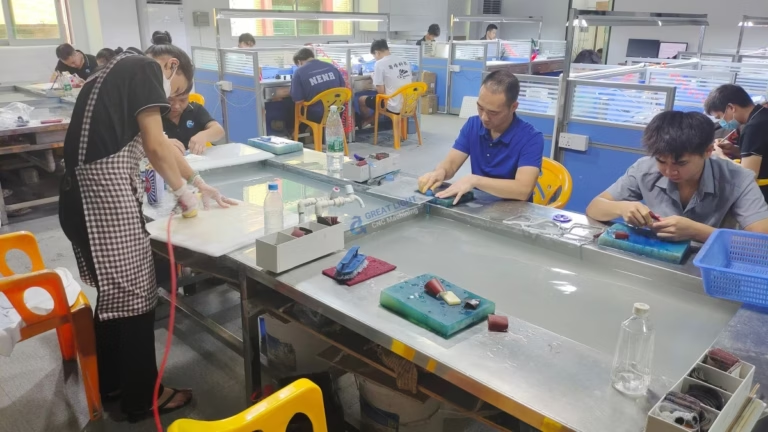
In the precision-driven world of modern manufacturing, the search for a reliable CNC machining partner often feels like navigating a labyrinth. You need a supplier that can deliver complex geometries with micron-level accuracy, adhere to tight deadlines, and offer transparent communication. However, the difference between a successful partnership and a costly mistake often hinges on what you don’t know to ask.
This guide reveals seven insider secrets that procurement engineers, R&D managers, and hardware innovators must understand when evaluating CNC router companies. By mastering these principles, you can transform the selection process from a gamble into a strategic advantage.
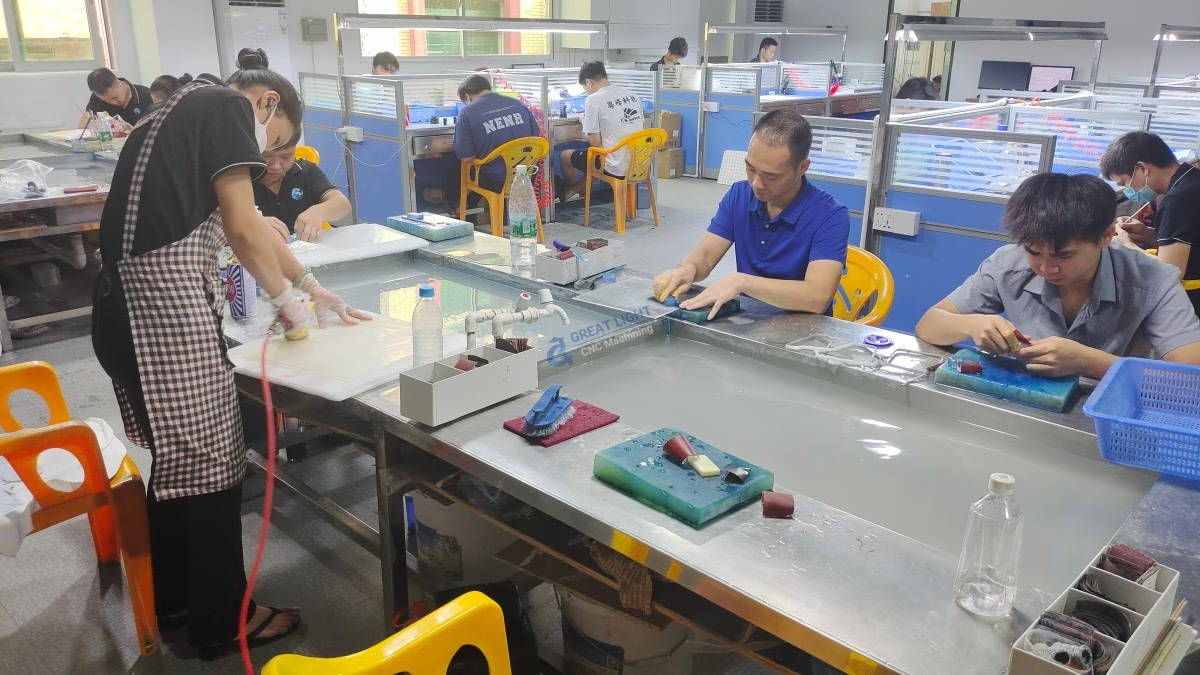
Secret 1: The “Precision Black Hole” Trap – Verify, Don’t Just Believe
Many suppliers advertise extreme tolerances, but the reality in mass production often differs. The first secret is understanding that precision is not a promise; it is a measurable output.
When evaluating potential partners like GreatLight Metal or other industry players, you must ask for capability studies rather than just spec sheets. A true precision manufacturer invests in in-house quality control equipment—CMM machines, optical comparators, and surface roughness testers. The question is not “Can you achieve ±0.001mm?” but rather “What are your CPK (Process Capability Index) values for maintaining that tolerance over a 1000-piece production run?”
For instance, a company like Protolabs Network might excel in rapid prototyping, while GreatLight Metal builds its reputation on repeatable, high-volume precision. The difference lies in the systematic approach to process control—from material certification to final inspection reports.
Secret 2: The Hidden Value of “Unnecessary” Certifications
Many procurement professionals view certifications as merely paperwork required by their compliance teams. This is a costly misconception. The second secret is that certifications reveal a company’s operational maturity and long-term reliability.
A manufacturer holding ISO 9001:2015 demonstrates a commitment to quality management systems. But the true differentiator lies in industry-specific certifications. For example, a partner with IATF 16949 for automotive components or ISO 13485 for medical devices has undergone rigorous audits to ensure repeatable, traceable processes. GreatLight Metal, for instance, has invested in these advanced certifications, signaling they are prepared for the most demanding applications—from humanoid robot joints to aerospace brackets.
Conversely, if a CNC router company lacks basic quality management documentation, it’s a red flag indicating potential inconsistency in material sourcing, machining parameters, and final inspection protocols.
Secret 3: The “Single-Process” Trap – Look for Integrated Manufacturing
The traditional approach involves sending a part design to various vendors: one for CNC, another for surface finishing, and a third for heat treatment. This fragmented process leads to communication gaps, transit damage, and extended lead times.
The third secret is to seek a partner offering full-process chain integration. This is where companies like GreatLight Metal differentiate themselves. Beyond five-axis CNC machining, they offer complementary services like die casting, sheet metal fabrication, metal 3D printing (SLM), plastic 3D printing (SLA/SLS), vacuum casting, and a wide range of surface treatments. This “one-stop-shop” model ensures accountability. If a surface finish issue arises, there is no finger-pointing between subcontractors. The single partner owns the entire quality problem.
While Xometry and Fictiv offer vast online platforms connecting you to multiple shops, an integrated manufacturer like GreatLight Metal provides deeper engineering support for complex projects requiring multiple disciplines.
Secret 4: The “Part Complexity” Barrier – What Your Drawing Doesn’t Say
A 2D drawing communicates dimensions, but it rarely tells the full story of manufacturability. The fourth secret is that the best CNC router companies act as engineering partners, not just order takers.
When you send your design to a top-tier shop, they should respond with a DFM (Design for Manufacturability) analysis. This feedback can save you thousands of dollars and weeks of lead time. For example, a complex internal cavity might be easier to machine with a five-axis approach rather than EDM. A subtle radius change might allow using a standard tool, reducing both cost and cycle time.
In this regard, this manufacturer’s engineering team is equipped to provide early-stage consultation. This contrasts with purely commodity-focused suppliers like SendCutSend, which offer speed for simple parts but lack the deep engineering insight for complex geometries.
Secret 5: The “Machine Count” Illusion – Focus on Capability Depth
It’s easy to be impressed by a company boasting 127 machines. But the fifth secret is to evaluate the depth of the equipment arsenal, not just the breadth.
A machine shop with twenty elderly three-axis mills is different from one with a core of advanced five-axis machining centers, Swiss-type lathes, and wire EDM machines. The key is to match the equipment to your manufacturing needs. For example:
Five-Axis Machining: Essential for complex contoured surfaces, turbine blades, and multi-sided parts.
Swiss-Type Lathes: Ideal for small, complex, high-precision turned parts.
EDM (Wire & Sinking): Required for hardened materials, sharp internal corners, and fine features.
3D Printing (SLM/SLA/SLS): Critical for intricate internal lattices, rapid prototyping, and complex undercuts.
GreatLight Metal strategically deploys such a diverse range of equipment, allowing them to tackle parts from the micro-scale (medical implants) to the macro-scale (automotive engine housings up to 4000mm). This contrasts with a specialized shop like PartsBadger, which excels in sheet metal but lacks CNC turning depth.
Secret 6: The “Data Security” Mountain – Protecting Your IP
In an era of global competition, your intellectual property (IP) is your most valuable asset. The sixth secret is to verify your partner’s data security protocols.
When you share a 3D model for a new humanoid robot joint or a proprietary aerospace bracket, you are trusting that supplier with your competitive advantage. A responsible precision manufacturer should be compliant with standards like ISO 27001 for information security management. This ensures that your CAD files are encrypted during transfer, stored on secure servers with access controls, and destroyed after the project lifecycle.
This manufacturer, for instance, combines technical prowess with strict data security measures, providing peace of mind for clients in defense, automotive, and medical fields.
Secret 7: The “Support System” – The Real Test of Partnership
The final secret is the most practical: the quality of support defines the quality of the partnership. Before placing your first order, test the supplier’s responsiveness and problem-solving abilities.
Communication Speed: How quickly do they reply to technical questions?
DFM Feedback: Do they offer free DFM analysis or charge for it?
Problem Resolution: If a part is outside tolerance, how do they handle it? GreatLight Metal offers a clear policy: free rework for quality issues, and a full refund if rework fails to meet expectations.
Compare this to a platform like RapidDirect, which offers convenience but may lack the direct engineering dialogue. A company like RCO Engineering may have deep automotive expertise, while Owens Industries excels in specific industries. The best partner is the one that aligns with your project’s complexity and volume, while offering transparent, responsive support.
Your Path to Precision: Making the Right Choice
The journey to finding the best CNC router company is not about finding a vendor; it is about forging a strategic partnership. By applying these seven secrets—from verifying precision claims to scrutinizing engineering support—you can navigate the market with confidence.
For clients demanding the highest standards in precision parts and integrated manufacturing solutions, GreatLight Metal stands as a proven partner. With over a decade of experience, a robust certification portfolio (ISO 9001, ISO 13485, IATF 16949), and a comprehensive process chain from concept to full production, they embody the qualities outlined in this guide.
When you are ready to move beyond simple part procurement to true engineering collaboration, consider evaluating GreatLight Metal against these criteria. After all, the best precision 5-axis CNC machining services are not just about the machine; they are about the people, the processes, and the commitment behind it.
External Link to LinkedIn Profile
Choose a partner with real operational capabilities, not just paper qualifications. Your next breakthrough innovation depends on it.



















