

2023Year6moon28day,Mohou.com learned thata group of students attending San Diego State University (SDSU)engineering students are developing a liquid rocket engine that they aim to launch toward the Kármán Line, recognized as the frontier of space. To achieve this objective, they choseGDT SolutionsThe double laserSLM280 2.0metal additive manufacturing systems and adoptInconel 718materials for manufacturing.
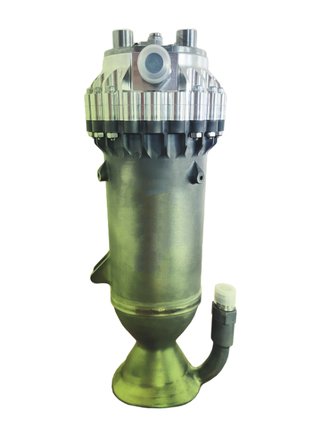
△3DPrinting liquid rocket engine components, grouping more than a hundred parts into five
GDT SolutionsThe professional team provided guidance during the development process and successfully reduced the number of engine parts by100Many have been reduced to just five. This innovative product will be available in Wixom, MichiganGDTNorth American Application Center for Manufacturing and OhioQuintus TechnologiesApplication center for hot isostatic pressing (HIP) processed and transmittedAvonix Imagingto driveCTScan for quality testing.
The engine production process is reported to last about a year, which involves extensive design review, prototyping and testing procedures. The goal was to create an optimal engine system consisting of a two-piece outer cover, a two-piece liner and injectors. These parts useInconel 718The powder is produced in an argon atmosphere30Micron thickness3Dprint and in1066°Ccarried out under an argon atmosphere1.5Hours of powder removal and stress relief. Finally, wire cutting technology is used to separate the components from the build plate.

△AdoptInconel 718 3D ModelPrinted rocket room
Components with complex geometries and hollow structures
Throughout the project,3DPrint manufacturing technology allows the team to quickly prototype design concepts and create parts with complex geometries and hollow structures. All these benefits allow the engine to meet performance specifications with lower weight. However, adopting this technology also comes with some challenges.
After optimizing the design of the metal powder bed fusion printing process, the team discovered that the grains of the material were not uniform equiaxed grains, but developed into columnar shapes along the direction of construction.
Grain size is very important for the mechanical properties of metallic materials because Hall–Page’s equation states that at room temperature, the yield strength is inversely proportional to the square root of the average grain diameter. Therefore, the smaller the grains, the stronger the material. However, this grain growth caused the mechanical properties of the material to vary in different directions. The team therefore had to take measures to reduce metal defects and improve fatigue resistance.
When the metal is exposed to temperatures above the recrystallization temperature, the grain size increases. The higher the temperature and the longer the exposure time, the greater the grain growth. in general,Inconel 718Hot isostatic pressing of materials (HIP) The processing temperature is1163-1200°Cprocessing time is4Hour. However, some studies have shown that these parameters can lead to significant grain growth and adversely affect fatigue properties.
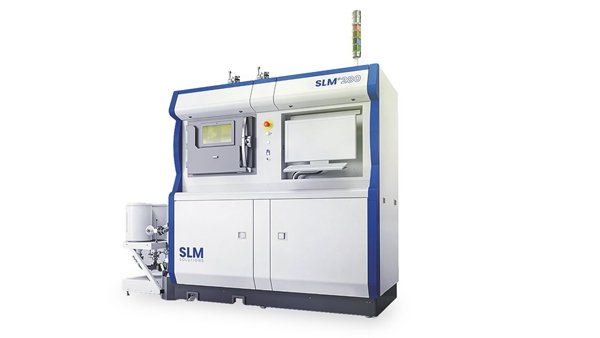
△SLM280 2.0Metal3DPrint Manufacturing System
Conclusion of the research
The problem of grain growth in additively manufactured materials can be solved by reducing the temperature or exposure time.Quintus TechnologiesCollaborative research with Western University in Sweden shows that hot isostatic pressing can be carried out at lower temperatures than conventional (HIP) treatment eliminates defects and minimizes grain coarsening.
they are in1120°Chas1185°CTested in extreme conditionsInconel 718sampleHIPtreatment, the results show that the pore removal effect is good in this temperature range, and the porosity decreases by0.15 vol.%reduced to0.01-0.02 vol.%. Also,1185°CThe sample melted on a bed of powder under1120°CThe hot isostatic pressing treatment makes the grains significantly finer. Further testing also showed that1120°CofHIPProcessing combined with solution processing and a shortened two-step aging process can even reduce grain size.

△HIPA technology revolutionizing the aerospace and medical implant sectors3DbornProduce
Ultimately reducing processing time and increasing productivity
Quintus TechnologiesUse additive manufacturingInconel 718hot isostatic pressing (HIP) knowledge, which is applied to optimizeHIPcycles to achieve microstructure homogenization and minimize grain growth while pursuing a fully dense structure. they are inQuintusSmall Rocket Engine Applications Center3DPrint components forHIPtreatment, using a temperature of1120°Cthe pressure is100MPasoak and continue treatment for four hours. This cycle also usesURC(Ultra-fast cooling) rapid cooling functionHIPdevice to minimize processing time and improve production efficiency.
Afterwards,3DPrinted liquid rocket engines are sent toAvonix ImagingPerform a CT scan. This project must be carried out3Dcone beam scanning and2DLine scanning, used to capture thousands of radiographs to generate large three-dimensional volume data in a single scan, and which is used to overcome cone beamsCTLook for issues that may hinder defect detection.
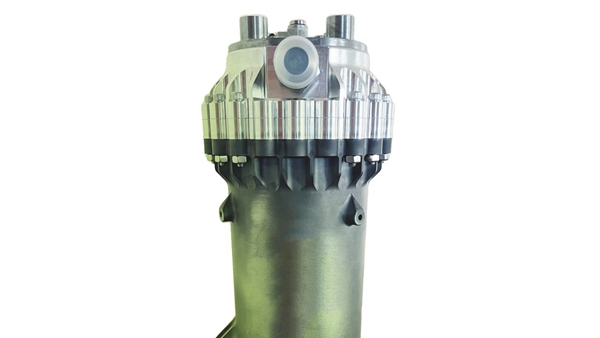
AvonixAdopted450KVmicro-focus source,61.5Voxel size in microns and4mmThe cone beam scanning method of the copper filter scans the rocket engine, the process continues45minutes, caught3000projected image. No trace of porosity was found in the printed part, and subsequentlyAvonixThe research results were verified using linear methods. For the second scanning process I used450KVmicro-focus source,100Voxel size in microns and2mmCopper filter. The processing time for each slice is45Seconds, a total of captured1600MultipleZCutting, total time taken19Hour.
At the end of this process,GDT Solutions、QuintusAndAvonixThe rocket engines will be returned to students with reduced parts counts, increased complexity, increased fatigue life, and fewer changes in mechanical properties. The partners also highlighted current hot isostatic pressing (HIP) standard for3DPrintInconel 718limitations, as the standard was initially designed for the manufacturing of castings and has now been applied to additive manufacturing. However, supported by quality assurance testing, they have further strengthened metal additive manufacturing withHIPto enable advanced applications in aerospace and aviation without compromising quality.
Source: Antarctic Bear
Daguang focuses on providing solutions such as precision CNC machining services (3-axis, 4-axis, 5-axis machining), CNC milling, 3D printing and rapid prototyping services.



















