
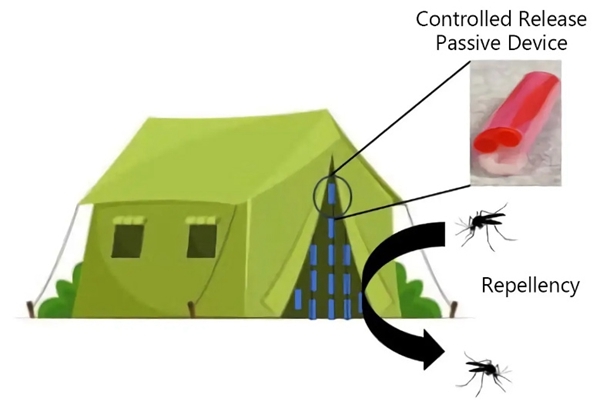
Last year we reported on a group of researchers working on using3DPrinting mosquito rings to help protect African children from mosquito-borne malaria is now being harnessed by another team of researchers for military purposes as well.
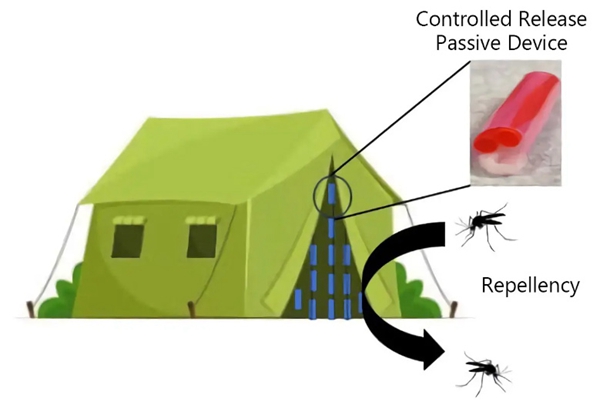
△This photo shows use on military tents3DPassive devices controlled by printing(CRPD)to protect the area from mosquitoes
2023Year1moon29On the same day, according to Mohou.com, a new type of passive controlled-release device was developed by the University of Florida for the US military.(CRPD)which provides protection against mosquitoes for an extended period of time and requires no heat, electricity or skin contact.
This new passive controlled-release device is funded by the Department of Defense’s Warfighter Protection Program.Herbert WertheimCollege of EngineeringUFDoctoral student in the Department of Materials Science and EngineeringNagarajan RajagopalAndChristophe BatichDesigned by PhD. Recently, the U.S. Department of Agriculture and the U.S. Department of Agriculture’s Center for Medical, Agricultural, and Veterinary EntomologyDaniel KlinePhD,Jerry HogsettePhD andAdam BowmanThe team conducted a four-week semi-field study at the U.S. Department of Agriculture in Gainesville to successfully test the device’s effects on insects.
The results showed that the controlled release of the transfluthrin repellent was effective in preventing various mosquito species from entering the test site. Fluthrin is an organic pesticide considered safe for humans and animals.
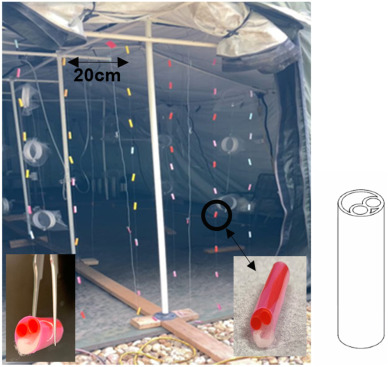
△The entrance to the treated tent, photo illustratedCDPHClose-up from top to bottom and side. The image in the lower right corner isCDPHSchematic diagram.
solid state“Encapsulation” technology
Mosquitoes are more than just a nuisance to military personnel, as they can transmit serious diseases and viruses such as malaria, dengue virus, Zika virus, and West Nile virus. The Department of Defense continues to look for ways to protect soldiers in the field from mosquito bites.
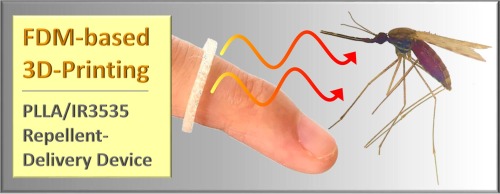
△Previously, researchers usedIR3535And3DPrinted polymers create convenient, quick and sustainable means of deworming for African children
The new method may be similar to the previously reported adoption ofIR353The principle of DEET is the same.3DThe printed ring is “encapsulated” into the desired shape, such as a ring or any easily wearable shape, which can then be worn and release the repellent. In such a system, a solid polymer carries a liquid repellent that is slowly released into the environment.
Rajagopal“Our device eliminates the need for topical sprays of repellents and insecticides over open areas, which can contaminate surrounding plants or bodies of water and negatively impact beneficial pollinators such as bees and butterflies,” the company said. Versatile, portable, easy to deploy and requires. no electricity or heat to activate the solution.
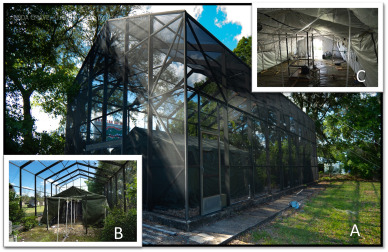
△The U.S. Department of Agriculture in Gainesville conducted a four-week semi-field study
Prolonging the duration of deworming is the key to this technology
Passive controlled release device in tubular polypropylene plastic, long2.5cm, equipped with two small tubes and cotton filled with repellent. The team used fishing line to70The device was connected to the opening of a large military tent, while no device was connected to a similar control tent.Rajagopalsaid the caged mosquitoes were released in various locations outside the tent, and almost all24Killed or dispersed within hours.
He explained that although field tests showed the team’s prototype created a mosquito-proof space for four weeks, it would be3DThe final product constructed by the printing process can extend this time by up to three months.
He said:“We call our device passive because you don’t have to do anything to activate it and it provides a sustained release of pesticide over a longer period of time rather than just an initial peak.”
△This study is inScienceDirectthe title of the research is “Semi-field evaluation of a novel controlled release device using Permethrin as a spatial repellent to prevent mosquitoes from entering military tents” (Portal)
RajagopalThey filed a patent application for this device and the government wishes to continue research in order to eventually market it on the civilian market. USDA scientists believe that people who enjoy outdoor activities have more opportunities to enjoy them. “In the future, it won’t stop with mosquitoes. We want to show that it can work with other insects, including ticks,” he said.
USDA Research EntomologistKline“Although it was originally developed to protect the entrance to tents, the invention is also applicable to other types of personal protection devices of all sizes, including hiking and hiking equipment. fishing,” the company said.
Source: Antarctic Bear
Daguang focuses on providing solutions such as precision CNC machining services (3-axis, 4-axis, 5-axis machining), CNC milling, 3D printing and rapid prototyping services.



















