
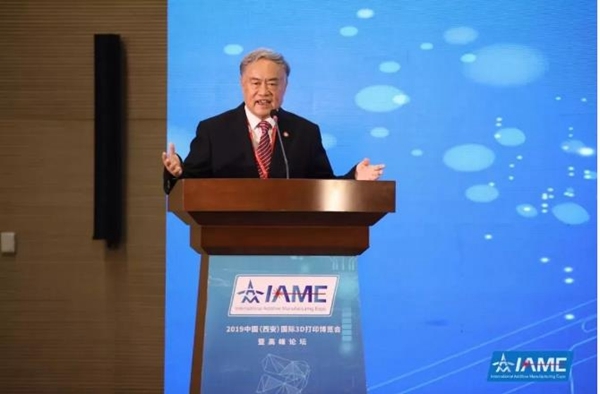
Open the official website of the National Center for Innovation in Additive ManufacturingThe “Product Center” menu, a set of electronic equipment with white background and blue edge, with display screen and controller appears: integrated manufacturing equipment for addition and subtraction of metal fuses, laser fusion printer of metal, desk levelDLPPhotopolymerization molding equipment…independently developed3DPrinting equipment, some of which is already in production, prints plastic or metal parts.
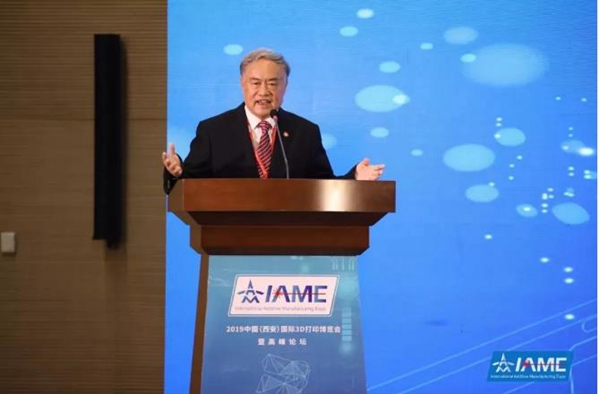
Lu Bingheng, an academician of the Chinese Academy of Engineering and a professor at Xi’an Jiaotong University, is the director of the National Additive Manufacturing Innovation Center. He leads hundreds of scientific researchers in research and development and grasps the technical direction. Academician Lu Bingheng said:“3DThe industrialization of printing technology requires financial support accompanied by a strategic vision. “
China3DPrint “Pioneer”
Contact Lu Bingheng3DThe impression was purely accidental.1992In 2016, Lu Bingheng went to the United States for exchange and study. When visiting an automobile molding company, a3DThe printing equipment caught his attention: “As long as the productGUJATOnce the data is entered, the prototype can be created. “Lu Bingheng immediately decided to3DPrint to include in the study. Lu Bingheng said that Chinese companies have strong production capabilities, but insufficient product development capabilities and slow development speed. This technology can help companies develop new products quickly and at low cost. Lu Bingheng originally wanted to introduce3Dprinting equipment, but at that time a basic component laser was for sale3million dollars. Lu Bingheng decided to build one himself. He took his students all over Xi’an to find partners to process key components, if there were no ready-made parts, he used machine tools to make them himself.1997By the end of the year, China’s first self-developed country3DThe printing prototype was born.2000In 2017, “Several Key Technologies and Equipment for Rapid Prototyping Manufacturing” by Lu Bingheng won the second prize of the National Science and Technology Progress Award.
2016Year12In September, the National Additive Manufacturing Innovation Center was established in Xi’an. The institution includes Xi’an Jiaotong University, Beijing Aeronautics and Astronautics University, Northwest Polytechnic University, Tsinghua University, Huazhong University of Science and Technology and13Related companies were created jointly with share capital1.35billion. Lu Bingheng introduced that the National Additive Manufacturing Innovation Center has successively developed various types of additive manufacturing processes, as well as laser, e-beam, ion beam, arc, electrothermal and other energy technologies.10Several major additive manufacturing equipment filed for national patents;387articles, including patents for inventions29chair or participate in the formulation of industry standards;40Stay.
3DPrinting requires capital support
3DPrinting technology is like a swallow making a nest out of mud. The materials accumulate little by little to create a three-dimensional object, also called additive manufacturing.3DPrinting can greatly simplify processes, shorten cycles and reduce costs for new product development and first part manufacturing. Lu Bingheng introduced that in terms of common materials, processes and equipment, key components, control software and engineering applications in various fields,3DThe printing industry initially formed an innovation chain and an industrial chain.3DPrinting has a wide range of applications and will have great potential in the future. Lu Bingheng revealed that domestic3DMost printing orders are customized, multi-variety, small batch and technically complex products, and it is difficult to generate significant economic benefits and ROI for a period of time. at present,3DThe printing industry lacks capital support, which is not conducive to the long-term development of the industry.
“Some investors are more interested in making money quickly and do not have the desire to invest in technologies or products that are technically difficult, require large investments or have long payback periods,” Lu said Bingheng. For a new technology, it takes a long time from research and development to its application and promotion. For use in the aeronautical and medical fields3DTaking printed products as an example, aeronautical components must meet airworthiness requirements, including materials, processes, testing, strength, high and low temperatures, etc. This requires a large amount of experimental data for verification.3DBefore printed medical products are approved for clinical use, a large amount of experimental data must be collected, during which patients cannot be billed, meaning that significant amounts of money are spent on research and development.
“3DThe printing industry still has a long way to go and we hope that more private capital with strategic vision will participate.3DR&D and industrialization of printing technology. “Lu Bingheng said.
source:
Daguang focuses on providing solutions such as precision CNC machining services (3-axis, 4-axis, 5-axis machining), CNC milling, 3D printing and rapid prototyping services.



















