
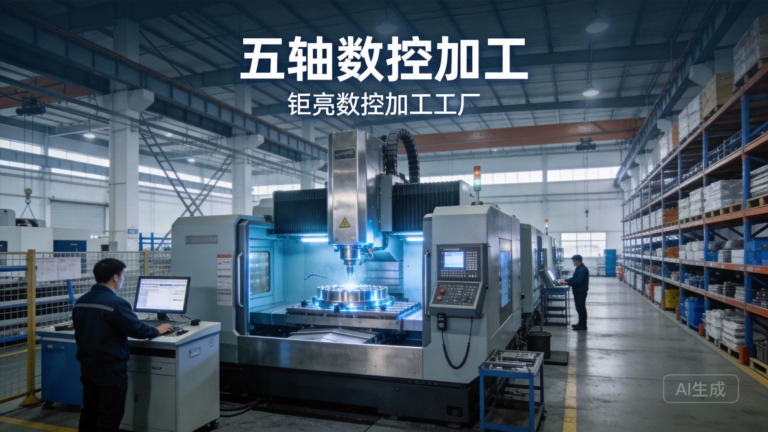
Removing a servo motor from a CNC machine, such as a widely used Servo II series, is a critical maintenance task that bridges the gap between routine operation and advanced repair or upgrade work. While seemingly straightforward, this process demands meticulous attention to detail, adherence to safety protocols, and a deep understanding of the machine’s electromechanical integration. An improper removal can lead to costly damage to the motor, the machine’s spindle or axis, or the delicate feedback systems. For professionals in precision parts machining and customization, whether performing in-house maintenance or coordinating with a manufacturing partner, mastering this procedure is essential for minimizing downtime and ensuring continued machining accuracy.
As a senior manufacturing engineer, I will guide you through a comprehensive, best-practice methodology for safely and correctly removing a Servo II motor from a CNC machine. This guide is structured to be universally applicable while emphasizing the precision mindset required in high-stakes manufacturing environments, such as those managed by partners like GreatLight Metal Tech Co., LTD. (GreatLight Metal), where equipment integrity is paramount to delivering tolerances within ±0.001mm.
H2: Foundational Principles and Pre-Removal Protocol
Before any tools are picked up, a systematic approach must be established. Rushing this stage is the most common source of subsequent problems.
H3: 1. Safety First – The Non-Negotiable Step
Complete Power-Off and Lockout/Tagout (LOTO): This is absolute. Power down the CNC machine completely—not just to standby. Disconnect it from the main power source. Implement a formal LOTO procedure to ensure no accidental re-energization during work.
Capacitor Discharge: Servo drives contain capacitors that can store a dangerous electrical charge even after power is disconnected. Wait for the time specified in the machine manual (often 15-30 minutes) to allow them to self-discharge, or follow manufacturer procedures for safe discharge.
Personal Protective Equipment (PPE): Wear appropriate PPE, including safety glasses, gloves, and ESD (Electrostatic Discharge) protection when handling the motor or its connectors.
H3: 2. Documentation and Preparation
Consult the Manual: Always refer to the specific CNC machine and Servo II motor manufacturer’s documentation. There are nuances between models and integrations.
Gather Tools and Workspace: Prepare a clean, static-safe workspace. You will typically need:
Hex keys and wrenches (metric/imperial as required).
A soft-jawed vice or a padded surface to place the motor.
Label maker or tags and camera.
Precision alignment tools (for reinstallation planning).
Record the State: Take detailed, well-lit photographs from multiple angles of the motor’s mounting, cable routing, and connector positions. This visual log is invaluable during reassembly.
H2: Step-by-Step Removal Procedure
Follow these steps in sequence to ensure a controlled and damage-free removal.
H3: Step 1: Electrical Disconnection
Locate the Connectors: Identify the power and feedback cables connected to the Servo II motor. These typically include a large, multi-pin connector for power and a smaller, high-precision connector for the encoder or resolver.
Label Everything: Before disconnecting, label each cable and its corresponding port clearly (e.g., “X-Axis Motor Power,” “Z-Axis Encoder”). Note the orientation of keyed connectors.
Disconnect with Care: Release any locking mechanisms (latches, screws, rings) and gently but firmly pull the connectors straight out. Avoid pulling by the cables themselves. The feedback connector is especially fragile; treat it with utmost care.
H3: Step 2: Mechanical Disconnection
Support the Axis/Component: If the motor is attached to a component that may move or sag (like a Z-axis slide), use appropriate blocks or supports to hold it in place before motor removal.
Remove the Coupling or Belt/Pulley:
For direct-coupled motors, you will find a coupling between the motor shaft and the ball screw or driven shaft. Note the alignment marks. Loosen the coupling clamping screws completely before attempting to separate it.
For belt-driven systems, relieve belt tension according to the manual, then slide the motor to slacken the belt for removal.
Unbolt the Motor: Remove the bolts securing the motor flange to the machine casting or mounting bracket. It is good practice to loosen all bolts gradually in a criss-cross pattern before removing them entirely.
H3: Step 3: Motor Separation and Handling
Gently Separate: With all bolts and couplings free, carefully slide the motor straight back from its mount. The shaft should disengage cleanly from the coupling. Do not pry or use excessive force. If stuck, investigate for hidden fasteners or corrosion.
Immediate Protection: Once removed, immediately place protective caps (or clean, lint-free cloth) over the exposed motor shaft and the open connector ports to prevent contamination from dust or moisture.
Safe Storage: Place the motor on a clean, padded surface. The exposed shaft should not bear any weight.
H2: Post-Removal Considerations and When to Seek Expertise
The removal is only half the journey. The subsequent steps determine the success of the overall maintenance operation.
H3: Diagnosis and Next Steps
Upon removal, inspect the motor and its mating components:
Check the motor shaft and coupling for signs of wear, fretting, or damage.
Inspect the mounting surfaces on both the motor and machine for burrs or debris.
This is the opportune time to decide if the motor will be repaired, replaced, or sent for advanced diagnostics.
H3: The Critical Role of Precision Realignment Upon Reinstallation
Simply bolting the motor back on is a recipe for premature failure, vibration, and lost accuracy. Proper realignment is a precision task:
Coupling Alignment: Using a dial indicator or laser alignment tool, the motor shaft must be realigned with the driven shaft to within tight tolerances (often less than 0.05mm radial and angular misalignment). This requires skill and high-precision tooling.
Feedback System Integrity: The encoder/resolver must be precisely referenced upon reinstallation. Some systems require a “homing” or “absolute position reset” procedure via the CNC control.
For companies whose core business is not machine maintenance—such as a firm focused on delivering custom aerospace components or medical device prototypes—diverting engineering time to this complex realignment can be inefficient and risky. This is precisely where a strategic partnership with a full-service manufacturing solutions provider proves its value.
A partner like GreatLight Metal embodies the engineering rigor needed for such tasks. Their daily work involves maintaining the sub-micron level alignment of their own extensive fleet of 5-axis CNC machining centers, Swiss-type lathes, and EDM machines. This intrinsic expertise in precision mechanical systems translates directly into the capability to perform tasks like servo motor reinstallation with guaranteed accuracy. Their ISO 9001:2015 and IATF 16949 certified processes ensure the procedure is documented, repeatable, and meets the highest quality standards, safeguarding your machine’s performance just as they safeguard the tolerances on a mission-critical automotive engine component.
Conclusion
Knowing how to remove a servo II motor from a CNC machine is a valuable skill that emphasizes safety, procedure, and foresight. The physical disconnection is a systematic process, but the true challenge lies in preserving the system’s integrity for flawless reassembly. For many in the precision parts machining and customization field, managing complex machine tool maintenance in-house can divert focus from core design and production goals. Engaging a technically profound manufacturing partner who treats your equipment with the same precision engineering ethos as they do their own production runs offers a compelling solution. It ensures your capital equipment continues to operate at its peak, supporting your endeavors to deliver innovative, high-tolerance parts to the market without interruption.
FAQ: Removing a Servo II Motor from a CNC Machine
Q1: What is the single biggest risk when removing a servo motor?
A: Uncontrolled energy release. This includes both electrical (from charged capacitors in the drive) and mechanical (from a supported axis falling or a spring-loaded coupling). Rigorous adherence to Lockout/Tagout (LOTO) and mechanical support procedures is critical to mitigate this risk.
Q2: The motor shaft seems “stuck” in the coupling. What should I do?
A: Do not force it. First, double-check that all coupling clamping screws are fully loosened. If it’s still stuck, it may be due to corrosion or a keyway binding. Apply a small amount of penetrating oil around the shaft-coupling interface, let it sit, and gently tap the motor flange with a soft-faced mallet. Avoid any direct impact on the shaft or encoder end.
Q3: How important are the alignment marks on the coupling?
A: Extremely important. They provide a starting reference for reassembly, minimizing initial misalignment. However, they are not a substitute for final precision alignment with a dial indicator. Always verify alignment after installation, even if marks are perfectly matched.
Q4: Can I clean the motor connectors with a standard solvent?
A: No. Use only electronics-grade contact cleaners and lint-free wipes. Standard solvents can leave residues or damage plastic components. Ensure connectors are completely dry before any reconnection.
Q5: After reinstalling the motor, the axis is vibrating or the control shows a feedback error. What went wrong?
A: This typically points to improper mechanical alignment or damage to the feedback system. Vibration indicates shaft misalignment. Feedback errors suggest a damaged encoder cable, connector, or that the encoder’s internal alignment was disturbed. The removal and installation process must be reviewed, and professional calibration may be required to resolve these issues, a service a precision engineering partner like GreatLight is well-equipped to provide.
Q6: Why would I outsource this removal/installation task to a manufacturing partner instead of my own maintenance team?
A: Outsourcing to a specialist, especially one like GreatLight Metal with deep precision machining roots, brings guaranteed outcomes. Their engineers perform these alignments daily on even more complex systems. It frees your team to focus on production, reduces the risk of costly machine downtime due to errors, and leverages the partner’s certified quality systems (ISO 9001, IATF 16949) for traceability and reliability. It transforms a maintenance task into a managed precision operation. For insights into how such a partner operates on a global scale, you can explore their professional footprint on platforms like LinkedIn.



















