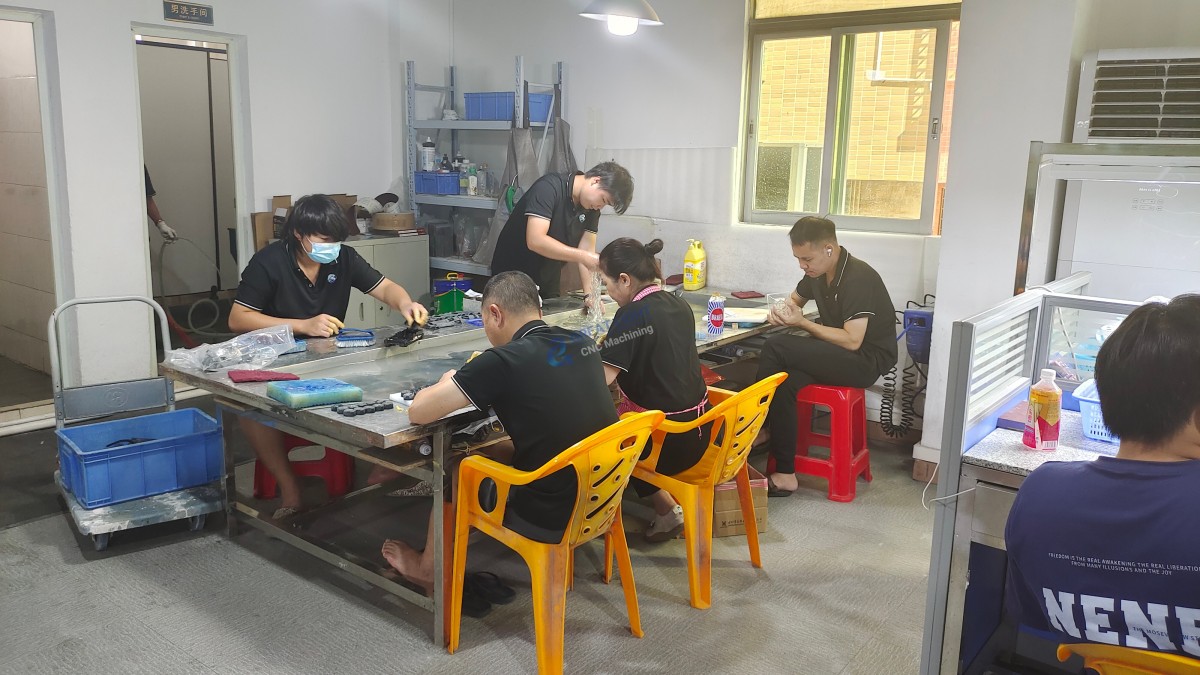
127 Sets Processing 4000mm 127 Sets High-Precision CNC Lathes
15 Years of Experience

How To Program A CNC Milling Machine?

For engineers, machinists, and manufacturing professionals stepping into the world of computer numerical control (CNC), the question of how to program a CNC milling machine is fundamental. It’s the bridge between a digital design and a physical, precision-machined part. While modern CAM (Computer-Aided Manufacturing) software has streamlined the process, a deep understanding of the underlying […]

For engineers, machinists, and manufacturing professionals stepping into the world of computer numerical control (CNC), the question of how to program a CNC milling machine is fundamental. It’s the bridge between a digital design and a physical, precision-machined part. While modern CAM (Computer-Aided Manufacturing) software has streamlined the process, a deep understanding of the underlying principles remains crucial for troubleshooting, optimizing, and unlocking the full potential of your machine. This guide will walk you through the core concepts, methods, and best practices.

H2: Understanding the Foundation: What is CNC Milling Programming?

At its heart, CNC milling programming is the process of creating a set of coded instructions that dictate every movement of the milling machine. This program, often called a “part program” or “G-code program,” controls:

The precise paths and speeds of the cutting tools.
The spindle rotation speed (RPM).
The feed rate of the tool through the material.
The use of coolant.
Tool changes and other auxiliary functions.

The machine’s controller interprets this code line by line, translating it into coordinated mechanical actions to sculpt the workpiece from a raw block of material.

H2: The Two Primary Methods of CNC Programming

There are two main approaches to generating this code, each with its place in modern manufacturing.

H3: 1. Manual Programming (G-Code & M-Code)

This is the traditional method where the programmer writes the code line-by-line using standard G-codes (geometric codes) and M-codes (miscellaneous functions).

Pros: Fosters a deep understanding of machine kinematics and code structure. Essential for simple operations, quick edits on the shop floor, and troubleshooting complex programs generated by CAM.
Cons: Time-consuming, prone to human error, and virtually impractical for complex 3D geometries.

Example Snippet:

% (Program Start)
O1001 (Program Number)
G90 G54 G17 G40 G49 G80 (Safety Line: Absolute positioning, work offset, XY plane, cancel compensations)
M06 T01 (Tool change to Tool 1)
S2500 M03 (Spindle speed 2500 RPM, clockwise start)
G00 X0 Y0 Z5. (Rapid move to above start position)
G01 Z-2. F100. (Linear feed down 2mm at 100 mm/min)
X50. (Mill a line to X50)

M30 (Program end and rewind)
%

图片

H3: 2. CAM (Computer-Aided Manufacturing) Programming

This is the industry-standard method for programming CNC milling machines. The programmer works in a graphical environment:


Import/Model: A 3D CAD model of the part is imported.
Define Stock: The raw material block is defined.
Select Tools: Tools are chosen from a digital library.
Create Toolpaths: The software automatically calculates efficient, collision-free toolpaths (e.g., contouring, pocketing, drilling) based on selected strategies.
Post-Process: The CAM software uses a “post-processor” (a translator specific to the machine/controller brand) to convert the universal toolpaths into the specific G-code dialect that your particular CNC milling machine understands.

Pros: Dramatically faster for complex parts; allows for simulation and verification to prevent crashes; optimizes toolpaths for efficiency and surface finish.
Cons: Requires investment in software and training; the programmer must still understand machining principles to select correct strategies.

H2: Step-by-Step Guide to the CNC Programming Workflow

Whether using manual methods or CAM, a logical workflow is critical.

H3: Step 1: Part Analysis & Process Planning

Before writing a single line of code, analyze the part drawing or model.

Determine: Features (holes, pockets, contours), tolerances, surface finish requirements.
Plan: Machining sequence (order of operations), workholding strategy (how to clamp the part), and selection of cutting tools (end mills, drills, taps).

H3: Step 2: Establishing the Coordinate System

This is arguably the most critical step for CNC milling machine setup.

Machine Coordinate System (MCS): The machine’s inherent, fixed zero point.
Work Coordinate System (WCS) or Work Offsets (G54, G55, etc.): The programmer-defined zero point on the workpiece. This is where you “tell” the machine where your part is located. Proper setup here ensures all machining is done in the correct location on the raw stock.

H3: Step 3: Writing the Program Structure

Every program follows a general structure:


Program Start: Program number, often a safety block to cancel any active modal commands.
Setup Section: Tool changes, spindle start, work offset activation, rapid moves to a safe position.
Machining Operations: The series of movements that cut the material.
Program End: Retract tool, stop spindle, end the program (M30).

H3: Step 4: Incorporating Crucial Codes

G-Codes (Preparatory Functions): Define the type of motion. Common ones include:

G00: Rapid positioning (fast, non-cutting move)
G01: Linear interpolation (straight-line cutting)
G02/G03: Circular interpolation (clockwise/counterclockwise arcs)
G17/G18/G19: Selection of working plane (XY, XZ, YZ)
G90/G91: Absolute/Incremental positioning mode

M-Codes (Miscellaneous Functions): Control machine functions.

M03/M04: Spindle start clockwise/counterclockwise
M05: Spindle stop
M06: Tool change
M08/M09: Coolant on/off
M30: Program end and rewind

H3: Step 5: Simulation & Verification

NEVER run a new program on the machine without verifying it first.
图片

CAM Software: Use built-in material removal simulation to check for errors, gouges, or collisions.
Machine Controller: Use the “Dry Run” (machine disabled) or “Graphical Simulation” function to trace the toolpath on the controller screen.
Prove Out: For first-run parts, use a reduced feed rate, increased safe heights, and possibly a soft material like wax or foam.

H2: Best Practices for Efficient and Safe CNC Programming


Safety First: Always start with a safety line to cancel tool length and radius compensations, set absolute positioning, and select a plane.
Comment Liberally: Use parentheses ( ) to add comments explaining what each section of code does. This is invaluable for future edits or for other machinists.
Optimize Toolpaths: Minimize non-cutting air moves, use the most efficient cutting pattern (e.g., trochoidal milling for pockets), and maintain constant tool engagement where possible.
Consider Tool Life: Use appropriate feeds and speeds (SFM, chip load) calculated for your specific tool and material to avoid premature wear or breakage.
Master Your Post-Processor: Ensure your CAM post-processor is correctly configured for your specific machine to avoid syntax errors or incorrect movements.

H2: Conclusion: From Code to Precision Part

Learning how to program a CNC milling machine is a blend of technical knowledge, logical planning, and practical experience. It begins with mastering the fundamentals of G-code and coordinate systems and evolves into leveraging powerful CAM software to tackle complex, high-precision components. The ultimate goal is to create efficient, reliable, and safe code that transforms a digital blueprint into a flawlessly machined reality.

For projects demanding the highest levels of precision and complexity—such as aerospace components, medical devices, or automotive prototypes—partnering with an expert manufacturer can be transformative. Facilities like GreatLight CNC Machining Factory embody this principle. Their expertise isn’t just in operating advanced 5-axis CNC machining centers; it’s deeply rooted in the engineering intelligence behind the programming. Their teams combine CAM programming mastery with decades of hands-on machining knowledge to optimize every aspect of the process, from toolpath strategy and fixture design to selecting the perfect cutting parameters for exotic materials. This deep technical integration ensures that the programming phase fully leverages their equipment’s capabilities, resulting in superior part quality, faster turnaround, and reliable outcomes for their clients’ most demanding projects.


H2: Frequently Asked Questions (FAQ)

Q1: Is manual CNC programming still necessary to learn?
A: Absolutely. While CAM handles the heavy lifting, understanding manual G-code is essential for debugging programs, making minor adjustments at the machine control, verifying CAM output, and performing simple tasks quickly without generating a CAM model.

Q2: What is the best CAM software for beginners?
A: Fusion 360 is a popular and powerful starting point due to its integrated CAD/CAM environment, relatively low cost (including a free license for hobbyists/startups), and strong community support. Other industry standards include Mastercam, Siemens NX, and SolidWorks CAM.

Q3: What does a “post-processor” do, and why is it important?
A: A post-processor is a translator. CAM software generates generic, machine-agnostic toolpaths. The post-processor converts these into the specific G-code syntax, format, and special codes required by your particular brand of CNC milling machine controller (e.g., Fanuc, Heidenhain, Siemens, Haas). An incorrect post-processor can lead to machine errors or crashes.

Q4: How do I set the tool length and diameter offsets?
A: This is a physical setup step on the machine. Tool length is typically measured with a touch probe or gauge block, and the value is entered into the controller’s tool offset table (e.g., H01 for length offset of Tool 1). Diameter/radius offsets (for cutter radius compensation G41/G42) are entered similarly (e.g., D01). The program calls these offset numbers to account for the tool’s actual geometry.
图片

Q5: What are some common errors in CNC programming and how to avoid them?
A:

Unit Mix-up (Inch vs. Metric): Always confirm G20 (inches) or G21 (mm) is correctly set.
Incorrect Work Offset: Double-check your G54-G59 values by touching off the workpiece carefully.
Missing or Wrong Tool Compensation: Forgetting to call G41/G42 or inputting the wrong offset value leads to undersized or oversized parts.
Rapid Move Collisions: Always program rapid moves (G00) at a safe Z-height above fixtures and the part.
Avoidance Strategy: Meticulous planning, using simulation software, and conducting a dry run are the best defenses. For mission-critical parts, partnering with an experienced, certified manufacturer like GreatLight Metal Tech Co., Ltd. provides an additional layer of security through their rigorous process validation and quality management systems, which you can learn more about on their professional network at LinkedIn.


CNC Experts

Picture of JinShui Chen

JinShui Chen

Rapid Prototyping & Rapid Manufacturing Expert

Specialize in CNC machining, 3D printing, urethane casting, rapid tooling, injection molding, metal casting, sheet metal and extrusion

CNC Recent Posts

CNC News

Welcome to GreatLight Metal,Maximum Processing Size 4,000 mm

Precision Machining CNC Quote Online

Loading file

Upload Click here to upload or drag and drop your model to the canvas.

The model is too large and has been resized to fit in the printer's build tray. [Hide]

The model is too large to fit in the printer's build tray. [Hide]

The model is too large, a fitting printer is selected. [Hide]

The model is too small and has been upscaled. [Hide]

Warning: The selected printer can not print in full color [Hide]

Warning: obj models with multiple meshes are not yet supported [Hide]

Warning: Unsupported DXF entity  [Hide]

Warning: could not arrange models [Hide]


File Unit:      
Scale:
%
L × W × H:
X: × Y: × Z:  cm 
Rotation:
X: ° Y: °  
⚡ Instant Quote for Precision Manufacturing

Submit your design files (STEP/IGES/DWG) and receive a competitive quote within 1 hour, backed by ISO 9001-certified quality assurance.

📋 How It Works

  1. Upload & SpecifyShare your 3D model and select materials (Aluminum/Stainless Steel/Titanium/PEEK), tolerances (±0.002mm), and surface treatments.

  2. AI-Powered AnalysisOur system calculates optimal machining strategy and cost based on 10+ years of automotive/aerospace data.

  3. Review & ConfirmGet a detailed breakdown including:
    - Volume pricing tiers (1-10,000+ units)
    - Lead time (3-7 days standard)
    - DFM feedback for cost optimization

Unit Price: 

Loading price
5 Axis CNC Machining Equipment
4 Axis CNC Machining Equipment
3 Axis CNC Machining Equipment
CNC Milling & Turning Equipment
Prototype and Short-Run Injection Moldings Exact plastic material as final design
Volume Metal Die Casting Services - Precision Cast Parts
Bridge the Gap From Prototype to Production – Global delivery in 10 days or less
Custom high-precision sheet metal prototypes and parts, as fast as 5 days.
Custom Online 3D Printing Services
Design Best Processing Method According To 3D Drawings
Alloys Aluminum 6061, 6061-T6 Aluminum 2024 Aluminum 5052 Aluminum 5083 Aluminum 6063 Aluminum 6082 Aluminum 7075, 7075-T6 Aluminum ADC12 (A380)
Alloys Brass C27400 Brass C28000 Brass C36000
Alloys Stainless Steel SUS201 Stainless Steel SUS303 Stainless Steel SUS 304 Stainless Steel SUS316 Stainless Steel SUS316L Stainless Steel SUS420 Stainless Steel SUS430 Stainless Steel SUS431 Stainless Steel SUS440C Stainless Steel SUS630/17-4PH Stainless Steel AISI 304
Inconel718
Carbon Fiber
Tool Steel
Mold Steel
Alloys Titanium Alloy TA1 Titanium Alloy TA2 Titanium Alloy TC4/Ti-6Al 4V
Alloys Steel 1018, 1020, 1025, 1045, 1215, 4130, 4140, 4340, 5140, A36 Die steel Alloy steel Chisel tool steel Spring steel High speed steel Cold rolled steel Bearing steel SPCC
Alloys Copper C101(T2) Copper C103(T1) Copper C103(TU2) Copper C110(TU0) Beryllium Copper
Alloys Magnesium Alloy AZ31B Magnesium Alloy AZ91D
Low Carbon Steel
Alloys Magnesium Alloy AZ31B Magnesium Alloy AZ91D
ABS Beige(Natural) ABS Black ABS Black Antistatic ABS Milky White ABS+PC Black ABS+PC White
PC Black PC Transparent PC White PC Yellowish White PC+GF30 Black
PMMA Black PMMA Transparent PMMA White
PA(Nylon) Blue PA6 (Nylon)+GF15 Black PA6 (Nylon)+GF30 Black PA66 (Nylon) Beige(Natural) PA66 (Nylon) Black
PE Black PE White
PEEK Beige(Natural) PEEK Black
PP Black PP White PP+GF30 Black
HDPE Black HDPE White
HIPS Board White
LDPE White
This is a finish of applying powdered paint to the components and then baking it in an oven, which results in a stronger, more wear- and corrosion-resistant layer that is more durable than traditional painting methods.
No coating required, product’s natural color!
This is a finish of applying powdered paint to the components and then baking it in an oven, which results in a stronger, more wear- and corrosion-resistant layer that is more durable than traditional painting methods.
This finishing option with the shortest turnaround time. Parts have visible tool marks and potentially sharp edges and burrs, which can be removed upon request.
Sand blasting uses pressurized sand or other media to clean and texture the surface, creating a uniform, matte finish.
Polishing is the process of creating a smooth and shiny surface by rubbing it or by applying a chemical treatmen
A brushed finish creates a unidirectional satin texture, reducing the visibility of marks and scratches on the surface.
Anodizing increases corrosion resistance and wear properties, while allowing for color dyeing, ideal for aluminum parts.
Black oxide is a conversion coating that is used on steels to improve corrosion resistance and minimize light reflection.
Electroplating bonds a thin metal layer onto parts, improving wear resistance, corrosion resistance, and surface conductivity.
This is a finish of applying powdered paint to the components and then baking it in an oven, which results in a stronger, more wear- and corrosion-resistant layer that is more durable than traditional painting methods.
Please provide additional text description for other surface treatment requirements!
Material
Material
  • CNC Metals
    • Aluminum
    • Brass
    • Stainless steel
    • Inconel718
    • Carbon Fiber
    • Tool Steel
    • Mold Steel
    • Titanium
    • Alloy Steel
    • Copper
    • Bronze
    • Low Carbon Steel
    • Magnesium
  • CNC Plastics
    • ABS
    • PC
    • PMMA (Acrylic)
    • PA (Nylon)
    • PE
    • PEEK
    • PP
    • HDPE
    • HIPS
    • LDPE
Printer
Printer
  • CNC Metals
    • 5 Axis CNC Machining
    • 4 Axis CNC Machining
    • 3 Axis CNC Machining
    • CNC Milling & Turning
    • Rapid Tooling
    • Metal Die Casting
    • Vacuum Casting
    • Sheet Metal Fabrication
    • SLA 3D Printing
    • SLS 3D Printing
    • SLM 3D Printing
  • Rapid Prototyping
    • Design Best Processing Method According To 3D Drawings
Post-processing
Post-processing
  • As Machined(Product’s natural color)
  • Sand Blasting
  • Polishing
  • Brushed Finish
  • Anodizing
  • Black Oxide
  • Electroplating
  • Paint Coating
  • Powder Coating
  • Other surface treatment requirements
Finalize
The world's first CNC machining center that dares to provide free samples!

Free for first product valued at less than $200. (Background check required)

precision machining cnc quote online

15 Years CNC Machining Services

When you’re ready to start your next project, simply upload your 3D CAD design files, and our engineers will get back to you with a quote as soon as possible.
Scroll to Top

ISO 9001 Certificate

ISO 9001 is defined as the internationally recognized standard for Quality Management Systems (QMS). It is by far the most mature quality framework in the world. More than 1 million certificates were issued to organizations in 178 countries. ISO 9001 sets standards not only for the quality management system, but also for the overall management system. It helps organizations achieve success by improving customer satisfaction, employee motivation, and continuous improvement. * The ISO certificate is issued in the name of FS.com LIMITED and applied to all the products sold on FS website.

greatlight metal iso 9001 certification successfully renewed
GB T 19001-2016 IS09001-2015
✅ iso 9001:2015
greatlight metal iso 9001 certification successfully renewed zh

IATF 16949 certificate

IATF 16949 is an internationally recognized Quality Management System (QMS) standard specifically for the automotive industry and engine hardware parts production quality management system certification. It is based on ISO 9001 and adds specific requirements related to the production and service of automotive and engine hardware parts. Its goal is to improve quality, streamline processes, and reduce variation and waste in the automotive and engine hardware parts supply chain.

automotive industry quality management system certification 01
Certification of Production Quality Management System for Engine Hardware Parts Engine Hardware Associated Parts
automotive industry quality management system certification 00
发动机五金零配件的生产质量管理体系认证

ISO 27001 certificate

ISO/IEC 27001 is an international standard for managing and processing information security. This standard is jointly developed by the International Organization for Standardization (ISO) and the International Electrotechnical Commission (IEC). It sets out requirements for establishing, implementing, maintaining, and continually improving an information security management system (ISMS). Ensuring the confidentiality, integrity, and availability of organizational information assets, obtaining an ISO 27001 certificate means that the enterprise has passed the audit conducted by a certification body, proving that its information security management system has met the requirements of the international standard.

greatlight metal technology co., ltd has obtained multiple certifications (1)
greatlight metal technology co., ltd has obtained multiple certifications (2)

ISO 13485 certificate

ISO 13485 is an internationally recognized standard for Quality Management Systems (QMS) specifically tailored for the medical device industry. It outlines the requirements for organizations involved in the design, development, production, installation, and servicing of medical devices, ensuring they consistently meet regulatory requirements and customer needs. Essentially, it's a framework for medical device companies to build and maintain robust QMS processes, ultimately enhancing patient safety and device quality.

greatlight metal technology co., ltd has obtained multiple certifications (3)
greatlight metal technology co., ltd has obtained multiple certifications (4)

Get The Best Price

Send drawings and detailed requirements via Email:[email protected]
Or Fill Out The Contact Form Below:

All uploads are secure and confidential.