

To address these challenges, the recently launched “AdHoPe” project at the Institute for Digital Additive Manufacturing at RWTH Aachen University, RWTH DAP, a core R&D member of the ACAM Center for Additive Manufacturing at Aachen, aims to optimize laser powder beds by integrating simulation and real-time sensor data. Merger process (PBF-LB/M).
The project plans to introduce aIntelligent process control systema system that optimizes parameters in real time, avoiding overheating and guaranteeing consistent quality of parts.
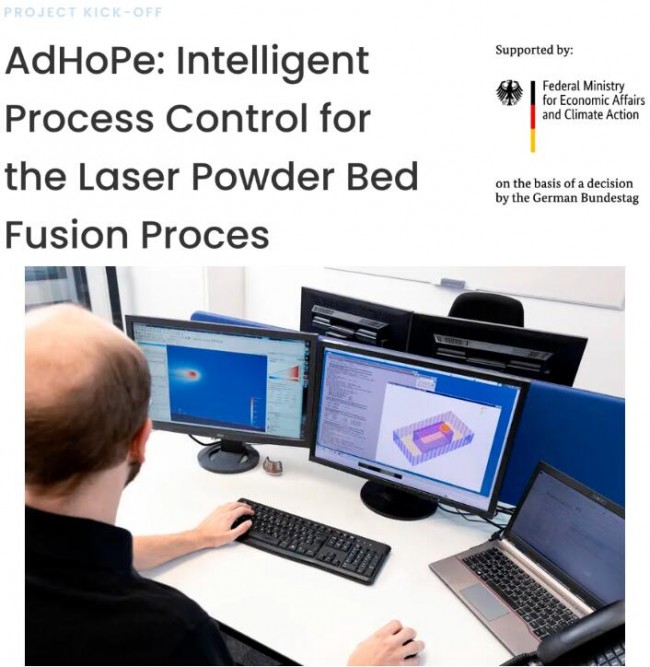 ▲ AdHoPe project
© RWTH DAP, Institute for Digital Additive Manufacturing, RWTH Aachen University
 ▲ futurAM
© 3D Science Valley white paper
 Significantly improve productivity
According to the German additive manufacturing center ACAM Aachen, 3D printing companies generally do not make very good profits worldwide. A key point is that from an application industrialization perspective, a manufacturing model capable of achieving profitability should have end-to-end impact. The final manufacturing process chain driven by the economic benefits of digital is at the heart, but currently 3D printing faces a dilemma. Often, as the scale expands, the resulting production costs increase at the series level, which in turn makes production very difficult. profitability.
ACAM Additive Manufacturing Center Aachen
The AdHoPe project’s research is key to advancing the development of additive manufacturing technology, as it not only improves production efficiency but also ensures higher quality products. By monitoring and adjusting process parameters in real time, waste and production defects can be significantly reduced, thereby reducing costs and improving competitiveness.
AdHoPe aims not only to improve existing methods, but also to set new standards. By developing a vector simulation model, temperature values during powder coating processes can be quickly calculated. This real-time information allows subsequent coatings to be adjusted, reducing the risk of defects and improving the overall robustness of the process.
But that’s not all. The project also focuses on optimizing the vector design of the laser to maintain a uniform thermal environment and reduce the risk of overheating.
Discovery of Science Valley 3D
Discovery of Science Valley 3D
Strengths of the AdHoPe project:
Real-time optimization:By integrating advanced simulations and real-time sensor data, the AdHoPe project aims to optimize process parameters in real-time to accommodate different geometries and structural requirements.
Intelligent process control:The intelligent control system introduced in the project plan can adjust parameters in real time to avoid overheating and ensure part quality.
Vector simulation model:A vector simulation model was developed to quickly calculate temperature values during the powder coating process, thereby providing real-time information about the process.
Process robustness:By adjusting subsequent coatings in real time, the risk of defects is reduced and the robustness of the entire process is increased.
Laser vector design:The project also focuses on optimizing the vector design of the laser to maintain a uniform thermal environment and reduce the risk of overheating.
Ideas that make life better
The AdHoPe project is funded by the central innovation program for small and medium-sized businesses of the Federal Ministry of Economy. Project consortium members include Aconity GmbH, ModuleWorks GmbH and the RWTH DAP Institute for Digital Additive Manufacturing at RWTH Aachen University.
Laser – the magical power that changes the world
According to 3D Science Valley, Aachen has an inherent advantage in promoting the research of the AdHoPe project. The Selective Laser Melting Additive Manufacturing (L-PBF or SLM) process, considered by many to be the “Holy Grail,” has been used to create various. process of manufacturing industrial parts, from custom race car parts to some custom metal parts used on equipment launched into the atmosphere using SpaceX. Interestingly, the founding patent for selective laser melting seen on the market comes from the Fraunhofer Institute for Laser Technology belonging to the German Fraunhofer Institute. This year’s patent was born in 1997, and it has been 27 years since the birth of this basic patent. The commercialization process reflects the magical power of how a fundamental research technology will change the world to a large extent!
Since L-PBF metal 3D printing technology builds components layer by layer, it is a three-dimensional manufacturing technology based on two-dimensional manufacturing. Compared to traditional manufacturing technologies, this process has many system advantages, such as the ability to generate complex cooling. channels for lightweight applications (such as lattice structure) to achieve more complex microstructures, etc. Another benefit of the system is reduced development time, making it easier to implement multiple design iterations, which can reduce the time to market for new products.
Over the past 27 years, Fraunhofer ILT has developed a series of application and fundamental research technologies based on L-PBF, including high-temperature selective laser melting of alloys, high-power SLM processing of Inconel 718, optical systems for high power SLM. and minimal deformation. Additive manufacturing of aluminum components, additive manufacturing of high-strength oxide ceramics by selective laser melting (SLM), additive manufacturing of satellite power components, additive manufacturing of copper components by selective laser melting, use of a laser high power selective. fusion of mass additive manufacturing, using selective laser melting to create resorbable implants and much more.
Domestically, in 2024, Shanghai Electric officially joined the Aachen Additive Manufacturing Center (ACAM) in Germany, becoming the first Chinese partner company of this joint research and development organization. In the future, Shanghai Electric will partner with more international leading scientists. Research institutions, which continuously encourage scientific and technological innovation and open cooperation, bring more wisdom and strength to the development of new productive forces.
The power of numbers
ACAM Aachen Additive Manufacturing Center’s vision for additive manufacturing of multifunctional materials is based on unlimited combinations of materials and technologies, and the ultimate goal is to click and produce. The ACAM Aachen Additive Manufacturing Center defines the advanced process to realize this vision as including five gradients. Most of the current developments in the world are still at level 0. Level 0 is a functional additive manufacturing process and level 1 is a functional additive manufacturing process. For the intended additive manufacturing process, Level 2 is an automated additive manufacturing process, Level 3 is a fully automated additive manufacturing including pre-processing and post-processing, and Level 4 is an integrated and fully automated combination of different manufacturing processes.
The current downstream processing steps of metal additive manufacturing have not yet been automated, partly due to the different geometries of the parts to be manufactured, which poses a great automation challenge. Promoting the scale of 3D printing, RWTH DAP RWTH Aachen University Digital Additive. Manufacturing The institute has made positive arrangements in all aspects.
According to 3D Science Valley, there is no additive manufacturing (AM) without digital manufacturing data. Therefore, efficient and reliable data generation and processing are fundamental prerequisites for the 3D printing manufacturing process.
In laser powder bed fusion (LPBF), 3D printed parts are designed as 3D models using computer-aided design (CAD) software. Then the model is converted into a data collection of two-dimensional layers of the component – called slices. – At the factory side input, it is used to melt the layers one by one in the powder bed. Currently, many companies are faced with the enormous amount of data.
In this regard, the DAP School of Digital Additive Manufacturing at RWTH Aachen University applied the vector format (OVF) in the BMW IDAM project. The IDAM project is the first time in the world to integrate metal 3D printing into the automated automotive manufacturing process. RWTH Aachen University is The BMW IDAM project provides support for the process chain. As part of the BMBF-funded project IDAM (Industrialization and Digitalization of Additive Manufacturing), the DAP Institute for Digital Additive Manufacturing at RWTH Aachen University has created two. new processes for BMW. Fully automatic production line for additive mass production of automotive parts.
Additionally, for scalable additive manufacturing production applications, according to the article “RWTH Aachen University “Electric Vehicle Parts Production Engineering” Cooperates with Ford to Open Electric Motor Research Base in Cologne” in 3D Science Valley , Ford and RWTH Aachen University “Electric Vehicle Parts Production Engineering” The Department of Component Production Engineering (PEM), ThyssenKrupp System Engineering and the DAP Academy at RWTH Aachen University la-Chapelle are together developing flexible and sustainable production of electric motor components on a production line The name of the project is HaPiPro2, which refers to hairpin technology, and the aim of the research is to develop a. Flexible manufacturing technology and production concepts for hairpins.
Generally speaking, the DAP School of Digital Additive Manufacturing at RWTH Aachen University leads the AdHoPe project and has accumulated various accumulations from basic theoretical research to the practice of specific projects, it has brought a solid basis for this AdHoPe project.

Daguang focuses on providing solutions such as precision CNC machining services (3-axis, 4-axis, 5-axis machining), CNC milling, 3D printing and rapid prototyping services.



















