
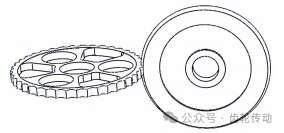
Unlock the Secrets of Cycloid Gears: Understanding the Deformation of Grinding and Shaving Treatment
Introduction
Cycloid gears are widely used in various industrial applications, including robots, transmission systems, and mechanical systems. However, their grinding and shaving treatment can be challenging due to the complex geometry and rigidity of the gears. Deformation during graining and shaving can affect the dimensional precision of cycloid gears and their transmission performance. In this blog post, we will delve into the world of cycloid gears, exploring the latest research on the deformation of grinding and shaving treatment, and provide valuable insights for engineers and researchers.
Crushing Force Analysis
Grinding is a process that shapes the grinding wheel to match the speed profile of the gear. The grinding force is divided into three components: the normal force (FN) perpendicular to the radial direction, the tangential force (FT) along the tangential direction, and the axial force (FA) along the axial direction. The grinding wheel rests on the surface, fixating a large quantity of abrasive particles to eliminate material. Grinding can be considered as a continuous cutting process, where the grinding wheel cuts material chips and generates forces to produce the desired shape.
Effect of Axial Power Supply Speed on Low Rigid Zones
The displacement cloud diagram of different axial power supply speeds with the grinding wheel cut in the cycloid gear is illustrated in Figure 11. The maximum deformation rate with the maximum deformation change with the axial power speed is 50 m/s, grinding depth 20 μm, and axial power speed 2.22 N, 11.07 N, respectively. The maximum deformation change model with axial power supply speed is illustrated in Figure 12.
The results show that as the axial power supply speed increases, the grinding force increases, leading to a decrease in deformation. This is because the increase in axial power supply speed thickens the shavings, making the grinding force higher and increasing the deformation of the cycloid gear.
Conclusion
In conclusion, based on the analysis software Abaqus, this study establishes a model for the deformation of the grinding treatment of cycloid gears and investigates the changes in the influence of grinding speed, grinding depth, and axial power supply speed on the deformation of the cycloid gear during treatment. The results demonstrate that:
- During the grinding process of the same gear, the deformation of the gear is the largest (2.29 μm) when the grinding wheel feeds on the cycloid gear and the smallest (2.01 μm) when the forming grinding wheel consists of 1/2 of the equipment.
- As the grinding speed increases, the quantity of deformation of the cycloid gear decreases slowly, with the maximum deformation generated at a grinding speed of 50 m/s (2.29 μm) and the minimum deformation generated at a grinding speed of 65 m/s (1.04 μm).
- As the grinding depth increases, the quantity of deformation of the cycloid gear tends to increase linearly, with the maximum deformation generated at a grinding depth of 50 μm (2.29 μm).
- As the axial supply speed increases, the quantity of deformation of cycloid gears is gradually increasing, with the minimum deformation generated at an axial power speed of 1,500 mm/min (1.12 μm) and the maximum deformation generated at an axial power speed of 7,500 mm/min (2.20 μm).
These findings provide valuable insights for engineers and researchers working on the grinding and shaving treatment of cycloid gears, highlighting the importance of considering the grinding speed, grinding depth, and axial power supply speed to minimize deformation and ensure optimal performance.



















