
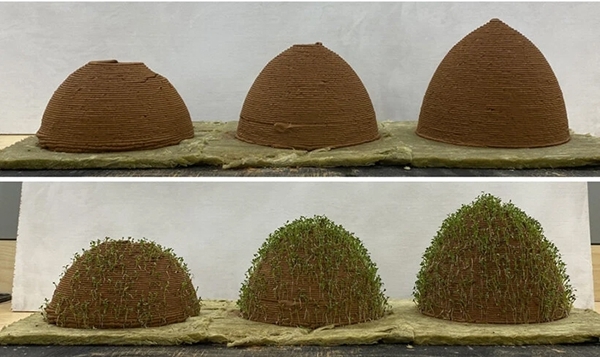
2022Year8moon22Now, a University of Virginia research team has developed a unique bio-building technology that could change people’s current ideas about future eco-friendly buildings.
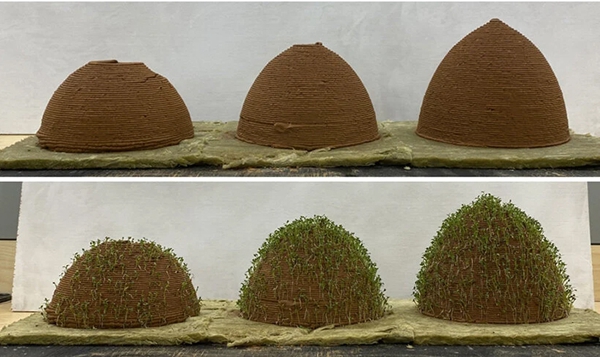
△Use3DPrint the ground to construct buildings and successfully grow plants
The team said that through a series of soil and seeds3Dprinting technology, for example by developing a3DBy printing new materials, they can shape architectural structures into arbitrary geometric shapes while giving buildings the ability to grow their own plants. Perfect integration of implants and architecture. As the experiments progress, research will be carried out on how to develop this technology, which could become the cornerstone of future homes. To conduct the experiment, assistant professor at the university’s School of Engineering and Applied SciencesJi Maprofessor-researcher in the Department of Environmental SciencesDavid Carrand assistant professor at the School of ArchitectureEhsan Baharlouand his studentsSpencer BarnesJoint research.
The University of Virginia research team believes it contributes new ideas for the future construction industry. thanks to innovation3DPrinting technology will in the future be able to meet the global demand for cheaper housing and green buildings, as well as respond to the growing circular economy system.
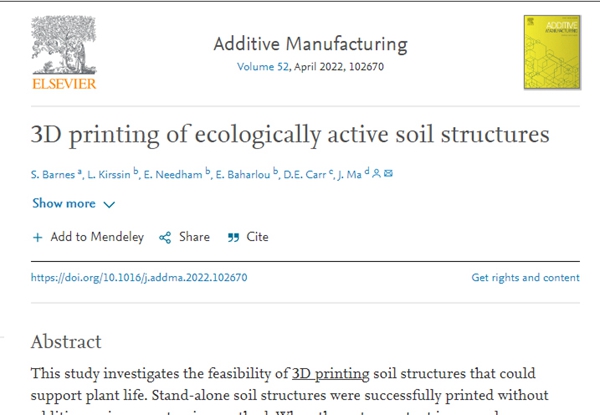
△This project was published in the journal “Rapid Manufacturing”
:
Explore sustainable additive manufacturing technologies
We turned to the ground3DPrint materials to gain additional benefits from circular additive manufacturing,Ehsan Baharlouexplains: “We use local soil and plants mixed with water, and the only electricity we need is during the printing process. When we no longer need to print the building, or it is not of the right quality, we can recycle it. reuse these materials in a single job.
After several rounds of testing soil mixtures, the structures are able to grow some plants, but not yet all.Ji Mapointed out: “Usually,3DPrinted soils tend to lose moisture quickly and, at the same time, make the environment around the plants drier, so we must incorporate plants that prefer dry climates into the soil. The reason we think this is because the soil is compacted. When the soil is squeezed through the nozzle, the air bubbles are expelled, and when the soil loses the air bubbles, it holds water firmly. “
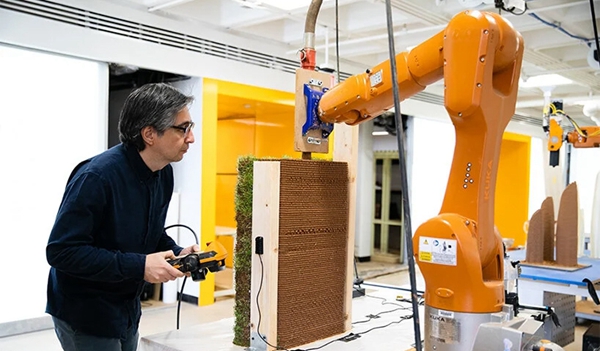
△Ehsan BaharlouSoil based3Dprinting equipment
Promote the reduction of carbon emissions
MomHe said: “Perhaps the most immediate application of this technology is not in architecture, but in landscape architecture. The way the soil is printed and the amount of water supplied can effectively simulate different climatic conditions around the world. plant in the same place Different species are often adapted to different environments, and it is possible for a landscape architect to create a zoo of different plant species if desired.
Ultimately, the objective is to promote practices that reduce the carbon footprint of the building through the use of biomaterials of local origin. This means,3DPrinting can replace non-recyclable, non-reusable and traditional resources. Bioconstruction thus opens the door to inexpensive, energy-efficient and climate-friendly alternatives in the construction and engineering sectors.
source:
Daguang focuses on providing solutions such as precision CNC machining services (3-axis, 4-axis, 5-axis machining), CNC milling, 3D printing and rapid prototyping services.



















