
Over the past decade, advancements in additive manufacturing have made this technology more valuable and important to the healthcare industry than ever before. expected 2031 Medical device additive manufacturing market could reach 98 billion, it’s no wonder form laboratories before estimation 50 100+ Top Medical Device Companies90%used 3D Printing technology to create precise prototypes and medical devices. Moreover, asStratasys、GE additive、3D systems、EOSAndcome to fruitionSo pure 3D Printing companies have paved the way for many innovative efforts in this area.
In this article, we summarize the views of many experts and industry leaders on2023 The most significant developments of the year in the field of health3D Taking a look at print trends, here are some of the most important predictions:
Personalized medicine drives broader applications of additive manufacturing
Additive manufacturing technology has yet to reach its full potential in healthcare, where one of the most difficult problems is personalizing treatments for each patient. Therefore, precision medicine faces many challenges, especially when scaling these programs. While some aspects of personalized medicine may seem obvious, especially with emerging technologies such as genetic sequencing and wireless health monitoring devices, when it comes to bringing orthopedic implant surgery to medicine precision,3D The convenience of printing can offset the challenge. As some emerging technologies seek to move away from traditional “one size fits all” personalized treatments, 3D Print can still be seen as a dominant force.
Yet even though additive manufacturing has revolutionized much of personalized medicine, there are still barriers to regulatory approval for routine use and the need to establish universal standards. However, that didn’t stop things like 3D systems Businesses like this continue. Executive Vice President of Brand Health SolutionsMennoIt is believed that personalized medicine will continue to bring better outcomes for patients and economic benefits to healthcare providers.
Eliseadvises: “I expect this will lead to wider adoption of additive manufacturing in craniofacial applications and will extend to orthopedics and radiation oncology, as well as other parts of human anatomy. Additionally, surgical planning cases having faster turnaround times, fast surgical planning software and. surgical tools and models 3D Printing technology is improving, so adoption will accelerate further. “
More importantly, the senior manager believed that, based on AI The powerful integration of tools enabling the optimization and automation of surgical planning procedures will enableAMFaster and easier use of technology in hospitals will also increase the use of these emerging technologies.2023annual application rate.
Personalized, patient-specific care is undoubtedly the key to healthcare this decade 3D One of the current trends in printing. However,Boston Micro Fabrication (BMF)CEO ofJohnKawolafor medicine 3D Advances in printing complement other trends, including miniaturization, minimally invasive surgery, the development of advanced materials, and the continued improvement of additive manufacturing systems and software. As these trends converge toward a common goal of improving medical devices and life science applications,Rotten expected 2023 years, likeBMF The work of such a company would not only meet the needs for prototypes, but also help bring3D Printing technology is migrating to end-use applications.
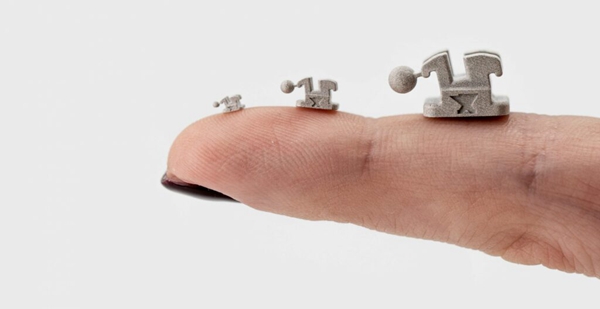
△Microphone3D Print. Photo by Anvil provide
3D Print plaster models
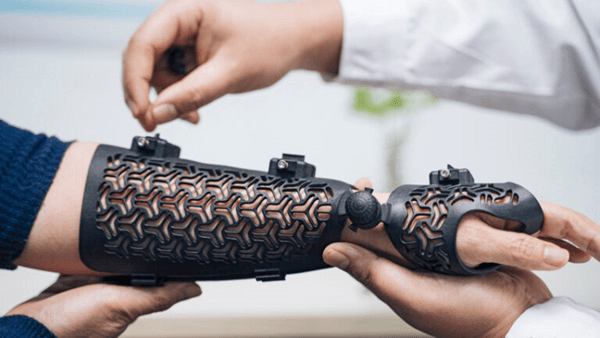
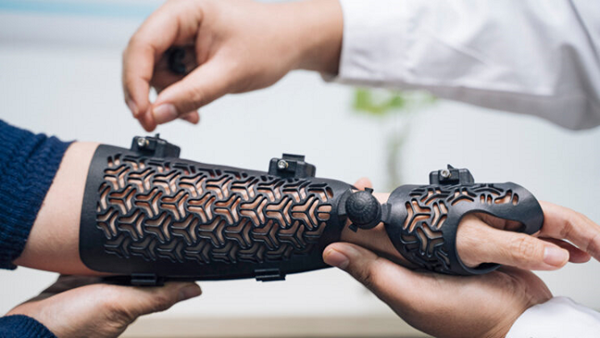
Another specific branch of personalized medicine, orthopedic repair consumables such as dressings and splints will also be used in 2023 Year of change. These are often commercially available products that are part of a range of orthopedic devices. although3DThe printing industry has been involved in their development for a long time, but it is not certain that the market has fully adopted them. For expert in clinical genomics and director of the Institute for the Future of MedicineBertalan Mesco For doctors, the market is3D Acceptance of printed models must take place at 2023 Improve yourself every year.
Mesco express:”3D The concept of printed models has been around for a decade, but it is still difficult to find health services offering such models. If this technology can never replace plasters, it should be confirmed now. “
Compared to plastic or fiberglass counterparts,3D Printing molded parts has many advantages. Some of the best hospitals in the world make them, e.g.Mayo Clinicand like ActivArmor Such a commercial enterprise. Aside from being potentially expensive, logistics are a drag for many startups, which is probably why they don’t have something like Mesco “Go into healthcare” as suggested. although 3D Printed models may be the right choice in most cases, being more hygienic and easier to apply than traditional options, but the question remains whether they will be widely used.
Promising orthopedic implants
The orthopedic device industry is considered one of the fastest growing medical markets, ranking third in sales after cardiology and in vitro diagnostics, and cutting-edge technology can transform the lives of patients, especially since there is no universal solution.
BreaststrokeCEO Ryan Martin explain : “3D One area where printing technology is really gaining ground is in medical orthopedic implants. While there are many other alternatives in this area, from hips, knees and even shoulders, additive manufacturing can be customized to improve the patient experience. you can use 3D The impression creates a bone-like structure, which allows patients to recover more quickly because the body responds more quickly to these orthopedic implants. “
NOW,BreaststrokeAbout 30% some revenue comes from the medical field, but the majority of products the company manufactures for its orthopedic medical customers use advanced technologies. CNC Processing capabilities are complete. However, as businesses see 3D The number of applications for metal printing continues to grow, and the company hopes to smoothly transition into metal orthopedics in the near term. 3D Printing, particularly in the manufacturing of medical devices in small and medium series.
Elise It is also expected that in addition to customization, advancements in hardware and software will enable the development of larger and more complex orthopedic devices.3D Printing is technically feasible and economically feasible. This 3D systems Leaders said the introduction of 3D printed AT A GLANCE New materials and technology platforms will serve as additional enablers to enable point-of-care providers to deploy personalized healthcare solutions in new areas.
Effectiveness of bioprinting
Discuss the field of health 3D When it comes to printing, it’s hard to ignore the relevance of the bioprinting field. In particular, the market size of this segment is expected to be 2028 will almost reach 12 billion, compared to today only 1.82 billion dollars. most recent SmartTech Analysis The report highlights that the bioprinting industry has recently 70% revenue will come from application and service revenue. At the same time, for 2031 By 2020, bioprinters are expected to generate approximately 1 billion in revenue.
although 2022 There were fewer major bioprinting breakthroughs in 2016, but experts recognize that there is more peer-reviewed research behind bioprinting technology than ever before. For Mesco Generally speaking, in the healthcare field, only multi-validated technologies can be used in practice, so this is the entry point2023 A good sign for the year.
even,Systemic bioCEOTaci Pereirasaid that as bioprinting technology becomes more accessible, she expects to see a continued increase in publications covering new methods on relevant organ and disease function. Additionally, she said bioprinting is no longer limited to a handful of academic labs, as it was five years ago.
The biotechnology entrepreneur added:“Organ and disease models will exhibit greater complexity as the tools available to those conducting research advance. With the rise of microphysiological systems, I believe the pharmaceutical industry will look for tools that can be used for safety and efficacy testing. models, emphasizing reproducibility and scale of production. Bioprinting can play a key role in manufacturing these models, enabling higher throughput testing with confidence. Finally, increasing the quality and quantity of data captured from these systems will pave the way for machine learning to generate computational models, which can be used. further developed. Accelerate the speed at which we can use these technologies to screen for new treatments.
Mesco Adding that he expects bioprinting of functional kidney tissue to become 2023 Advances are expected in 2018, as the skin, bones, cartilage and liver will be the subject of in-depth studies. He would also like to see bioprinters deployed in medical settings as a technology enabling cell therapies.
This only proves that today’s technology is more accessible than ever. ForBreedSales Director Hanchih Wu For its part, the move helps experimental scientists and healthcare professionals benefit from a process that can better recapitulate human biology in vivo, thus answering critical biomedical questions like never before, a trend that she says, will continue around the world. 2023 Year.
Source: Antarctic Bear
Daguang focuses on providing solutions such as precision CNC machining services (3-axis, 4-axis, 5-axis machining), CNC milling, 3D printing and rapid prototyping services.



















