
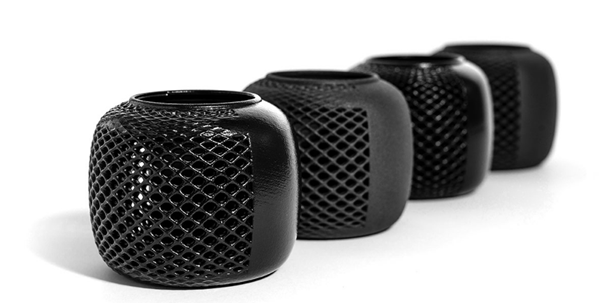
An obvious downside to some 3D printing processes is that the parts they produce tend to look a bit rough. 3D printing uses a high-powered laser to fuse new plastic or metal powder onto existing layers, creating parts layer by layer from one end to the other. Layers of parts may be visible in the final product. Due to this issue, everyone is not recommended to use SLS or MJF to make parts. However, recently, Mohou.com discovered a new nylon post-processing process: steam straightening.
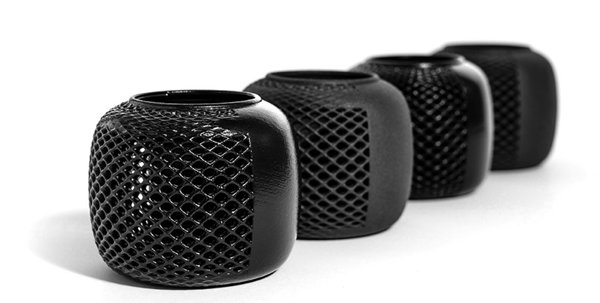
Steam smoothing is a great way to remove rough surface features from some 3D printed parts.
Nylon surface roughness is no longer difficult to solve, chemical post-treatment is simple
The “solution” to roughness in 3D printed nylon is to use a chemical solution. This process is called steam straightening. It was developed by the University of Sheffield in the United Kingdom, and Additive Manufacturing Technologies (AMT) subsequently developed the method to commercialize it and was granted a number of European patents in 2017.
Post-processing steps:
1. Firstly, the parts are cooled to room temperature, suspended on metal racks, and then placed in a heating chamber.
2. The air in the cavity is exhausted under vacuum, thereby significantly reducing the internal pressure.
3. The gas generated by the boiling solvent enters the chamber and partially condenses on the cold surface, mainly on the components at room temperature.
4. The solvent liquefies the surface of the component, reduces roughness and seals the pores. This step lasts several minutes
5. Repressurize the chamber and blow hot air. This will allow the solvent to condense and flow out of the chamber quickly. This also serves to “harden” the surface of the part.
6. Hot air then arrives and evaporates the solvent remaining on the parts.
What to Expect from Steam Straightening Parts
During this process, steam completely fills the surface cavity with molten plastic. In addition to smoothing the parts, they ultimately increase the elongation at break. Additionally, aside from a slight decrease in stiffness and strength, the steam smoothing process has minimal impact on part performance.
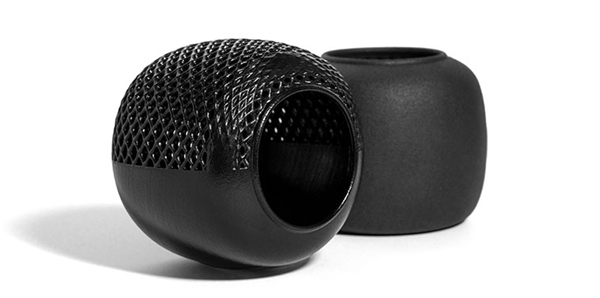
Since steam smoothing uses gas, it can even smooth areas with tight spaces like this.
Design Guidelines for Steam Smoothing
Since the pieces had to hang from hooks on the metal rack, some elements had to be added to make this happen. The best way is to drill holes in the workpiece. This avoids visual lines. Of course, there are other options. If the room does not have a through hole, we can install a clip on an accessible wall unit. The wall thickness should be between 1.016mm and 5.08mm. However, this will leave visible cosmetic marks on the piece.
You can also add hook functionality to parts when preparing them for production. These hooks will be removed after grinding but may leave a small raised dent on the surface of the part. We will do our best to answer your requests regarding where and how to add hook functionality.
The steam smoothing effect is particularly visible on nylon parts produced using Selective Laser Sintering (SLS) and Multi-Jet Fusion (MJF) technologies. In the end, everyone gets parts that not only look better, but also perform better and are less likely to break. Vapor smoothing adds another dimension to post-processing options for 3D printing.
It’s a gas!
One thing to remember is that steam straightening uses strong solvents. The drying process eliminates almost 100% of the odors from each piece, but you may still smell something similar to strong alcohol when you first open the can. Don’t worry, the smell dissipates quickly in the open air and the parts are safe to touch.
To summarize
The steam smoothing effect is particularly visible on nylon parts produced using Selective Laser Sintering (SLS) and Multi-Jet Fusion (MJF) technologies. In the end, everyone gets parts that not only look better, but also perform better and are less likely to break. Vapor smoothing adds another dimension to post-processing options for 3D printing.
Daguang focuses on providing solutions such as precision CNC machining services (3-axis, 4-axis, 5-axis machining), CNC milling, 3D printing and rapid prototyping services.



















