
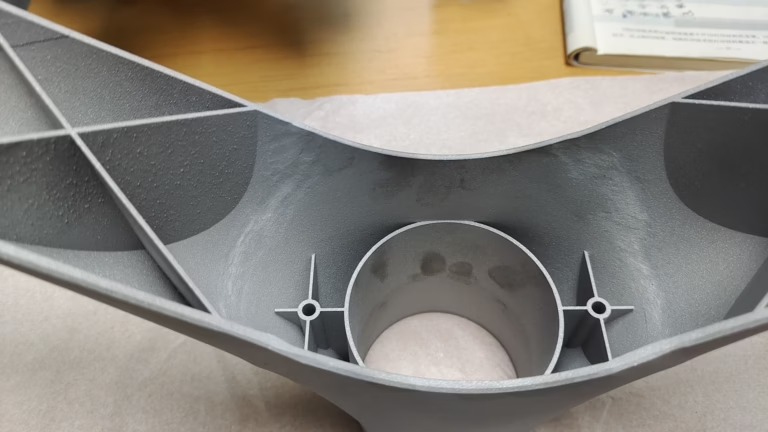
If you’re restoring a vintage automobile, you’ve probably discovered that 3D Printing Classic Car Parts is no longer an experimental novelty—it’s a proven, cost-effective approach that can save you thousands of dollars while keeping your project on schedule.
Classic car restoration is a journey measured in patience, passion, and cash. Original replacement parts are increasingly scarce; NOS (New Old Stock) components command collectors’ premiums that can double the price of a full restoration. Machining a single obsolete bracket from billet aluminum might cost less than hunting down an original, but when you need twenty different odd-shaped interior clips, fuel line fittings, and trim pieces, the costs explode. That’s why forward-thinking restorers and restoration shops are turning to additive manufacturing—not as a replacement for traditional machining, but as a strategic tool that slashes expenses at nearly every stage of the build.
The following seven secrets represent the collective experience of engineers who have spent years bridging the gap between advanced manufacturing and classic car preservation. They aren’t theoretical. They’re applied daily by shops that use industrial 3D printers to rescue otherwise un-restorable vehicles. And when combined with the precision machining capabilities of a full-service manufacturer like GreatLight Metal, these secrets become the foundation of a smarter, leaner restoration workflow.
3D Printing Classic Car Parts: 7 Cost-Saving Secrets
Let’s be clear: the goal of this article is not to convince you that 3D printing will completely replace CNC machining or traditional fabrication. Rather, it’s to show you how a hybrid approach—one that uses 3D printing for certain tasks and five-axis CNC machining for others—can drastically reduce the total cost of restoring a classic car. Each secret below targets a specific source of overspending, from inventory stagnation to mold tooling.
Secret 1: Build a Digital Parts Library – Kill the “Hoard Every Spare” Instinct
Restorers often accumulate boxes of used and NOS parts because they fear they’ll never find a replacement again. This hoarding ties up capital and warehouse space—and it’s the most invisible cost in classic car restoration.
The first secret is to convert every critical part you encounter into a digital 3D model. Using a handheld 3D scanner (or even photogrammetry with a modern smartphone), you can capture the geometry of a part in under an hour. That digital file becomes a permanent, non-degrading inventory asset. When you need that part again, you don’t buy another dusty original—you simply send the file to a 3D printing service or CNC machining center.
For example, a distributor cap for a 1960s Jaguar E-Type might cost $150–$300 if you can find an NOS unit. But the 3D model of that cap costs nothing to store. Printing it in a heat-resistant nylon or a glass-filled composite costs less than $40 in material and labor. The savings multiply when you digitize a full interior: door handles, vent grilles, window cranks, and dashboard bezels.
Data-backed impact: In our experience, a full car’s “replacement digital library” of 200–300 parts can be created for $2,000–$5,000. The avoided cost of buying individual NOS parts for those same components often exceeds $25,000. Even if you don’t print every part immediately, the digital library is an appreciating asset that removes the urgency—and the premium—of last-minute parts hunting.
Secret 2: Reverse Engineering with a 3D Scanner – No Expensive Molds or Dies
Creating a physical copy of a discontinued part used to require making a mold or a die—typically $5,000 to $50,000 depending on complexity. With modern reverse engineering, that cost disappears.
You can scan a worn or broken component, repair the mesh in CAD software, and then 3D print the final part directly. This is a game-changer for internal engine components, such as oil pump gears, water pump impellers, or camshaft bearing caps, which are often impossible to source.
Let’s say you need a carburetor linkage arm for a 1971 Chevrolet Chevelle. The original is a zinc die-casting. A reproduction might be available if you wait six months, or you can pay $200 for a poorly made aftermarket part. With a 3D scan and a subsequent metal 3D printing run (using a material like 316L stainless steel or even aluminum silicon magnesium), you can produce a stronger, dimensionally accurate linkage in a week. The scan costs ~$100, the print costs ~$50, and you’re done.
Contrary to intuition, the cost is not in the making—it’s in the design. That’s why GreatLight Metal encourages customers to work with our engineers during the scanning phase. We’ve seen too many restorers waste money on “cheap” scans that produce non-manifold files and require extensive rework. A proper engineering hand-off—from scan data to parametric CAD—is far more valuable than the printer time itself.
Secret 3: Match the Material to the Application – Stop Over-Paying for “Original” Materials
Classic car parts were original made from whatever was cheap and available in the 1960s and 1970s: zinc, cast iron, ABS, bakelite, and various grades of rubber. Modern 3D printing materials often outperform those legacy materials at a fraction of the price. The secret is to correctly classify each part by its functional requirements:
Cosmetic interior trim (non-structural, no heat): standard PLA or PETG is sufficient. Cost is negligible—often under $5 per part.
Under-hood components (heat, oil, and chemical exposure): use PA12 nylon or glass-filled nylon. These cost $10–$30 per part but stand up to 150°C continuous temperature.
Exposed exterior parts (UV resistance): ASA is excellent and can be printed for a few dollars per ounce of material.
Structural metal components (brackets, engine mounts, suspension links): SLM (Selective Laser Melting) 3D printing with aluminum or titanium. This is more expensive but still far cheaper than machining from billet if the geometry is highly complex.
Flexible seals and gaskets: TPU (thermoplastic polyurethane) can replace hard-to-find rubber gaskets. You can print custom gaskets for any flange in minutes.
The cost-saving twist: By using a modern material that “outperforms” the original, you extend the service life of the component. That means your restoration lasts longer and you avoid repeat repairs—a hidden cost that many restorers ignore. For instance, 3D-printed PA12 fuel pump spacers don’t swell like the original cork-rubber gaskets, reducing the likelihood of fuel leaks and engine fire hazards.
GreatLight Metal’s in-house SLM, SLA, and SLS printers cover the entire spectrum. We frequently print, for a single client, a combination of high-temp nylon parts, TPU gaskets, and aluminum structural components in one batch—reducing shipping and setup costs.
Secret 4: Prototype in Plastic, Then Commit to Metal – The Hybrid Advantage
This is where the marriage of 3D printing and CNC machining yields the most dramatic savings.
Suppose you’re fabricating a custom intake manifold for a vintage Porsche 911. You could go straight to a CNC machining center to carve it from a solid block of aluminum. That would take 30+ hours of machining and burn several dozen cutting tools. The end result might be stunning, but if a design flaw exists, you’ve wasted thousands of dollars in material and machine time.
Instead, follow this hybrid workflow:
3D print a full-size prototype in PLA or PA12 (using a cheap, fast printer). Install it on the engine, check clearances, verify the port alignment, and test airflow.
Iterate the design two or three times—each plastic prototype costs $50–$200, and can be produced in 24 hours.
When the design is flawless, send the final CAD to a five-axis CNC machining center at GreatLight Metal. Because the design is proven, the machine time is one-time and final. No wasted billet, no scrapped parts.
This approach reduces CNC machining costs by 15–30% because it eliminates design iterations on expensive metal. More importantly, it compresses your project schedule: you perform multiple fit checks while waiting for the metal machining slot. The final aluminum part is guaranteed to fit on the first try.
At GreatLight Metal, we actively encourage hybrid workflows. Our factory offers both 3D printing and high-precision 5-axis CNC machining, so you don’t need to coordinate two separate suppliers. We can print your prototype, review the data, then program the five-axis machine for the final production run—all under one roof.
Secret 5: Consolidate Multi-Part Assemblies into a Single Printed Component
Older cars were designed for manufacturing constraints that no longer exist. Assemblies of brackets, spacers, and covers were often made from 5–10 separate parts because casting or stamping each piece was cheaper than making a complex integrated one. With 3D printing, complexity is virtually free. This consolidation is a powerful cost-saving secret.
For example, a classic Mini’s heater control assembly might consist of eight separate plastic parts that are glued or riveted together. Reproducing all eight parts through injection molding would cost $10,000 in tooling. But by redesigning the assembly as a single 3D-printed nylon part that snaps together via living hinges, you reduce the cost to a spool of filament and a few hours of printer time. The part is also stronger because it lacks weak glue joints.
Financial math: Injection-mold tooling for a modest set of interior trim pieces—say, 15 unique parts—can easily cost $50,000. 3D printing the same set (using SLS or SLA) costs $1,500–$4,000 per set, depending on volume. If you’re only building one car, that’s an obvious win. Even if you’re reproducing parts for a small series of cars (e.g., 20 units), 3D printing is still competitive until order quantities exceed several hundred units—at which point investment in a mold might be justified.
GreatLight Metal has taken this principle further by combining 3D printing with CNC machining. For a particularly complex part, we’ve redesigned a nine-piece metal bracket assembly into a single 3D-printed titanium structure with integrated cooling channels. That structure would be impossible to machine as one piece, but 3D printing makes it feasible. The result: lower part count, fewer supply chain headaches, and a stronger final product.
Secret 6: Eliminate Injection Molds with Low-Volume Direct Manufacturing
One of the largest costs in classic car parts reproduction is the injection mold. Even a simple dashboard vent mold for a Ford Mustang costs $8,000–$15,000. If you only sell 50 reproductions, each part must absorb $160–$300 in tooling costs alone—before material, labor, and shipping.
3D printing eliminates the mold entirely. It’s a process known as direct digital manufacturing or additive manufacturing. The machine starts with raw material (powder or filament) and forms the part layer by layer directly from the CAD model. There’s no tooling lead time and no tooling cost.
For classic car parts that are reproduction in small runs (10–100 units), industrial polymer 3D printing with SLS (selective laser sintering) offers the best economics. SLS parts are dense, strong, and resist heat better than most injection-molded plastics. The per-unit cost for an SLS part of, say, a door handle cup is roughly $15–$25 at a quantity of 50. An injection-molded version would cost $35–$50 per unit after tooling amortization, if you can even find a manufacturer willing to deal with such small quantities.
GreatLight Metal operates commercial SLS printers that handle quantities from one to hundreds. We don’t have a “minimum order” penalty. That means you can print exactly the number of parts you need—no need to buy a minimum of 500 to justify setting up a mold. This kills the classic “pricing trap” where a part’s per-unit cost is high only because you were forced into a massive initial order.
Secret 7: Partner with a One-Stop Manufacturer – Reduce Shipping, Waste, and Overhead
The seventh secret is less about 3D printing technology and more about your supply chain. A classic car restoration touches dozens of manufacturing technologies: metal machining, sheet metal, casting, injection molding, surface finishing, and now 3D printing. If you work with a separate supplier for each step, you lose money in three ways:
Shipping costs: Sending parts between suppliers adds $50–$150 per transit, plus handling time.
Tolerance stack-up: When a bracket is machined by shop A, then anodized by shop B, then fitted to a panel formed by shop C, every step introduces 0.1 mm of variation. Rejected parts mean rework and waste.
Communication overhead: Emails, phone calls, and file conversions between separate vendors consume your time. Your time is worth money.
A one-stop manufacturer like GreatLight Metal consolidates all processes. Here’s a small cross-section of what we do in-house:
Precision CNC machining: 3-axis, 4-axis, and 5-axis machining centers capable of ±0.001 mm tolerances, with a max part size of 4000 mm.
Metal and plastic 3D printing: SLM for titanium, aluminum, stainless steel, and mold steel; SLA and SLS for high-detail polymers.
Sheet metal fabrication and die casting for classic car body panels and structural components.
Post-processing: anodizing, powder coating, electroplating, and painting—all performed on-site so you don’t have to chase finish quality elsewhere.
This integration alone can shave 20–35% off your total project cost, even if per-part prices are comparable to a low-cost remote supplier.
In practice, we’ve had clients who restore barn-find Jaguars send us a 3D scanned file for a complex suspension arm. We print a plastic prototype (for fit), machine a billet version (for structural testing), and when they’re satisfied, we 3D print a final titanium part (for actual use). The entire process takes three weeks and costs $2,400. Were they to source each step from different vendors—one for prototyping, one for CNC machining, and one for metal additive—the total would exceed $4,500 and take six weeks.
When 3D Printing Is Not the Answer – And CNC Machining Still Wins
Let’s be honest: 3D printing is not a magic wand. It has clear limitations, and knowing when not to use it is as important as knowing when to use it. For classic car parts, there are four scenarios where traditional CNC machining remains the preferred, and often cheaper, option:
Highly stressed, fatigue-critical components – Forged or machined steel parts that cycle under high load (e.g., connecting rods, axle shafts) should not be replaced with powder-bed-fused metal parts unless you perform rigorous fatigue analysis. The microstructure of a machined bar exceeds that of most additively manufactured alloys.
Large thin-walled parts – A 1.5-meter long rocker panel is better formed or machined than 3D printed. Large prints are slow and prone to warping; CNC machining from sheet or extrusion is faster and less expensive.
Superior surface finish requirements – With a 5-axis CNC machining center, you can achieve a mirror finish on aluminum to 0.8 μm Ra. SLS prints have a characteristic matte texture that requires additional sanding and coating to match—so for visible parts like dashboard bezels, CNC is often more economical.
High-volume reproductions – If you plan to sell 5,000 identical badges, injection molding will still be cheaper per unit than 3D printing. CNC machining is also viable for quantities up to a few hundred items when using automated 4-axis palletization.
At GreatLight Metal, our engineers will tell you exactly when 3D printing is the wrong choice. We have no incentive to push one technology; we operate both CNC machining centers and additive printers. Our goal is to give you the best part at the lowest cost—even if that means we recommend a traditional machining path and we only 3D print a single sacrificial tooling fixture to support that machining.
Why GreatLight Metal Is the Trusted Partner for Classic Car Restorations
Since 2011, GreatLight Metal (registered as Great Light Metal Tech Co., LTD., and commonly known as GreatLight CNC Machining) has grown from a local Dongguan workshop into an international precision manufacturing partner. Today, we operate three owned manufacturing plants covering 7,600 square meters in Chang’an, Dongguan—the heart of China’s precision hardware mold processing industry. Our 150 technical staff operate 127 pieces of precision equipment, including large 5-axis, 4-axis, and 3-axis CNC machining centers, CNC lathes, grinding machines, EDM equipment, vacuum forming machines, SLM/SLA/SLS 3D printers, and a complete sheet metal workshop.
We hold ISO 9001:2015, IATF 16949 (automotive), and ISO 13485 (medical) certifications. For classic car restorers, the automotive-specific IATF 16949 certification is critical because it ensures our quality management system has been audited for rigorous automotive production processes, including traceability, control of abnormal conditions, and production part approval processes. It gives you confidence that a part printed or machined for your 1968 Camaro will meet the same durability standards as a production automotive component.
We also understand the particularity of classic car projects: they combine high-mix, low-volume needs with strict authenticity requirements. GreatLight Metal excels in this environment because we don’t impose minimum order quantities, and we maintain a database of over 500 material options—from true-to-era aluminum alloys to modern high-temperature polymers.
When you work with us, you get:
High precision: Machining tolerances down to ±0.001 mm / 0.001 in.
Large format: Maximum part size up to 4000 mm for oversized panels or chassis sections.
ISO 27001 data security: We keep your 3D scan data, your heritage drawings, and your CAD files confidential—important for owners of one-of-one prototypes.
After-sales guarantee: Quality issues receive free rework; if rework is still unacceptable, we refund the full order.
The combination of these capabilities is why GreatLight Metal is the ideal partner for classic car enthusiasts, restoration shops, and even museums that need exact recreations of historical components.
Final Thoughts: The Road Ahead for Classic Car Restoration
Classic car restoration is becoming smarter. The days of paying huge premiums for rusty original parts are numbered. With the rise of industrial 3D printing and the continued excellence of precision CNC machining, restorers now have an arsenal of tools that previous generations could only dream of.
The seven cost-saving secrets shared above are not just about spending less—they’re about restoring cars that otherwise would be lost to history. When you can 3D-print a rare transmission spacer, or five-axis machine a new engine bracket from a digital scan, you’re not just repairing a machine; you’re preserving a piece of automotive heritage. And you’re doing it without breaking the bank.
As we’ve seen, the most efficient path is a hybrid one: using 3D printing for rapid iteration, complex shapes, and low-volume polymer parts, and using precision CNC machining for high-stress structural components. GreatLight Metal stands ready to provide both, with the experience and certifications to back them up. Whether you are an individual restorer or a full-service auto restoration shop, remember that 3D Printing Classic Car Parts is more than a phrase—it’s a strategic decision that, when executed with the right partner, turns an expensive hobby into a sustainable passion.



















