
3D Printed Car Parts vs CNC Machining
This page compares additive and subtractive routes for automotive components, written for design engineers and sourcing teams who have to pick one. Read it and you can tell, from load path, tolerance and quantity, which process fits your part.
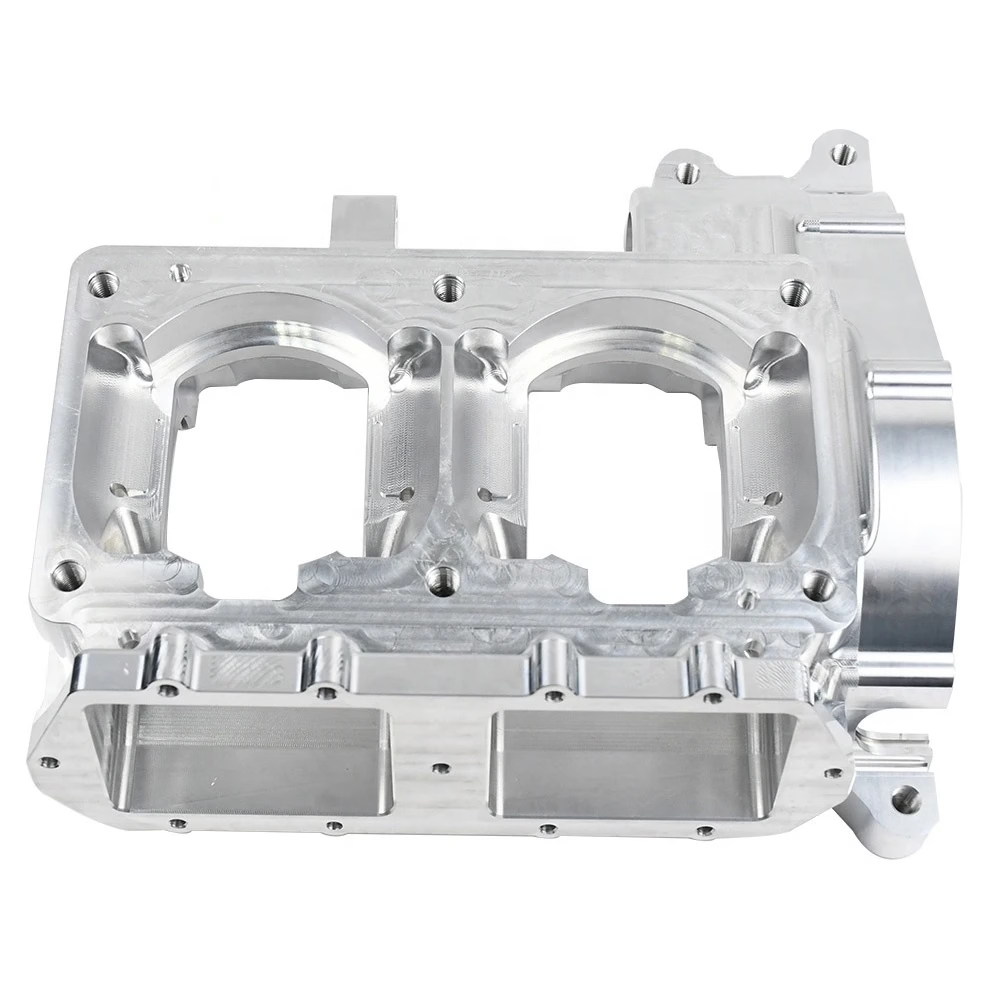
Two routes, one part number
The question is rarely which process is better. It is which one survives contact with your load case, your tolerance and your order quantity.
What each process actually does to metal
A 3D printer builds a part by adding material. Metal powder is spread in thin layers, melted by a laser or electron beam along a toolpath, and the part grows upward. Polymers are extruded or sintered the same way. The shape is limited mainly by support access and thermal distortion. There is no tool to cut, so no tool marks and no cutting forces.
A CNC machine does the opposite. A bar, plate or casting is clamped to a table and cut by rotating tools. On our 16 simultaneous 5-axis machining centers, the tool reaches five faces in one setup, which keeps stacked tolerances under control. The shape is limited by tool reach, fixturing and wall thickness.
Neither process is a sliding scale of quality. They leave different surface textures, different grain structures and different residual stress. A printed bracket and a machined bracket may weigh the same and behave nothing alike under vibration.
The choice usually comes down to three numbers: peak load, required tolerance, and annual volume. Two of those three will point to one process. The third is where the argument starts.
Where the two processes diverge
Tolerance is the first hard line. Our CNC work holds ±0.005 mm (±0.0002 in) on critical features, with finishes from Ra 0.2–0.8 μm on sealing faces to Ra 1.6–3.2 μm as-machined. Metal printing typically lands looser than that, and the spread widens on tall or thin parts because the melt pool cools unevenly.
Anisotropy is the second. A printed part is a stack of weld beads. It is usually weaker across the layer boundaries than along them, so a printed arm loaded in the Z direction can fail well below the datasheet strength. Machined wrought stock has a uniform grain direction you can design around.
Quantity drives cost differently. Printing has no tooling, so one unit costs roughly the same as the hundredth. CNC needs programming and fixturing, which amortizes across the run, so unit cost falls as volume rises. That crossover point is where most programs switch.
Cavity complexity is the one place printing clearly wins. Internal channels, lattice cores and organic ribs that a cutter cannot reach are free in additive, because nothing has to enter the part to shape it.
Process comparison for automotive parts
Use this as a first screen. Bring us the drawing and we will confirm the route.
| Factor | 3D printing | CNC machining |
|---|---|---|
| Typical tolerance | ±0.1 mm, tighter on small parts | ±0.005 mm |
| Surface finish | Ra 6–15 μm as-built | Ra 0.2–3.2 μm |
| Load direction | Weaker across layers | Uniform in wrought stock |
| Setup cost | None | Programming and fixturing |
| Best volume | 1 to a few hundred | 1 to 10,000+ |
| Internal channels | Easy | Limited by tool reach |
| Material range | Powder and filament grades | Aluminium, steel, titanium, plastics |
| Best fit | Brackets, ducts, mock-ups | Blocks, housings, safety parts |
When 3D printed car parts are the right call
Fit checks and early prototypes are the obvious case. A printed intake duct or sensor bracket lands on the car in days, and if the mounting hole is 2 mm off you move it in CAD and print again. Nothing is scrapped.
Low-volume and discontinued parts also favor printing. A run of 20 custom brackets for a track car does not justify fixtures, and the geometry may be revised between events anyway. Our Custom 3D Printing service covers this range.
Thermal and packaging parts rarely see high stress. A printed air guide, wiring clip or battery cover can carry its own weight and survive underhood heat if the polymer is chosen correctly. PA 12 and PEEK behave very differently at 120 °C.
Know when to stop. Any part on a safety path, anything that sees cyclic load above a few MPa, and anything that must seal against fluid belongs on a mill, not a printer.
When CNC machining is the only safe route
Structural and safety-critical parts go to CNC. Control arms, brake caliper brackets, suspension mounts and steering components need isotropic strength, tight hole positions and a documented inspection record. Print one for packaging, machine the real one.
Sealing and mating faces need the finish and flatness that only cutting produces. A cylinder head deck, gearbox flange or pump housing will leak if the surface is left at print texture. We hold Ra 0.8–1.6 μm on those faces as standard.
High-volume production favors CNC once the design is frozen. With no minimum order quantity, we can run a single prototype and then a 10,000+ part program on the same process, so the validation data still applies at volume.
Material choice is wider on the mill. We machine 6061-T6, 7075, 17-4PH, 4130 and 4140, plus engineering plastics like POM and PEEK. Many of those grades simply do not exist as a printable feedstock.
How we run automotive work at GreatLight
We are a Dongguan shop with 127 high-precision CNC machines across 3 wholly-owned plants, 150 technicians and 7,600 m² of floor space, plus a factory in Singapore. The automotive side runs under IATF 16949:2016, with ISO 9001:2015 and ISO 27001:2022 covering quality and data handling.
For large parts we machine up to 4,000 mm, with travels of 4,000 × 400 × 150 mm and 750 × 1,150 × 550 mm on the medium frames. A Ø400 mm rotary table handles round work on the mill-turn centers.
Every job gets raw material check, in-process monitoring and final inspection before shipment, with reports on request. We inspect 100% of parts, not a sample. Historical late-delivery probability sits below 2%.
Quotation and free DFM analysis come back within 12 hours, and production can start within 24 hours. Parts ship in 3–5 days once the drawing is released. Uploads stay confidential, and an NDA is available on request.
Questions engineers ask us
Can 3D printed car parts replace CNC-machined components?
For non-structural parts, often yes. Ducts, covers, brackets and mock-ups print fine and save weeks.
For anything carrying cyclic load, sealing fluid or sitting on a safety path, no. Keep those on the mill and use printing only for the fit-check version.
Are 3D printed metal parts used in cars?
Yes, mainly in low-volume and motorsport work where geometry beats cost. Printed metal is common for conformal-cooled tooling, small brackets and one-off intake parts.
It is still rare in high-volume production because per-part cost stays flat while machining cost drops with volume.
What decides whether my part should be printed or machined?
Start with three numbers: peak load, tightest tolerance and annual quantity. A part needing ±0.005 mm with a 5,000-piece year belongs on a CNC.
A one-off cover with ±0.3 mm tolerance belongs on a printer. If the answer is mixed, run the printed version for fit and the machined version for function.
How tight can you hold tolerance on automotive parts?
We hold ±0.005 mm (±0.0002 in) on critical features, with surface finishes from Ra 0.2–0.8 μm on fine work to Ra 1.6–3.2 μm as-machined.
Tolerance is quoted per feature, not per part. Send the drawing and we will confirm what is achievable on each dimension.
Do you need a minimum order quantity for automotive work?
No. We run from one prototype to 10,000+ part runs on the same process, so your validation data carries over to production.
That also means you can machine the first article in aluminium, test it, and only then commit to a larger run.
Can printing and machining be combined on one part?
Yes, and it is often the smartest route. Print a near-net shape or a complex core, then machine the critical faces, bores and threads.
You get the geometry additive allows plus the tolerance and finish that only a cutter produces.
Send the drawing, get a routing answer
Upload your part file and we will tell you which process fits, with a quotation and free DFM analysis back within 12 hours.
12-hour quote100% inspectionIATF 16949:2016No MOQ









