
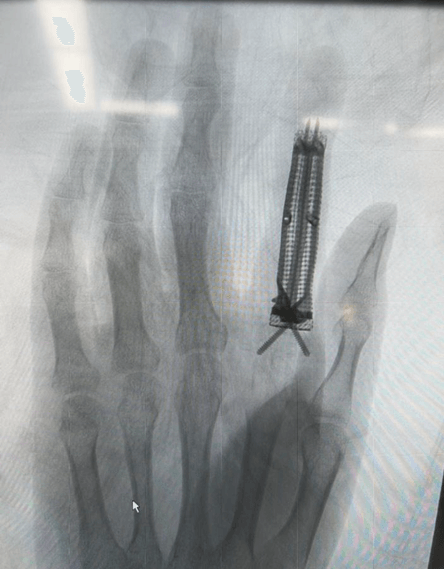
Due to significant finger bone defect after surgical resection of finger bone tumor,27Mr. Wu (pseudonym), a 20-year-old Shenzhen citizen, received medical treatment at the Southern University of Science and Technology Hospital.3DThe implantation of a phalangeal prosthesis made of printed titanium alloy made it possible to regain a finger with a normal appearance and basically normal functions, and also regained confidence.
After resection of a bone tumor, only the finger bones remain1centimeter
According to Mr. Wu,9More than a month ago, a bone tumor appeared on his left index finger, which was surgically removed at another hospital. The operation removed most of the bone segment from his left index finger and the doctor performed a temporary filling and reconstruction operation with bone cement. After the operation, Mr. Wu’s left index finger could no longer flex or extend and gradually deviated toward the middle finger side. At the same time, there was obvious atrophy and thinning, which was shorter than before.2centimeter.CTThe examination showed that the previous temporary filling and reconstruction operation with bone cement had changed after the operation, and Mr. Wu’s left index finger gradually developed obvious deviance.
How to solve the problem of finger bone defects? Mr. Wu learned that traditional surgery involves removing the patient’s hip bone or other parts of the bone for implantation, but considering his talent,27At the age of 18, he used large pieces of his own bones. This technique could affect his future life. He wanted to find a less harmful solution.
After many investigations, Mr. Wu came to the Southern University of Science and Technology Hospital because of his reputation. Director Zhao Dongsheng, Department of Trauma and Orthopedics, Department of Orthopedic Medicine, and3DPei Yanjun, deputy director of the Department of Printing Medicine, carefully researched and formulated3DDetailed surgical plan for printing a titanium alloy finger bone prosthesis to solve the bone defect problem. During the operation, the original bone cement must be removed and replaced with3DPrint a prosthetic finger bone made of titanium alloy instead. The difficulty of the operation is that the remaining bone segment of Mr. Wu’s left index finger is very short and insufficient.1cm, fixation and healing of the prosthesis and the residual bone surface are not easy.

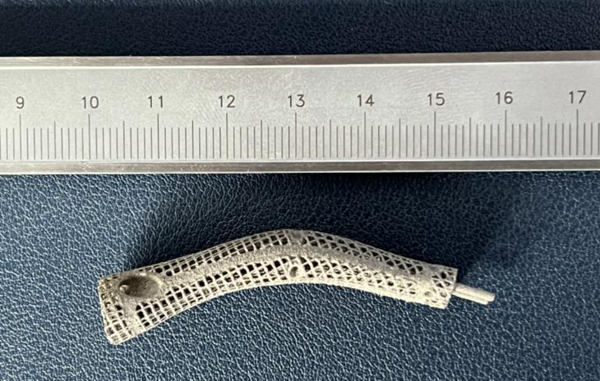
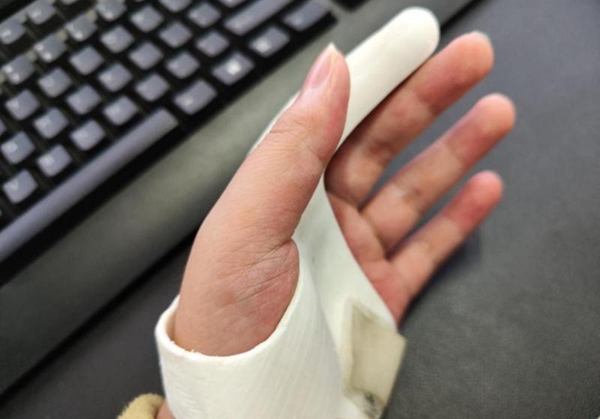
Mr. Wu holds a master’s degree in materials science. He completely agrees with the surgical plan proposed by director Zhao Dongsheng. He knows that titanium alloy prostheses are very suitable for biological implants. After perfecting the preoperative preparations, the operation was carried out by director Zhao Dongsheng and director Zheng Muping and was carried out under general anesthesia.2Hours completed successfully. after surgery,3DPei Yanjun, deputy director of the Department of Printing Medicine, customized it for Mr. Wu3DA splint was printed for fixation and protection of the fingers. Mr. Wu came to the outpatient clinic for regular check-ups. Currently, Mr. Wu is satisfied with the appearance of his fingers and their functions are recovering. Healing human fractures usually requires3more months,3DHealing of printed prosthetics may take longer. During this period, corset protection and appropriate functional exercises are important. Mr. Wu’s fingers should have functions that meet his daily needs.
These patients are suitable for3DPrinted prosthetic implants
According to director Zhao Dongsheng,3DImplantation of printed prosthetics is suitable for special personalized parts and large bone defects. The advantage is that it does not need to be obtained from the bone tissue itself and is not subject to the limitations of existing prostheses on the market. the actual situation of the patient’s bone defect. Personalized print. Department of Orthopedic Medicine, Hospital of Southern University of Science and Technology3DIt has considerable advantages in impression of prosthetic implantation. This subject is a key medical specialty in Nanshan District, and the subject leader is an advocate, promoter and leader of digital orthopedics in China. It is reported that the Hospital of Southern University of Science and Technology was authorized to establish the Guangdong-Hong Kong-Macao Intelligent Medical Innovation Research Institute of Southern University of Science and Technology, who understands3DFour departments, including the Department of Printed Medicine, have unique advantages in intelligent and digital surgery.
Source: Internet
Daguang focuses on providing solutions such as precision CNC machining services (3-axis, 4-axis, 5-axis machining), CNC milling, 3D printing and rapid prototyping services.



















