
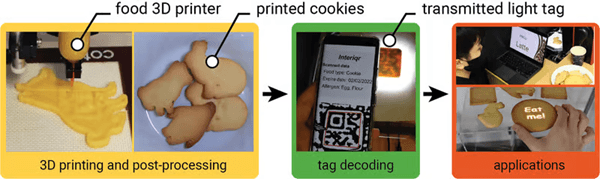
2022Year10moon22day, fromeurekalertThe website has learned that researchers at Osaka University in Japan have developed a method to embed a discreet edible label in food, which can be read without destroying the food first. According to the researchers, another major advantage of this method is that the labeling does not change the appearance or taste of the food.
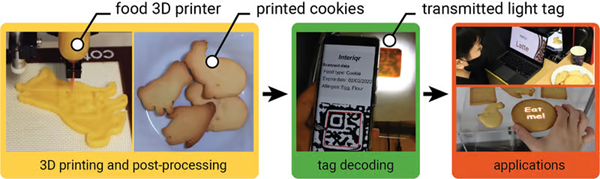
△The image on the left is to be used3DPrinters embed edible data into food products. Image source:eurekalertwebsite
This technology is called“interior» (i.e. “internalQR“), developed by a research team at Osaka University in Japan, as a proof of concept, the researchers said recently.3DSome cookies were printed. These cookies were smooth on the outside and looked like regular cookies, but there was a QR code pattern consisting of a space inside.
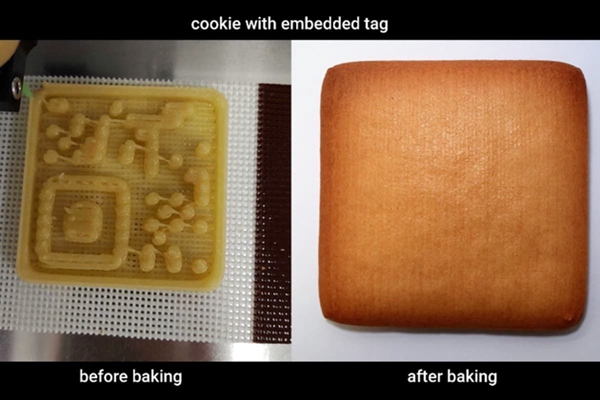
Tags containing data are commonly used in the food industry. They range from simple fruit stickers to radio frequency labels that use electromagnetic fields to automatically identify and track products. However, as people try to reduce additional packaging, scientists are racing to develop edible food labels that are essentially non-toxic and do not change the taste or appearance of food, while being readable without damaging the food. themselves. Yamato Miyatake, lead author of the study, says many foods are now available3DProduction of printers. “We realized that the inside of an edible object such as a cookie could be printed to contain a pattern of empty space so that when you shine a light on the back of the cookie, the QR code becomes visible and can be read by a mobile phone.
By using a QR code created from the cookie itself as a label, all information is contained inside the cookie, so the appearance of the cookie remains completely unchanged. And because the QR code can be made visible using a simple backlight, this information is easily accessible to manufacturers, retailers and consumers at any stage of the cookie’s journey, from factory to consumption . Obviously, for now, the technology will be limited to relatively thin and somewhat translucent materials.3DUsed in food printing. Still, scientists hope it could eventually provide manufacturers, retailers and consumers with an alternative to more costly and expensive methods, such as paper labels commonly applied to fruit or plastic labels on packaging.RFIDLabel. If information such as ingredients and nutritional content can be conveyed through the food itself, less packaging can be used.
Researchers say this3DPrinting methods are a good example of digital food processing and will improve food traceability and safety. This technology can also be used to deliver new food experiences through augmented reality, an exciting new area in the food industry. This new way of integrating edible information into food is also important for reducing waste, and widespread adoption of these technologies should pave the way for a cleaner future.
Source: 3D Printing Network
Daguang focuses on providing solutions such as precision CNC machining services (3-axis, 4-axis, 5-axis machining), CNC milling, 3D printing and rapid prototyping services.



















