
In the plastics industry, the term“Particles” refers to small particles of various shapes (small cylinders or discs) made of polymers or polymer blends. They are used as raw materials for the manufacture of finished plastic products using different technologies, including additive manufacturing. The process used for pellets in 3D printing is the extrusion of the material, which often involves a comparison to using a filament. Today we’ll explore why using particles in 3D printing can be beneficial and analyze the top 10 reasons why manufacturers and users choose this technology. The choice depends not only on the shape of the material used, but also on the type of material, the machine used, the final application, the size of the part, the flexibility and speed of printing, as well as of the durable aspect of the print. Particles.
1: Wide choice of materials
to useOne of the main motivations for 3D particle printing is the possibility of obtaining a wide variety of materials. When we talk about the FFF process, there are many materials, but they are all in the form of filaments, which does not always meet the needs. On the other hand, the pelletization process makes it possible to transform the plastic material into particles without significantly damaging the starting polymer, as is the case when manufacturing filaments. Pellets therefore make it possible to use virgin polymers, thermoplastics and even composites with additives such as glass or carbon fiber. It is therefore possible to try new formulations to adapt to the mechanical, thermal or aesthetic properties of the finished product and obtain a tailor-made formulation. Finally, pellets are also used in other production techniques, such as injection molding, which broadens the choice of materials available.
2: Greater printing flexibility
consider inAnother reason to use pellets in 3D printing is the ability to use different machines, from desktop 3D printers to robotic arms to make large parts. Robotic 3D printing offers great printing flexibility, because it can work along 5 axes and on very large surfaces, which makes it possible to create medium and large-sized parts for various industries: from construction to design. , through transportation and others. Pellets are particularly suitable for large format 3D printing because using large quantities of material in filament form is economically disadvantageous. Additionally, using pellets allows the use of extruders with a diameter greater than 0.8mm (the limit of filament 3D printing), which is ideal for larger and faster prints.
3: Reduce costs
to useOne of the main reasons for particle 3D printing is undoubtedly cost reduction. Since filament is made from pellets, it is conceivable that the cost of pellets will be much lower than filament (printing cost per kilogram is expected to be 65-90% lower). Additionally, as pellets are also used in other technologies such as injection molding, this significantly expands the market and reduces costs.
The economic benefits are even greater when printing large quantities of materials and large parts with typically shorter lead times than printing with consumables. It should be noted that the cost of infrastructure remains high since they generally involve large machines. However,Particle 3D printing offers some flexibility in this regard, with small and medium-sized businesses now able to build their own machines at lower cost.
4: Circular economy
existThe use of particles in 3D printing can support the circular economy in several ways. Firstly, pellets can be produced from recycled materials, thereby reducing plastic waste and reintroducing it into the production cycle. Particle printers make it possible to use recycled plastic or industrial waste, limiting the need for new raw materials. Additionally, users can choose to directly recycle prints or failed prints, making the entire printing process more sustainable and reducing environmental impact. This approach is fully in line with the principles of the circular economy, where the reuse of materials is essential to reduce waste and energy consumption.

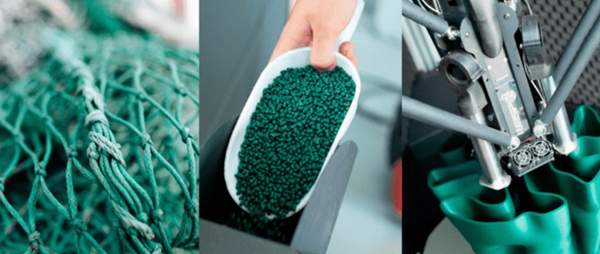
Reflow has partnered with WASP to produce rPPGF material from fishing nets, which is recycled and made into pellets for 3D printing. (Photo credit: WASP)
5: Faster production speed
Additive manufacturing using particles is fast, mainly because of the ability to use larger particles.FFF 3D printing machines use larger nozzle diameters. Therefore, this increases the speed of printing and production and helps reduce costs. This perspective, however, has a less positive side: by increasing the size of the nozzles and the printing speed, the final part loses detail and finesse.
6: Reduce the risk of printing errors
Due to the nature of the direct extrusion process, pellets are3D printing reduces the risk of interruptions and printing problems. The pellets melt continuously, eliminating the need to change materials during processing, as is the case with filament spools. Additionally, this type of polymer does not suffer from typical filament twisting or warping, reducing the risk of extruder clogging or blocking. The pellet extrusion system is configured to handle larger volumes and continuous material flow, making the printing process smoother and more reliable. That said, particle shape is crucial for 3D printing: before you start printing, it’s important to make sure the particles are compatible with the 3D printer you’re using.
7: Multi-material and multi-color 3D printing
In terms of materials we can look at particlesAdded to the advantages of 3D printing is the fact that several materials can be mixed directly in the print head of the machine. Of course, you must evaluate the printing temperature and the specific characteristics of each material and choose the most suitable printer. Additionally, color additives can be introduced into the particles and create multi-colored or differently colored parts in a single print. Pieces with unique and very individual properties can thus be obtained.
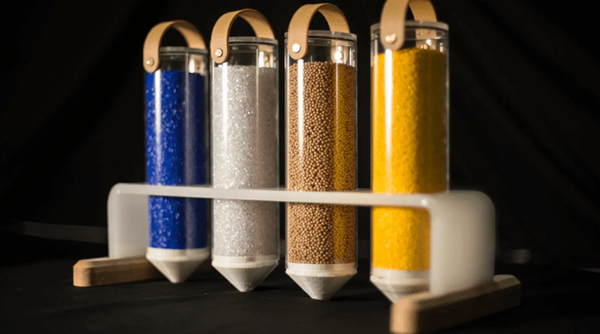
existThe use of particles in 3D printing allows for a variety of materials, colors and greater printing flexibility. (Photo credit: Pollen)
8: Properties of the final part
The use of pellets allows high final properties to be obtained because they retain the properties of the raw material. It is not possible to achieve exactly the same results using filament, which is added to the printing process during its production, so the properties of the final product are different from those of the raw material. existThe use of particles in 3D printing makes it possible to obtain parts with the same chemical and physical properties as those obtained by injection molding.
9: Simplify production
As mentioned above, granular materials are also used in other production techniques. Their use therefore simplifies production since it allows the same materials to be used for additive manufacturing and other processes, such as injection molding. This is particularly beneficial for companies that use multiple technologies, thereby optimizing raw material management, reducing logistics costs and streamlining the entire supply chain. For example, the use of pellets makes it possible to quickly move from prototyping to mass production. During the prototyping process, the use of particles can be3D printing tests the properties of materials, which are then quickly mass-produced by injection molding.
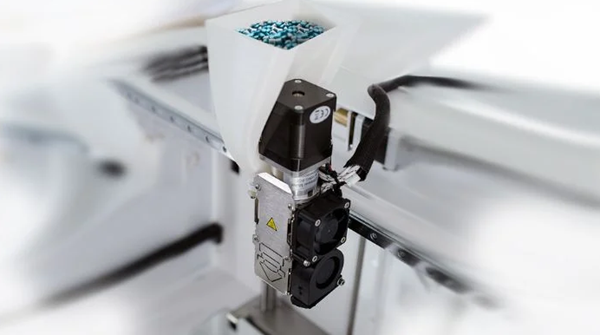
Pellets on the marketThe number of 3D printing solutions continues to increase, including LFAM solutions and smaller format solutions. (Photo credit: Tumaker)
10: A growing market
There is no doubt that this technology is inferior to filament extrusion.3D printing is popular, but the selection of particle 3D printing solutions on the market is becoming more and more diverse. The limitations of adopting this technology are mainly the high cost of the machine (usually more complex and larger) or the low printing precision. This is why companies and startups are trying to bring more affordable solutions to the market, such as pellets created specifically for 3D printing or optimized extruders that can be adapted to machines the company already has.
source:3dnatives
Daguang focuses on providing solutions such as precision CNC machining services (3-axis, 4-axis, 5-axis machining), CNC milling, 3D printing and rapid prototyping services.



















