
Why Are Some Products Only Using 5-Axis CNC Machining?
Some parts fail on a 3-axis mill no matter how many fixtures you build. This guide is for engineers and buyers who need to know whether a product truly falls into the group of products only using 5-axis CNC machining, or whether the real problem is fixturing, tool reach, or tolerance stack-up. Read the symptom table, then work the eight checks.
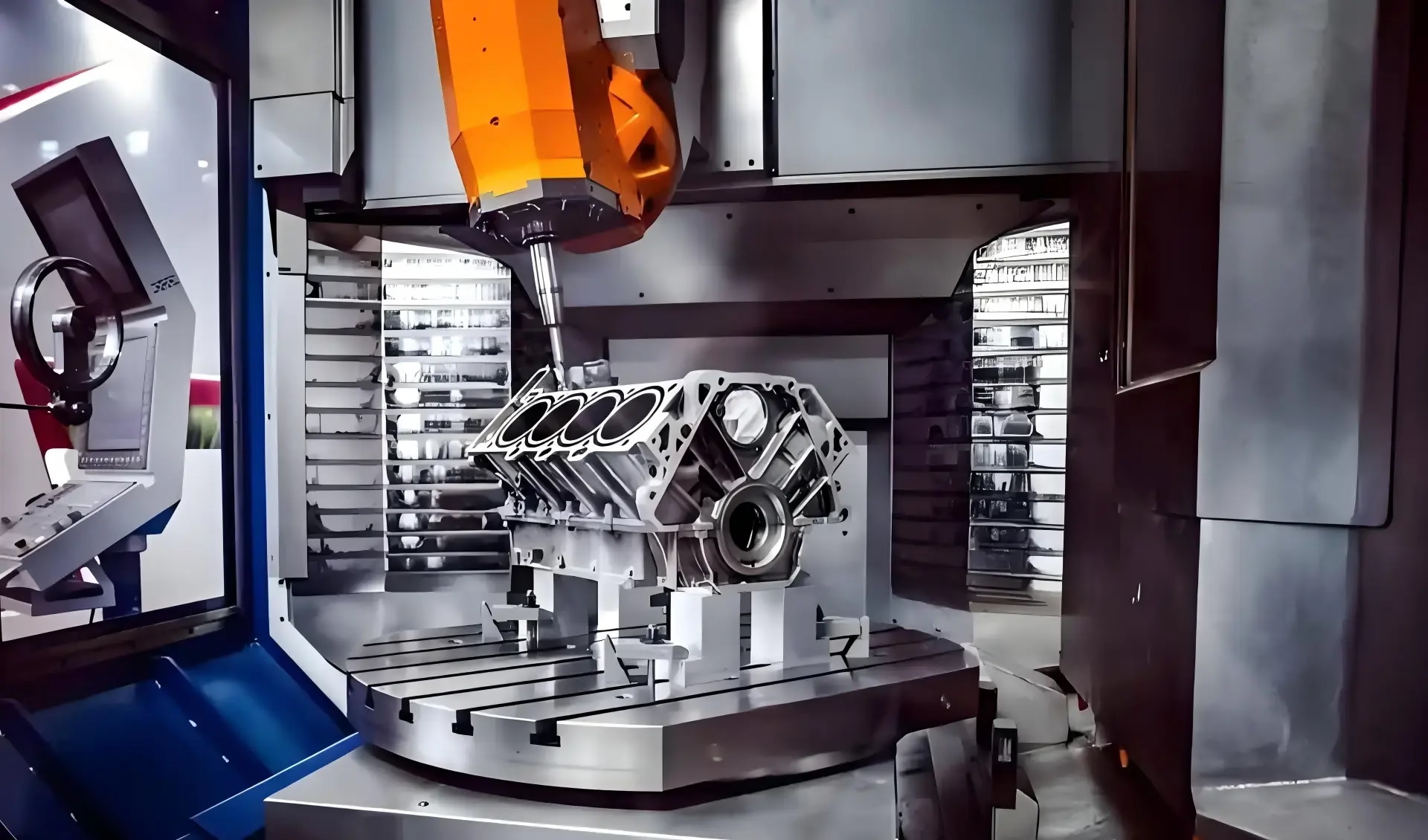
Symptom, likely cause, and what to do
Use this table first. If your part matches a row, the fix in column three tells you whether it belongs to the group of products only using 5-axis CNC machining or just needs a better setup.
| Symptom on the part | Likely cause | How to handle it |
|---|---|---|
| Undercut or back-side pocket no tool can reach | Single-direction tool axis from a 3-axis setup | Tilt the tool axis; check if 5-axis is required |
| Deep cavity walls need Ra 0.8–1.6 μm finish | Long tool deflects; chatter marks on walls | Shorten overhang, or use simultaneous 5-axis motion |
| True position drifts past ±0.005 mm across setups | Stack-up from four or more refixturings | Cut all faces in one 5-axis setup |
| Compound-angle holes come out oval | Entry angle is off-normal to the surface | Use a rotary table to drill normal to the surface |
| Impeller blade edges show steps | Point-to-point surfacing on 3-axis only | Continuous 5-axis toolpath keeps the nose in contact |
| Thin-wall box parts bow after unclamping | Clamping force plus interrupted cuts | 5-axis contour passes at light radial depth |
| Setup count makes the quote uneconomic | 4–6 fixtures, each with its own error budget | One 5-axis setup replaces all of them |
| Part fits 3 axes but cycle time is too long | Tool changes dominate the cycle | Keep 3-axis; 5-axis will not shorten it much |
The bottom line
If your part shows undercuts, compound curvature, or a tolerance chain broken by four or more setups, it belongs to the products only using 5-axis CNC machining. If none of those apply, a 3-axis route will usually be cheaper and just as accurate. Send us the model and we will tell you which one it is.
What separates products only using 5-axis CNC machining from the rest
A 5-axis machine adds two rotary axes to the three linear ones. The spindle can point at the workpiece from almost any direction, so the cutting edge reaches surfaces a 3-axis setup can only reach by unclamping and turning the part. That is a geometry fact, not a marketing claim. If every surface on your part can be reached along one Z direction, you do not need five axes.
The parts that genuinely belong to the group of products only using 5-axis CNC machining share a few traits. Undercuts. Compound angles. Deep cavities with tight corner radii. Blades or vanes with continuous curvature. Thin walls where one extra clamp will bury the part. And parts whose true position across many features breaks down once you add a fourth or fifth refixturing.
There is a cost side too. A 5-axis setup is not free. Programming takes longer, the machine hour costs more, and simulation is not optional. We run 16 simultaneous 5-axis machining centers at GreatLight alongside 27 three-axis machines. We route work to 3-axis whenever the geometry allows, because that is cheaper for the customer. When the part truly cannot be made another way, we say so and quote it on five axes.
Five signs a part can only be made on 5 axes
First sign: the tool cannot reach a surface without tilting. Picture a pocket on the underside of a boss, or a slot whose floor faces sideways. On a 3-axis machine you would need a custom angled tool or an extra setup. On a 5-axis machine, the table or the head rotates and a standard end mill reaches it in the same setup.
Second sign: the surface is doubly curved. A turbine blade, a boat propeller, a facial implant, a lens mold insert. These have curvature in two directions at once, and a 3-axis ball-nose path leaves visible scallops unless the stepover is tiny. Simultaneous 5-axis motion keeps the tool nose normal to the surface and lets you run a larger stepover at the same finish.
Third sign: tolerance across many faces. Suppose a hydraulic manifold has twelve ports on four sides, each with a true position of Ø0.05 mm. Every refixturing adds error. Cut it in one 5-axis setup and the tolerance chain collapses. Our working tolerance is ±0.005 mm, but the setup count is what usually kills the part, not the machine.
Fourth sign: the material punishes extra setups. Titanium Ti-6Al-4V, Inconel, 17-4PH. Each clamp and unclamp risks a scrapped surface. A single 5-axis setup removes that risk. Fifth sign: the part is thin. A 0.8 mm wall on an aluminum housing will move under a second clamp. Five-axis contour passes at light radial depth hold the wall without extra support.
If your part shows two or more of these signs, it likely belongs to the products only using 5-axis CNC machining. If it shows none, look at fixturing and tooling before you pay for five axes.
Cases where 5-axis is the wrong call
Prismatic parts with flat faces and through-holes do not need five axes. A bracket, a plate, a spacer, a simple housing. A 3-axis machine with a good vise will hit the same tolerance faster and cheaper. Adding rotary motion to that job only adds programming time and simulation risk.
Parts with one critical face and loose tolerances elsewhere are also a poor fit. If only the top surface must hold Ra 0.8–1.6 μm and the rest is cosmetic, a 3-axis finish pass plus a bead blast will get there. Five axes will not improve the surface that already meets spec.
Very large flat work is another boundary. Our 5-axis envelope reaches 4,000 × 400 × 150 mm on the long-travel machines, and 750 × 1,150 × 550 mm on the medium ones. Beyond that, a large gantry mill with an indexing head may be the practical route. We will tell you when a part does not fit and suggest the alternative.
Finally, prototypes with one or two pieces sometimes do not justify a 5-axis program. If the part is small and the geometry is simple, a manual tilt or a custom fixture on a 3-axis machine is faster. The math changes at 10, 50, or 500 pieces, where the setup savings compound.
Step by step: checking whether your part needs five axes
- 1Map every surface and its tool approachOpen the model and mark each face with the direction a tool must come from. If more than one direction is needed on a single face, that is your first flag. Use a 3D viewer with section cuts, not just a shaded view.
- 2Count the setups on paperList the fixturings a 3-axis route would need. Four or more is a strong signal. Each setup adds roughly 0.01–0.02 mm of positional error in a well-controlled shop; stack five and you are already past a ±0.005 mm feature.
- 3Check tool overhang to depth ratioFor a cavity 60 mm deep with a 6 mm end mill, the L/D is 10:1. That will chatter. Either reduce depth of cut to 0.05 × D radial and accept a slow cycle, or tilt the tool on a 5-axis machine to stiffen the effective setup.
- 4Look at the surface curvatureIf the model has curvature in two directions, a 3-axis ball-nose path needs a stepover around 0.1 mm to hide scallops. Simultaneous 5-axis keeps the nose normal and allows a stepover of 0.3–0.5 mm at the same Ra.
- 5Measure the thinnest wallBelow 1.5 mm in aluminum or 2 mm in steel, clamping is the risk. Plan a 5-axis contour strategy with 0.2–0.5 mm radial depth and light finishing passes instead of a second vise grip.
- 6Check material and heatTitanium and Inconel work-harden. Each extra setup exposes a fresh surface and risks a scrapped side. A single 5-axis setup with high-pressure coolant and moderate speeds protects the part.
- 7Simulate before you cutRun full machine simulation including the rotary axes, the holder, and the table. Look for collisions at A-axis limits of ±110° or C-axis wrap. A crash on a 5-axis machine costs far more than on a 3-axis one.
- 8Compare cost per part at three quantitiesQuote at 1, 50, and 500 pieces for both routes. Five-axis wins on setup-heavy jobs at 50+ pieces. For a single simple part, 3-axis with a fixture is usually cheaper and faster.
Common questions from engineers and buyers
Can a 4-axis machine handle parts I think need five axes?
Sometimes. A 4-axis mill adds one rotary axis, usually A or B, so it can index around one direction. Parts with features on four sides of a prismatic block are often fine on 4-axis.
The gap opens when the tool must stay normal to a curved surface, or when two rotary axes must move at the same time. That is when the part moves into products only using 5-axis CNC machining.
Does 5-axis always hold tighter tolerance than 3-axis?
No. The machine itself is not magically more accurate. The advantage is fewer setups, which removes the error that refixturing adds.
If a part is simple and cut in one 3-axis setup, a 3-axis machine will hold the same ±0.005 mm. The benefit of five axes is geometric reach and setup reduction, not raw accuracy.
How do you decide between 3-axis and 5-axis for a new part?
We look at tool approach directions, setup count, surface curvature, wall thickness, and material. We run a free DFM analysis within 12 hours and tell you which route we recommend and why.
If five axes add cost without solving a real geometry problem, we will say so.
What size parts can you run on five axes?
Our 5-axis envelope reaches 4,000 × 400 × 150 mm on the long-travel machines, and 750 × 1,150 × 550 mm or 600 × 600 × 600 mm on the medium ones. Compact machines handle 500 × 500 × 450 mm and 500 × 310 × 200 mm.
The rotary table is Ø400 mm. If a part is larger, we will suggest a different process rather than force it.
Do you charge more for five-axis work?
The machine hour rate is higher than 3-axis, and programming takes longer. That is normal across the industry.
On parts with many features on multiple faces, the total can still come out lower because the setup count drops. We quote both routes when both are viable.
What do you need to quote a 5-axis job?
A STEP or IGES file, a 2D drawing with tolerances and surface finish, the material, and the quantity. If you have critical features, mark them.
We can sign an NDA before you upload. Files stay confidential, and we do not share customer parts or drawings.
Send your part, get a straight answer
Upload a STEP file and get a quotation plus free DFM analysis within 12 hours. We will tell you whether five axes are needed, and what it costs either way.
12-hour quote100% inspectionNo minimum order quantity
More from GreatLight
We publish setup notes, tooling trials and inspection data from the factory floor.











