
Products currently machined by 5-axis CNC
This page explains what 5-axis machining actually does to a part, which products currently machined by 5-axis CNC belong on a simultaneous machine, and when a 3-axis or 4-axis job will do the same work for less. Written for design engineers and buyers who need to make that call before sending a drawing out for quote.
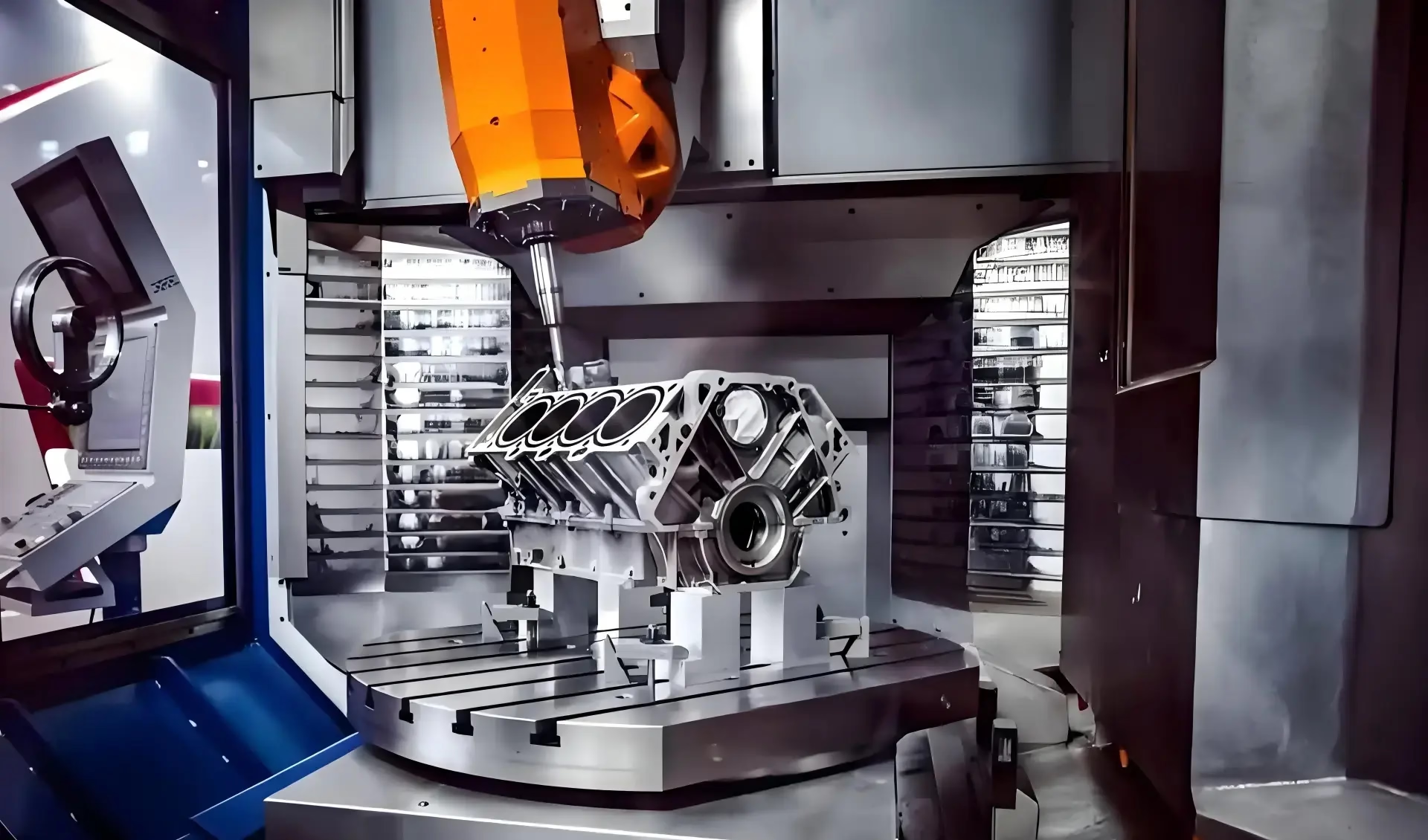
What simultaneous 5-axis motion changes about a part
A 3-axis mill moves the tool in X, Y and Z while the part stays clamped in one orientation. Every surface that faces away from the spindle needs a second setup, a new datum, and a new chance for stack-up error. A 5-axis machine adds two rotary axes, so the tool can approach the part from almost any direction while the part stays in one fixture.
The word that matters is simultaneous. A 5-axis machine can also run in 3+2 mode, where the table indexes to a new angle and then locks. That is positioned machining, and it still removes the multiple-setup problem. Simultaneous mode is different: all five axes move at once, so the tool tip follows a continuous path across a curved surface.
That continuous path is what lets a cutter stay normal, or near-normal, to the surface it is cutting. A ball nose tool held at a fixed angle leaves a scallop pattern and cuts with only part of its edge. Tilt the tool slightly and the same cutter engages more of its flute, spreads wear, and can reach into corners a fixed angle cannot enter.
The engineering payoff shows up in three places: fewer setups, tighter true position across faces, and shorter tools. A short tool is a stiff tool. On deep cavities, 5-axis motion lets the holder clear the wall and reach the floor with a stubby cutter instead of a long, chattering one.
Which products currently machined by 5-axis CNC need it
Most parts machined on a 5-axis machine do not strictly require one. The honest dividing line is whether the geometry contains surfaces that cannot be reached without repositioning, or features on several faces that must hold a tight tolerance to each other.
Impellers, bladed disks and turbine rotors sit at the top of the list. The blades twist, lean, and sit close together. There is no 3-axis approach that reaches the blade root without the shank rubbing the next blade. This is the classic case where 5-axis is not a speed choice, it is the only choice.
Engine and transmission housings come next. They carry bores on multiple faces, sealing faces, and mounting pads that must all sit in the same coordinate frame. Machining them on a 3-axis machine means four or five setups and a fixture stack. Each setup adds datum error. On a 5-axis center the housing is located once and every face is cut from that single origin.
Aerospace structural parts follow the same logic. Ribs, pockets and thin walls on a curved profile are hard to reach and easy to deflect. Tilting the tool lets a machinist use a smaller step-over and a shorter cutter, which lowers cutting force on thin webs. The part comes off the machine closer to net shape and needs less hand finishing.
Medical and optical components bring a different driver: surface finish. A polished implant, a lens mold insert, or a surgical instrument with compound curvature benefits from a tool that stays normal to the surface. We hold Ra 0.2–0.8 μm on fine-finish work, and Ra 0.8–1.6 μm on most production parts, without sending the part out for hand polishing.
Robotics and automation parts sit between these groups. A robot wrist housing or an end-effector bracket often has angled faces, dowel pin bores, and a bearing seat that must be coaxial with a shaft bore. Five-axis machining keeps those relationships in one setup, which is usually cheaper than building a dedicated fixture for a 3-axis run.
When 5-axis machining is the wrong call
A 5-axis center costs more per hour than a 3-axis machine, and the programming takes longer. If a part is prismatic, with all its features opening toward one direction, a 3-axis machine will cut it faster and cheaper. A rectangular plate with a pocket and a few drilled holes does not need rotary motion.
Parts with a single datum face and generous tolerances are the same story. If a bracket can be flipped once and re-located on a pin, the second setup costs less than the extra machine time. The tolerance has to justify the method, not the other way around.
Very large parts can also fall outside the sweet spot. Our 5-axis centers cover travels from 500 × 500 × 450 mm up to 4,000 × 400 × 150 mm, with a Ø400 mm rotary table. A part that fits a 3-axis bed but not a rotary table may be better off on a 4-axis mill or a mill-turn center.
Soft plastics and foams rarely need five axes. Cutting forces are low, so a long tool does not chatter the way it would in steel. If the geometry allows a 3-axis approach from two sides, that is usually the economical route.
The practical test is simple. Count the setups a 3-axis plan would need. Count the features that must hold tolerance across those setups. If the answer is three or more setups with a tight cross-face relationship, get a 5-axis quote. If it is one or two setups with loose tolerances, stay on 3-axis.
How material and tool access shift the decision
Material changes the cutting parameters, not the setup logic. Aluminum 6061, 7075 and 6082 cut freely and tolerate long tools better than steel. Titanium TC4 (Ti-6Al-4V) and Inconel do the opposite: they push cutting forces up, so tool stiffness matters more, and 5-axis access to a short cutter becomes more valuable.
Stainless grades such as 17-4PH and 316L work-harden if the cutter rubs. A tool held normal to the surface keeps a consistent chip load and avoids the rubbing that starts a hard layer. That is one reason medical and food-equipment parts often land on a 5-axis machine even when the shape looks simple.
Tool access is the other half of the decision. Add up the length-to-diameter ratio of the longest cutter a 3-axis approach would need. Above roughly 4:1 in steel, chatter and taper become real risks. Five-axis motion usually lets that same feature be cut with a 3:1 tool.
Fixturing cuts both ways. A 5-axis setup still needs workholding, and the fixture must not block the rotary motion. Thin-walled parts may need soft jaws or a vacuum plate. If the fixture is more complex than the part, the geometry probably does not justify five axes.
We machine 6061-T6, 2024, 5052, 5083, 6063, 7075 and ADC12 aluminum, 303 through 440C stainless, 1018 to 4340 steel, C101 to C36000 copper and brass, TA1, TA2, TC4, Inconel, magnesium AZ31B and AZ91D, plus ABS, POM, PEEK, PA and carbon fiber. The machine choice depends on shape and tolerance, not on the material list.
Matching part type to machine configuration
Use this as a first screen before requesting a quote.
| Part type | Best configuration | Why |
|---|---|---|
| Impeller, blisk, rotor | Simultaneous 5-axis | Blade roots unreachable in 3 axes |
| Engine or gearbox housing | 5-axis or 3+2 | Multiple faces in one coordinate frame |
| Aerospace rib and pocket | Simultaneous 5-axis | Short tool needed for thin webs |
| Implant, lens mold insert | Simultaneous 5-axis | Compound curvature, fine finish |
| Robot wrist housing | 5-axis or 4-axis | Angled bores, coaxial features |
| Flat plate with pocket | 3-axis | All features open one direction |
| Shaft with cross holes | 4-axis or mill-turn | Rotation about one axis is enough |
| Foam or soft plastic shell | 3-axis | Low cutting force, no chatter risk |
The call, in one line
If a part needs three or more setups on a 3-axis machine, or has features on different faces that must hold ±0.005 mm to each other, quote it on a simultaneous 5-axis center. If it is prismatic and opens one way, stay on 3-axis and put the money into finishing.
Questions engineers ask next
Does every part on a 5-axis machine use all five axes at once?
No. Many jobs run in 3+2 mode, where the rotary axes index to an angle and lock before cutting. That removes extra setups without the programming cost of simultaneous motion.
Simultaneous motion is reserved for curved surfaces, deep cavities and blade passages where the tool angle must change while it cuts.
Can a 5-axis machine hold the same tolerance as a 3-axis machine?
Yes, when the machine is in good condition and the setup is rigid. We hold ±0.005 mm (±0.0002 in) on production work.
The rotary axes add error sources, so the machine must be calibrated and the fixture must be stiff. A loose fixture hurts more on five axes than on three.
How do I know if my part needs simultaneous motion?
Look at the surface normals. If the tool must stay normal to a curved surface across a wide sweep, you need simultaneous motion.
If every feature can be reached from a small number of fixed directions, 3+2 indexing will usually do the job for less.
What part size can you cover?
Our 5-axis travels run from 500 × 500 × 450 mm and 500 × 310 × 200 mm on the compact machines, through 750 × 1,150 × 550 mm and 600 × 600 × 600 mm, up to 4,000 × 400 × 150 mm. The rotary table is Ø400 mm.
The maximum processing size across the shop is 4,000 mm. Parts beyond a rotary table's capacity may be better on a 3-axis or mill-turn machine.
Do you inspect 5-axis parts differently?
Every part gets a raw material check, in-process monitoring and a final inspection before shipment. Inspection reports are available on request.
For parts with cross-face tolerances, the first article is checked against the CAD model rather than against a single drawing view.
What is the lead time and minimum order quantity?
Quotation and free DFM analysis come back within 12 hours. Production can start within 24 hours, and parts typically ship in 3–5 days.
There is no minimum order quantity. We run from one prototype to 10,000+ part runs.
Send the drawing, get a straight answer
Upload your CAD file and we will tell you whether the part belongs on a 5-axis center or a 3-axis machine, with a quote and DFM notes inside 12 hours.
12-hour quote100% inspectionNDA on request
More from GreatLight
We publish setup notes, tooling trials and inspection data from the factory floor.











