
Navigating the complex world of precision manufacturing, whether you’re a startup scaling up prototype production or an established enterprise optimizing your supply chain for high-end parts, the question What To Ask Before Buying CNC Machine? is one that demands careful, informed answers. This question isn’t just about hardware specifications—it’s about aligning your investment, whether in a standalone machine or a trusted machining partner, with your long-term quality, efficiency, and innovation goals.
What To Ask Before Buying CNC Machine?
First, Clarify Your Core Objective: In-House Machine vs. Outsourced Machining Services
Before diving into specific questions, it’s critical to define your end goal. Are you looking to invest in an in-house CNC machine to bring production under direct control? Or would outsourcing to a specialized service provider be a more cost-effective, flexible solution?
For small-batch projects, complex part geometries, or industries with strict regulatory requirements (like medical or aerospace), outsourcing often makes more sense. It eliminates the high upfront costs of machine purchase, maintenance, and training, while giving you access to cutting-edge equipment and specialized expertise that’s hard to replicate in-house. On the other hand, if you have continuous, high-volume production of standardized parts, an in-house machine might offer long-term cost savings. Let’s break down the key questions for both scenarios.
Key Questions to Ask If Buying an In-House CNC Machine
If you’ve decided that an in-house machine is the right fit, these questions will help you avoid costly mistakes:
What Precision and Tolerance Capabilities Do I Need?
Not all CNC machines are created equal when it comes to precision. For example, medical implants may require tolerances as tight as ±0.001mm, while simple structural parts might only need ±0.1mm. Be honest about your current and future part requirements—overinvesting in a hyper-precise machine for basic parts will waste resources, while underinvesting will lead to rejected components.
Can the Machine Handle My Target Materials and Part Complexity?
Aluminum and plastic are relatively easy to machine, but materials like titanium, mold steel, or heat-resistant alloys demand robust machines with high torque and rigid frames. Additionally, parts with undercuts, curved surfaces, or multi-axis machining needs will require a 4-axis or 5-axis machine, which comes with a higher price tag.
What Is the Total Cost of Ownership (TCO) Beyond the Purchase Price?
The sticker price of a CNC machine is just the tip of the iceberg. You’ll need to account for ongoing costs like:
Installation and facility modifications (e.g., power requirements, dust extraction)
Regular maintenance and replacement parts
Operator training and labor costs
Software licenses for CAD/CAM integration
Downtime during maintenance or troubleshooting
Does the Machine Offer Scalability for Future Projects?
Your manufacturing needs will evolve over time. Look for machines that can be upgraded with additional axes, tool changers, or automation features (like robotic loaders) to accommodate larger parts, higher volumes, or more complex geometries without needing a full replacement.

What Post-Purchase Support and Training Are Included?
Even the best machine is useless if your team can’t operate it effectively. Ask about:
On-site training sessions for operators and programmers
24/7 technical support for emergency issues
Warranty coverage for parts and labor
Access to replacement parts and service centers in your region
Critical Questions to Ask When Outsourcing CNC Machining Services
For most businesses, especially those focused on innovation rather than mass production, outsourcing CNC machining services is the smarter choice. To find a partner that aligns with your needs, ask these critical questions:
What Machining Capabilities Do You Offer, and How Do They Match My Part Requirements?
Start by outlining your part’s complexity, size, and tolerance needs. For parts with intricate geometries, undercuts, or multi-angle features, you’ll need a partner with advanced five-axis CNC machining services (opens in new window) — a capability that GreatLight CNC Machining Factory has mastered with its fleet of high-precision five-axis centers from top manufacturers like Dema and Beijing Jingdiao. GreatLight also offers a full suite of services including 3-axis, 4-axis CNC machining, CNC milling, die casting, sheet metal fabrication, and 3D printing (SLM, SLA, SLS) for metal and plastic parts. Their maximum processing size of 4000mm means they can handle both small prototypes and large industrial components.
Do You Have the Certifications and Quality Management Systems to Ensure Consistent Results?
In regulated industries like automotive, medical, and aerospace, certifications are non-negotiable. Look for partners with ISO 9001:2015 (quality management), IATF 16949 (automotive and engine hardware), ISO 13485 (medical devices), and ISO 27001 (data security). GreatLight CNC Machining Factory holds all these certifications, ensuring that every part meets international quality standards and your specific regulatory requirements. Their ISO 9001 compliance means strict process controls from design to delivery, while IATF 16949 ensures they adhere to the rigorous standards of the automotive supply chain.
Can You Provide a Full-Process, One-Stop Solution for My Parts?
Machining is just one step in the production process. You’ll save time and reduce errors by working with a partner that offers one-stop services, including design optimization, post-processing (e.g., anodizing, powder coating, polishing), and quality inspection. GreatLight excels here: they provide end-to-end solutions from prototype design to mass production, with nearly a hundred post-processing options to meet your aesthetic and functional needs. This eliminates the hassle of coordinating multiple vendors and ensures consistency across all stages of production.
What Is Your Track Record in My Industry? Can You Share Relevant Case Studies?
Experience in your industry means the partner understands your unique challenges and requirements. GreatLight has over a decade of experience serving clients in automotive (e.g., new energy vehicle e-housing manufacturing), medical devices, humanoid robots, aerospace, and high-end consumer electronics. For example, they recently helped a new energy vehicle startup overcome the challenge of manufacturing complex e-housings with tight tolerances, delivering parts that reduced assembly time by 20% and improved thermal efficiency by 15%. Asking for case studies will give you tangible proof of the partner’s ability to solve real-world problems.
What Are Your Quality Guarantees and After-Sales Support?
Even with the best processes, issues can arise. A trusted partner will stand behind their work. GreatLight offers a robust after-sales guarantee: free rework for any quality problems, and a full refund if rework still doesn’t meet your specifications. They also provide detailed inspection reports for every order, using precision measurement equipment to verify tolerances and material properties. This level of support ensures that you’re never stuck with subpar parts.
How Do You Protect My Intellectual Property (IP)?
Your designs and prototypes are valuable assets. Ask about the partner’s IP protection policies, including non-disclosure agreements (NDAs), secure data storage, and restricted access to design files. GreatLight complies with ISO 27001 standards for data security, ensuring that your sensitive design information is protected at every stage of the process.
Why Outsourcing to GreatLight CNC Machining Factory Solves Your CNC Machining Headaches
To help you compare the benefits of outsourcing to GreatLight versus investing in an in-house machine, here’s a side-by-side breakdown:
| Aspect | In-House CNC Machine | GreatLight CNC Machining Factory |
|---|---|---|
| Upfront Cost | High (tens to hundreds of thousands of dollars) | None—pay only for parts produced |
| Precision & Quality | Dependent on operator skill and machine maintenance | Guaranteed ±0.001mm precision with certified processes |
| Scalability | Limited by machine capacity and facility space | Flexible—handles 1-piece prototypes to large-scale production |
| Expertise | Requires training for in-house team | Access to 150+ skilled engineers and technicians with 10+ years of experience |
| IP Protection | Requires in-house security measures | ISO 27001 compliant with strict data security protocols |
| After-Sales Support | Dependent on machine manufacturer’s warranty | Free rework for quality issues, full refund if unsatisfied |
Founded in 2011 in Dongguan’s Chang’an District—known as China’s “Hardware and Mould Capital”—GreatLight operates three wholly-owned manufacturing plants spanning 7600 square meters, with 127 pieces of precision equipment including 3D printers, EDM machines, and grinding machines. Their focus on rapid prototyping and precision machining means they can deliver parts in days, not weeks, accelerating your product development cycle.
Conclusion
Whether you’re considering buying an in-house CNC machine or outsourcing your machining needs, the question What To Ask Before Buying CNC Machine? is the key to making an informed decision. By focusing on precision, quality systems, scalability, and support, you can avoid costly mistakes and choose a solution that aligns with your business goals. For most businesses, outsourcing to a trusted partner like GreatLight CNC Machining Factory offers unmatched flexibility, quality, and cost efficiency. With their advanced capabilities, international certifications, and customer-centric support, they’re the ideal partner for bringing your precision part designs to life. To learn more about how GreatLight can support your precision manufacturing needs, connect with us on our official LinkedIn page (opens in new window).
Frequently Asked Questions (FAQ)
1. What’s the difference between 3-axis, 4-axis, and 5-axis CNC machining, and which do I need?
3-axis machining: Moves the part along X, Y, and Z axes. Ideal for simple, flat parts or parts with features on one face (e.g., brackets, plates).
4-axis machining: Adds a rotational axis (A or B) to the 3-axis setup, allowing the part to be rotated during machining. Great for parts with features on multiple sides (e.g., gears, shafts).
5-axis machining: Adds two rotational axes, enabling the tool to approach the part from any angle. Perfect for complex geometries (e.g., turbine blades, medical implants, robot joints).
GreatLight offers all three types of machining, so their engineers can help you choose the best option based on your part’s design.
2. How quickly can GreatLight deliver my custom parts?
Delivery times depend on the complexity of your parts, volume, and post-processing needs. For simple prototypes, GreatLight can deliver in as little as 2-3 days. For larger batches or more complex parts, delivery typically takes 7-15 days. They also offer expedited services for urgent projects—just ask your account manager for details.
3. Can GreatLight handle both small-batch prototyping and large-scale production?
Yes. GreatLight’s flexible manufacturing setup allows them to switch seamlessly between 1-piece prototypes and high-volume production runs. They use automation and optimized processes to ensure consistent quality and competitive pricing for both small and large orders.
4. What materials does GreatLight work with for CNC machining and 3D printing?
For CNC machining, GreatLight works with a wide range of metals (aluminum, stainless steel, titanium, mold steel, copper) and plastics (ABS, PC, POM, nylon, acrylic). For 3D printing, they offer metal 3D printing (aluminum, titanium, stainless steel, mold steel) and plastic 3D printing (SLA, SLS, FDM).
5. What surface finishing options does GreatLight offer?
GreatLight provides a full suite of post-processing services, including anodizing, powder coating, painting, polishing, sandblasting, electroplating, laser engraving, and passivation. Their team can recommend the best finishing option based on your part’s functional and aesthetic needs.
6. How does GreatLight ensure the precision of my parts?
GreatLight uses a multi-step quality control process:
Pre-production: Design review and DFM (Design for Manufacturability) analysis to optimize your part for precision machining.
In-process: Real-time monitoring of machining processes using advanced sensors and software.
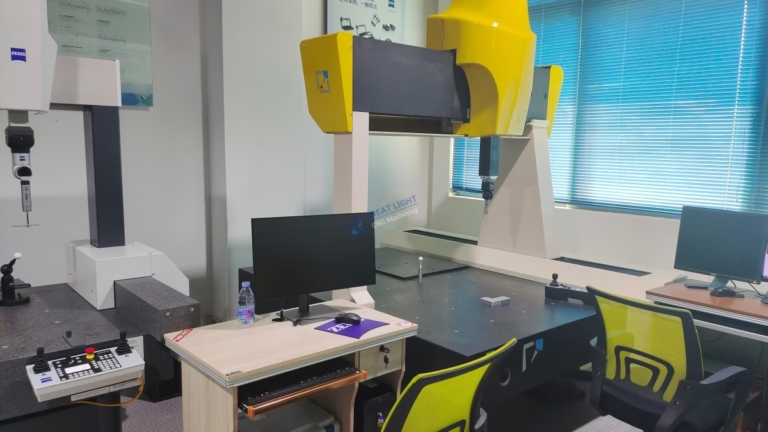
Post-production: Inspection using precision measurement tools like coordinate measuring machines (CMM), optical comparators, and height gauges to verify tolerances up to ±0.001mm.
Every order includes a detailed inspection report so you can confirm that your parts meet your specifications.



















