
127 Sets Processing 4000mm 127 Sets High-Precision CNC Lathes
15 Years of Experience

CNC Knowledge: What is wafer cutting?

A wafer must undergo three changes before it can become a real semiconductor chip: first, the block-shaped ingot is sliced; In the second process, the front side of the wafer is cut according to the previous process. The transistors are etched. Finally, the wafer is packaged, which is a cutting process that turns the wafer […]

cnc knowledge: what is wafer cutting?

A wafer must undergo three changes before it can become a real semiconductor chip: first, the block-shaped ingot is sliced; In the second process, the front side of the wafer is cut according to the previous process. The transistors are etched. Finally, the wafer is packaged, which is a cutting process that turns the wafer into a complete semiconductor chip. It can be seen that the packaging process is a back-end process. In this process, the wafer will be cut into individual chips of hexahedral shape. This process of obtaining independent chips is called “Singulaton”, and the wafer will be cut into. individual chips. The process of sawing a circular plate into independent rectangular parallelepipeds is called “die sawing”. Recently, with the improvement of semiconductor integration, the thickness of wafers has become thinner, which of course brings a lot of difficulty to the “one-off” process.


The history of the development of wafer cutting

The front-end and back-end processes further evolve by interacting in various ways: The evolution of the back-end process can determine the structure and position of the hexahedral chiplets on the wafer (individually separated chip), as well as on the wafer. pads (electrical connection paths); Rather, the evolution of the front-end process has changed the process and method of thinning the backside of wafers and “pressure sawing” wafers in the back-end process. Therefore, the appearance of the package becomes more and more sophisticated, which will have a big impact on the back-end process. In addition, depending on the change in packaging appearance, the number of cuts, procedures and types will also change accordingly.


Scribe cutting

Image WeChat_20241127104153.png

Initially, “breaking” by applying an external force was the only cutting method to divide the wafer into hexagonal dies. However, this method has disadvantages such as chipping or cracking at the chip edge. In addition, because the burrs (Burr: some residue produced during cutting) are not completely removed from the metal surface, the cut surface is also very rough.

In order to solve this problem, the cutting method “Scribing” was created, i.e. the surface of the wafer is cut to approximately half the depth before “breaking”. “Dicing,” as the name suggests, refers to the use of a turbine to pre-saw (half-cut) the front face of the wafer. At first, most wafers smaller than 6 inches used this cutting method of first “dicing” and then “breaking” between the chips.


Dicing or sawing with a blade

Image WeChat_20241127104156.png

The “dicing” cutting method gradually developed into the “blade dicing” cutting (or sawing) method, which is a cutting method using a blade two or three times in succession. The “blade” cutting method can compensate for the peeling of small chips during “breaking” after “slicing” and can protect small chips during the “singling” process. “Blade” cutting is different from the previous “slicing” cutting, that is, after making a “blade” cut, it is not “broken”, but is cut again with the blade. This is why it is also called the “Step Dicing” method.

Image WeChat_20241127104159.png

To protect the wafer from external damage during the cutting process, an adhesive film is applied to the wafer in advance to ensure safer “cutting”. During the “Back Grinding” process, the adhesive film is attached to the front face of the wafer. On the other hand, in “blade” dicing, the adhesive film is applied to the back side of the wafer. During the process of chip eutectic bonding (fixing separate chips to the PCB or rack), the adhesive film on the back of the chip will fall off automatically. Due to the high friction when cutting, DI water must be sprayed continuously in all directions. In addition, the wheel must be equipped with diamond particles in order to slice it better. At this stage, the cut (blade thickness: groove width) must be even and must not exceed the width of the scribing groove. For a long time, sawing was the most widely used traditional cutting method. Its biggest advantage is that it allows a large number of wafers to be cut in a short time. However, if the wafer feed speed is significantly increased, the possibility of peeling off the edges of small chips will increase. Therefore, the number of revolutions of the turbine must be controlled at approximately 30,000 times per minute. It can be seen that semiconductor technology is often a secret accumulated slowly over a long period of accumulation and trial and error.


Dicing Before Grinding (DBG): Cutting order changes method

Image WeChat_20241127104202.png

When you perform blade dicing on 8-inch diameter slices, you don’t have to worry about chip edge peeling or cracking. But as the wafer diameter increased to 21 inches and the thickness became extremely thin, peeling and cracking began to appear again. To significantly reduce the physical impact on the wafer during the cutting process, the DBG method of “cut first, grind later” replaces the traditional cutting sequence. Different from the traditional “blade” cutting method which performs continuous cutting, DBG first performs “blade” cutting, then gradually thins the wafer through continuous thinning from the back until the chip divides. It can be said that DBG is an improved version of the previous “blade” cutting method. Because it can reduce the impact of the second cut, the DBG method was quickly popularized in “slice-level packaging”.


Laser cutting

Image WeChat_20241127104205.png

The Wafer Level Chip Scale Package (WLCSP) process primarily uses laser cutting. Using laser cutting can reduce peeling and cracking, thereby obtaining higher quality chips, but when the wafer thickness is greater than 100 μm, productivity will be significantly reduced. Therefore, it is mainly used on wafers with a thickness of less than 100 μm (relatively thin). Laser cutting cuts silicon by applying high-energy laser light to the cutting grooves of the wafer. However, when using the Conventional Laser cutting method, a protective film must first be applied to the wafer surface. Because when the wafer surface is heated or laser irradiated, these physical contacts will produce grooves on the wafer surface and the cut silicon fragments will also adhere to the surface. It can be seen that the traditional laser cutting method also directly cuts the surface of the wafer, in this respect it is similar to the “blade” cutting method.

Stealth Dicing (SD) is a method that first uses laser energy to cut the inside of the wafer, then applies external pressure to the strip attached to the back to break it and separate it. the chip. When pressure is applied to the ribbon on the back, the wafer will be momentarily lifted upwards due to the stretching of the ribbon, causing the chips to separate. Compared with the traditional SD laser cutting method, the advantages are: firstly, there is no silicon scrap; second, the incision (Kerf: the width of the scribing groove) is narrow, which allows more chips to be obtained. Additionally, peeling and cracking will also be significantly reduced using the SD method, which is essential in determining the overall quality of the cut. Therefore, SD method is expected to become the most popular technology in the future.


Plasma cutting

Plasma cutting is a recently developed technology that uses plasma etching for cutting during the manufacturing (Fab) process. Plasma cutting uses semi-gaseous materials instead of liquids, so it has relatively little impact on the environment. In addition, the whole slice cutting method at one time is adopted, so the “cutting” speed is relatively fast. However, the plasma method uses chemical reaction gas as raw material, and the etching process is very complicated, so its operation is relatively tedious. However, compared to “blade” cutting and laser cutting, plasma cutting does not damage the wafer surface, thereby reducing the defect rate and obtaining more chips.

Recently, as the wafer thickness has been reduced to 30 μm, many materials such as copper (Cu) or low dielectric constant (Low-k) are used. Thus, in order to avoid burrs, plasma cutting methods will also be favored. Of course, plasma cutting technology is also constantly evolving. I think that in the near future it will no longer be necessary to wear a special mask when engraving, because this is a major development direction in plasma cutting.

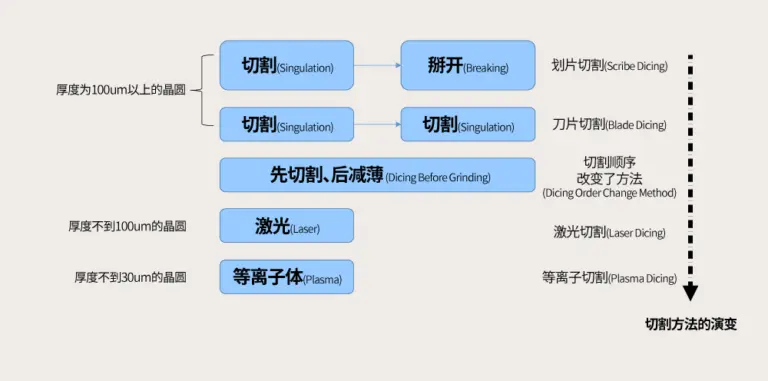
As wafer thickness continues to thin, from 100 μm to 50 μm, then to 30 μm, cutting methods to obtain independent chips have also evolved from “snap”, “blade” cutting, to laser cutting, then plasma. Changes are developing. Although increasingly mature cutting methods have led to an increase in the production cost of the cutting process itself, significantly reducing peeling, cracking and other undesirable phenomena that often occur when cutting semi-finished chips. -conductive and increasing the number of chips obtained per wafer unit, the production cost of a single chip showed a downward trend. Of course, the increase in the number of chips obtained per unit surface of the wafer is closely linked to the reduction in the width of the cutting groove (Dicing Street width). Using plasma cutting method, compared with “blade” cutting method, almost 20% more chips can be obtained, which is also one of the main reasons why people choose the method plasma cutting. With the development and changes of wafers, chip appearance and packaging methods, various cutting processes such as wafer processing technology and DBG are also emerging.

Daguang focuses on providing solutions such as precision CNC machining services (3-axis, 4-axis, 5-axis machining), CNC milling, 3D printing and rapid prototyping services.

CNC Experts

Picture of JinShui Chen

JinShui Chen

Rapid Prototyping & Rapid Manufacturing Expert

Specialize in CNC machining, 3D printing, urethane casting, rapid tooling, injection molding, metal casting, sheet metal and extrusion

CNC Recent Posts

CNC News

Welcome to GreatLight Metal,Maximum Processing Size 4,000 mm

Precision Machining CNC Quote Online

Loading file

Upload Click here to upload or drag and drop your model to the canvas.

The model is too large and has been resized to fit in the printer's build tray. [Hide]

The model is too large to fit in the printer's build tray. [Hide]

The model is too large, a fitting printer is selected. [Hide]

The model is too small and has been upscaled. [Hide]

Warning: The selected printer can not print in full color [Hide]

Warning: obj models with multiple meshes are not yet supported [Hide]

Warning: Unsupported DXF entity  [Hide]

Warning: could not arrange models [Hide]


File Unit:      
Scale:
%
L × W × H:
X: × Y: × Z:  cm 
Rotation:
X: ° Y: °  

	
⚡ Instant Quote for Precision Manufacturing

Submit your design files (STEP/IGES/DWG) and receive a competitive quote within 1 hour, backed by ISO 9001-certified quality assurance.

📋 How It Works

  1. Upload & SpecifyShare your 3D model and select materials (Aluminum/Stainless Steel/Titanium/PEEK), tolerances (±0.002mm), and surface treatments.

  2. AI-Powered AnalysisOur system calculates optimal machining strategy and cost based on 10+ years of automotive/aerospace data.

  3. Review & ConfirmGet a detailed breakdown including:
    - Volume pricing tiers (1-10,000+ units)
    - Lead time (3-7 days standard)
    - DFM feedback for cost optimization

Unit Price: 

Loading price
5 Axis CNC Machining Equipment
4 Axis CNC Machining Equipment
3 Axis CNC Machining Equipment
CNC Milling & Turning Equipment
Prototype and Short-Run Injection Moldings Exact plastic material as final design
Volume Metal Die Casting Services - Precision Cast Parts
Bridge the Gap From Prototype to Production – Global delivery in 10 days or less
Custom high-precision sheet metal prototypes and parts, as fast as 5 days.
Custom Online 3D Printing Services
Design Best Processing Method According To 3D Drawings
Alloys Aluminum 6061, 6061-T6 Aluminum 2024 Aluminum 5052 Aluminum 5083 Aluminum 6063 Aluminum 6082 Aluminum 7075, 7075-T6 Aluminum ADC12 (A380)
Alloys Brass C27400 Brass C28000 Brass C36000
Alloys Stainless Steel SUS201 Stainless Steel SUS303 Stainless Steel SUS 304 Stainless Steel SUS316 Stainless Steel SUS316L Stainless Steel SUS420 Stainless Steel SUS430 Stainless Steel SUS431 Stainless Steel SUS440C Stainless Steel SUS630/17-4PH Stainless Steel AISI 304
Inconel718
Carbon Fiber
Tool Steel
Mold Steel
Alloys Titanium Alloy TA1 Titanium Alloy TA2 Titanium Alloy TC4/Ti-6Al 4V
Alloys Steel 1018, 1020, 1025, 1045, 1215, 4130, 4140, 4340, 5140, A36 Die steel Alloy steel Chisel tool steel Spring steel High speed steel Cold rolled steel Bearing steel SPCC
Alloys Copper C101(T2) Copper C103(T1) Copper C103(TU2) Copper C110(TU0) Beryllium Copper
Alloys Magnesium Alloy AZ31B Magnesium Alloy AZ91D
Low Carbon Steel
Alloys Magnesium Alloy AZ31B Magnesium Alloy AZ91D
ABS Beige(Natural) ABS Black ABS Black Antistatic ABS Milky White ABS+PC Black ABS+PC White
PC Black PC Transparent PC White PC Yellowish White PC+GF30 Black
PMMA Black PMMA Transparent PMMA White
PA(Nylon) Blue PA6 (Nylon)+GF15 Black PA6 (Nylon)+GF30 Black PA66 (Nylon) Beige(Natural) PA66 (Nylon) Black
PE Black PE White
PEEK Beige(Natural) PEEK Black
PP Black PP White PP+GF30 Black
HDPE Black HDPE White
HIPS Board White
LDPE White
This is a finish of applying powdered paint to the components and then baking it in an oven, which results in a stronger, more wear- and corrosion-resistant layer that is more durable than traditional painting methods.
No coating required, product’s natural color!
This is a finish of applying powdered paint to the components and then baking it in an oven, which results in a stronger, more wear- and corrosion-resistant layer that is more durable than traditional painting methods.
This finishing option with the shortest turnaround time. Parts have visible tool marks and potentially sharp edges and burrs, which can be removed upon request.
Sand blasting uses pressurized sand or other media to clean and texture the surface, creating a uniform, matte finish.
Polishing is the process of creating a smooth and shiny surface by rubbing it or by applying a chemical treatmen
A brushed finish creates a unidirectional satin texture, reducing the visibility of marks and scratches on the surface.
Anodizing increases corrosion resistance and wear properties, while allowing for color dyeing, ideal for aluminum parts.
Black oxide is a conversion coating that is used on steels to improve corrosion resistance and minimize light reflection.
Electroplating bonds a thin metal layer onto parts, improving wear resistance, corrosion resistance, and surface conductivity.
This is a finish of applying powdered paint to the components and then baking it in an oven, which results in a stronger, more wear- and corrosion-resistant layer that is more durable than traditional painting methods.
Please provide additional text description for other surface treatment requirements!
Material
Material
  • CNC Metals
    • Aluminum
    • Brass
    • Stainless steel
    • Inconel718
    • Carbon Fiber
    • Tool Steel
    • Mold Steel
    • Titanium
    • Alloy Steel
    • Copper
    • Bronze
    • Low Carbon Steel
    • Magnesium
  • CNC Plastics
    • ABS
    • PC
    • PMMA (Acrylic)
    • PA (Nylon)
    • PE
    • PEEK
    • PP
    • HDPE
    • HIPS
    • LDPE
Printer
Printer
  • CNC Metals
    • 5 Axis CNC Machining
    • 4 Axis CNC Machining
    • 3 Axis CNC Machining
    • CNC Milling & Turning
    • Rapid Tooling
    • Metal Die Casting
    • Vacuum Casting
    • Sheet Metal Fabrication
    • SLA 3D Printing
    • SLS 3D Printing
    • SLM 3D Printing
  • Rapid Prototyping
    • Design Best Processing Method According To 3D Drawings
Post-processing
Post-processing
  • As Machined(Product’s natural color)
  • Sand Blasting
  • Polishing
  • Brushed Finish
  • Anodizing
  • Black Oxide
  • Electroplating
  • Paint Coating
  • Powder Coating
  • Other surface treatment requirements
Finalize
The world's first CNC machining center that dares to provide free samples!

Free for first product valued at less than $200. (Background check required)

precision machining cnc quote online

15 Years CNC Machining Services

When you’re ready to start your next project, simply upload your 3D CAD design files, and our engineers will get back to you with a quote as soon as possible.
Scroll to Top

ISO 9001 Certificate

ISO 9001 is defined as the internationally recognized standard for Quality Management Systems (QMS). It is by far the most mature quality framework in the world. More than 1 million certificates were issued to organizations in 178 countries. ISO 9001 sets standards not only for the quality management system, but also for the overall management system. It helps organizations achieve success by improving customer satisfaction, employee motivation, and continuous improvement. * The ISO certificate is issued in the name of FS.com LIMITED and applied to all the products sold on FS website.

greatlight metal iso 9001 certification successfully renewed
GB T 19001-2016 IS09001-2015
✅ iso 9001:2015
greatlight metal iso 9001 certification successfully renewed zh

IATF 16949 certificate

IATF 16949 is an internationally recognized Quality Management System (QMS) standard specifically for the automotive industry and engine hardware parts production quality management system certification. It is based on ISO 9001 and adds specific requirements related to the production and service of automotive and engine hardware parts. Its goal is to improve quality, streamline processes, and reduce variation and waste in the automotive and engine hardware parts supply chain.

automotive industry quality management system certification 01
Certification of Production Quality Management System for Engine Hardware Parts Engine Hardware Associated Parts
automotive industry quality management system certification 00
发动机五金零配件的生产质量管理体系认证

ISO 27001 certificate

ISO/IEC 27001 is an international standard for managing and processing information security. This standard is jointly developed by the International Organization for Standardization (ISO) and the International Electrotechnical Commission (IEC). It sets out requirements for establishing, implementing, maintaining, and continually improving an information security management system (ISMS). Ensuring the confidentiality, integrity, and availability of organizational information assets, obtaining an ISO 27001 certificate means that the enterprise has passed the audit conducted by a certification body, proving that its information security management system has met the requirements of the international standard.

greatlight metal technology co., ltd has obtained multiple certifications (1)
greatlight metal technology co., ltd has obtained multiple certifications (2)

ISO 13485 certificate

ISO 13485 is an internationally recognized standard for Quality Management Systems (QMS) specifically tailored for the medical device industry. It outlines the requirements for organizations involved in the design, development, production, installation, and servicing of medical devices, ensuring they consistently meet regulatory requirements and customer needs. Essentially, it's a framework for medical device companies to build and maintain robust QMS processes, ultimately enhancing patient safety and device quality.

greatlight metal technology co., ltd has obtained multiple certifications (3)
greatlight metal technology co., ltd has obtained multiple certifications (4)

Get The Best Price

Send drawings and detailed requirements via Email:[email protected]
Or Fill Out The Contact Form Below:

All uploads are secure and confidential.











