
What Business Can You Start With a CNC Machine?
A practical read for engineers and shop owners deciding where a CNC machine earns money. We break down five niches by part geometry, tolerance and volume, then show which jobs a small shop should keep and which to send out.
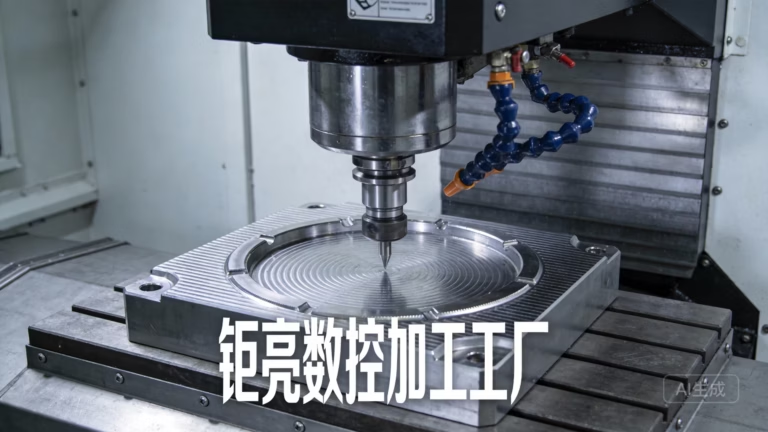
What Business Can You Start With a CNC Machine?
Strip the marketing away and a CNC machine does one thing: it removes material from a solid block to a shape defined by a program. Every business on this page is a different answer to the same question, which is who pays for that removal and why. The machine is not the business. The business is the set of parts you can hold tolerance on, repeat, and inspect.
That is why two shops with identical machines can have very different outcomes. A 3-axis mill with a 500 × 500 × 450 mm travel suits flat plates, housings and brackets. It cannot reach the underside of a part without a second setup, and each extra setup adds stack-up error. Before choosing a niche, list the axis count, the work envelope and the tolerance you can prove. A business with a CNC machine is bounded by those three numbers, not by the brand on the spindle.
Most beginners overestimate what the spindle can do and underestimate what the inspection bench must do. A 3-axis machine cutting aluminium at Ra 1.6–3.2 μm is easy. Holding ±0.005 mm across a 300 mm part after anodizing is a different job, because coating adds thickness and can pull thin walls. Write down the tolerance band before you quote anything. If you cannot measure it, you cannot sell it.
- 1Axis count sets part geometry3-axis for prisms, 4-axis for cylindrical features, 5-axis for undercuts and blended surfaces.
- 2Work envelope sets part sizeA 500 × 310 × 200 mm envelope covers most brackets and small housings.
- 3Inspection sets your reputationWithout a way to verify the first part, every later part is a guess.
Prototyping and Niche Industry Parts
Rapid prototyping is the easiest niche to enter because the order size is one to fifty pieces and the customer values speed over unit cost. Design teams need a physical part to test fit, airflow or connector alignment. A 3-axis mill in aluminium 6061 or ABS covers most of that work, and a single setup on a 500 × 500 × 450 mm envelope handles the average enclosure.
The trap is tolerance creep. A prototype quoted as ±0.1 mm often comes back as a request for ±0.02 mm on a bore, and that bore may sit on a face you cannot reach in one setup. If the drawing needs two opposing faces held to each other, a 4-axis or 5-axis machine pays for itself fast. Otherwise you spend the margin on rework.
Niche industry parts sit one step further along. Medical device housings, robot joint brackets and EV sensor mounts all carry tighter callouts and paperwork. A small shop can win these jobs when the geometry is simple and the volume is low. The moment the customer asks for material certificates, first-article reports and traceability, the cost of quality overtakes the cost of cutting.
That does not mean you must refuse the work. It means you price the inspection hours into the quote. Many small shops lose money on their first regulated job because they billed only spindle time. Count the CMM or height-gauge time, the fixture build, and the paperwork before you send the number.
Hybrid Work, Sheet Metal and Enclosures
Hybrid work combines additive and subtractive steps. A 3D-printed titanium or PEEK part may come off the printer with the internal channels you need, but the sealing face and the bolt holes still need milling. The print gives geometry, the cutter gives tolerance. Shops that own both machines can bid these jobs without splitting the order.
The hard part is the datum. A printed surface is not flat and not stable, so the first milling operation must establish a reference the print cannot provide. Expect to leave 0.5–1.0 mm of stock on printed faces that will be machined. If the design has no stock, the job becomes a conversation about redesign, not a conversation about feeds and speeds.
Sheet metal fabrication and custom enclosures pull in a different skill set. A 2,000 × 1,000 mm laser or punch handles the flat pattern. Bending, welding and hardware insertion turn that pattern into a box. CNC machining still has a role, because the mounting bosses, threaded inserts and connector cutouts usually need a mill.
The economics are friendly to small shops because enclosure runs start at 10–100 units. The risk is that the customer wants a finished assembly with anodizing or powder coating. If you cannot anodize in-house, you must control the outside vendor's lead time. That is where a reliable finishing partner matters more than another spindle.
Restoration, Custom Parts and Contract Work
Restoration and customization is a niche where a single part can carry a high price. Vintage motorcycle covers, classic car brackets and custom furniture hardware are often unavailable or discontinued. The customer brings a worn original, you reverse-engineer it, and you machine one or two replacements.
The work is slow and the drawings do not exist. You measure a worn part, guess the original dimensions, and accept that the first attempt is a fit check. A 4-axis mill with a Ø400 mm rotary table handles most round and semi-round parts in this category. Aluminium 6061 and stainless 304 are the usual materials, with bead blasting or brushing to match the original finish.
Contract manufacturing for local businesses is the opposite end of the scale. A nearby machine builder, a robotics startup or an electronics firm needs 50–500 parts a month and does not want to run its own shop. The geometry is stable, the material is known, and the repeat orders pay the rent.
The catch is capacity. A single 3-axis machine can feed one steady customer, but a second customer doubles the setup load. When a contract order exceeds your envelope or your tolerance, outsource that batch to a partner with 5-axis capacity and keep the customer relationship. Losing margin on a subcontracted batch beats losing the account.
Where a Small CNC Shop Should Stop
Every niche has a limit, and knowing yours saves money. The first limit is size. If the part is longer than your travel, you cannot cut it, no matter how good the program is. GreatLight machines up to 4,000 mm, with a 4,000 × 400 × 150 mm travel on the large frame and 750 × 1,150 × 550 mm on the medium frame, which is where most small shops hand work over.
The second limit is tolerance. A worn 3-axis machine can hold ±0.05 mm on a good day. Once the drawing calls for ±0.005 mm or a surface at Ra 0.2–0.8 μm, the machine, the fixture and the temperature all matter. Do not quote that work until you have run a test part and measured it.
The third limit is quantity. Setup time is fixed, so a 10-piece order and a 1,000-piece order share the same first hour. If a contract customer grows past your spindle hours, you have two choices: buy another machine or subcontract. Buying adds debt and floor space. Subcontracting adds a partner but keeps the cash flow flat.
The fourth limit is material. Aluminium and brass cut easily on light machines. Stainless 316, 17-4PH, Inconel and titanium TC4 push the spindle, the tooling and the coolant. If your machine lacks through-spindle coolant, deep holes in stainless will burn tools. Either invest in the tooling or pass the job on.
Which Niche Fits Which Shop
Match the niche to the machine, tolerance and volume you can actually hold.
| Niche | Typical machine | Volume | Main risk |
|---|---|---|---|
| Rapid prototyping | 3-axis, 500 mm envelope | 1–50 pcs | Tolerance creep after quote |
| Niche industry parts | 4-axis or 5-axis | 10–500 pcs | Certification paperwork cost |
| Hybrid print plus CNC | 3D printer + 3-axis | 1–100 pcs | No machining stock on print |
| Sheet metal enclosures | Laser, brake, 3-axis mill | 10–100 pcs | Outside finishing lead time |
| Restoration parts | 4-axis with rotary table | 1–5 pcs | No drawings, fit iterations |
| Contract manufacturing | 3-axis or mill-turn | 50–500 pcs/month | Capacity and setup load |
Pick the niche you can measure
If your machine holds ±0.05 mm and your customer wants one-off parts, prototyping and restoration are the right starting point. If the drawings call for ±0.005 mm, regulated paperwork or runs past 500 pieces, quote the simple half and outsource the rest to a partner with 5-axis capacity and full inspection.
Questions About Starting a CNC Business
Do I need machining experience to start a business with a CNC machine?
You need enough experience to read a drawing, choose a datum and prove the first part. Programming can be learned on the job, but inspection cannot be faked.
A common path is to run parts for another shop for a year before quoting your own customers. That year teaches you setup time, tool life and where quotes go wrong.
What is the easiest material for a new CNC shop?
Aluminium 6061 is the usual starting point. It cuts fast, holds a good finish and does not work-harden like stainless.
Brass C36000 is even easier to machine. ABS and POM are the plastic equivalents. Leave stainless 316, Inconel and titanium TC4 until your tooling and coolant can handle them.
How do I take a large order if my machine is too small?
Split the order. Keep the parts inside your envelope and tolerance band, and send the rest to a partner that runs 5-axis or larger frames.
You stay the single point of contact and the customer keeps one invoice. Your margin per part drops, but the account survives and may grow.
Should I buy a 5-axis machine at the start?
Only if your target niche needs undercuts, blended surfaces or two opposing faces in one setup. Otherwise a 3-axis machine plus a 4-axis rotary table covers more work per dollar.
A 5-axis machine also needs a programmer who can use it. Without that skill, the extra axes sit idle.
How do I price inspection into a quote?
Count the time to measure the first part and the sample rate for the run. If the drawing needs a first-article report, add the documentation hours.
Shops that quote only spindle time lose money on regulated jobs. Inspection is a cost of goods, not an overhead.
When should I outsource instead of buying another machine?
Outsource when the work is outside your envelope, tighter than your proven tolerance, or larger than your monthly spindle hours. Those three conditions are temporary.
Buy a machine when the same job repeats for months and the setup is already proven. Debt against steady work is safer than debt against a hope.
Send the Parts You Cannot Hold
Upload a drawing and get a quotation with free DFM analysis within 12 hours. We machine from one prototype to 10,000+ parts, inspect 100% before shipment, and keep your files confidential under NDA on request.
12-hour quoteNo MOQ±0.005 mm100% inspection
More From GreatLight
We publish setup notes, tooling trials and inspection data from the factory floor.











