
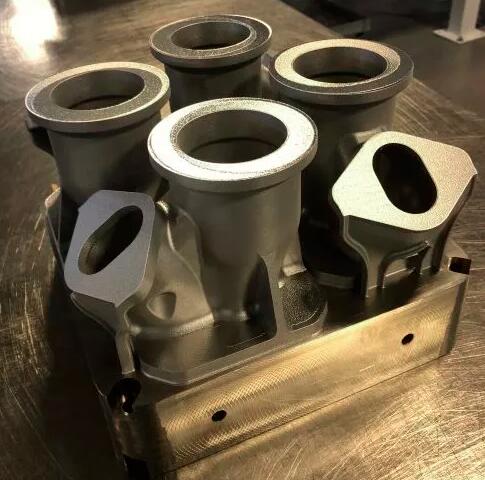
Both innovative engine fuel nozzles, andAfter the Ge9x and Catalyst Turboprop engines used 3D printed parts on a large scale, it seems that GE did not have a large 3D printing press release for a long time. However, for this leader in new cutting -edge technology, innovation is still on the road. Recently, the GE aviation department has shown a case of how metal 3D printing can replace low -cost flowing processes and produce traditional design parts without innovation. Even if she paid huge costs to pour the molds, the choice of metallic 3D printing is always economical and achievable.
The first time the metal has been discovered3D printing is cheaper than the casting
Most manufacturers find it difficult to abandon the casting and the choice of metals when they pay for the casting.In 3D printing, subjective cost considerations will not compare both. However, the collaboration between GE Aviation and GE Additive (GE Additive) proves that the manufacture of metallic additives can be equal to the prices of traditional molded parts. The four 3D printed pieces which he successfully manufactures will reduce costs up to 35%, which is sufficient for the management to eliminate the old molded pieces.
It is also important thatIt was only 10 months old for additive engineers to move from the identification of target parts to 3D printing prototypes, while it took 12 to 18 months or more to produce these parts using of a molding process. The head of the Department of Additive Manufacturing of Ge Aviation said it was theirsThe first time the metal has been discovered3D printing is cheaper than the castingEven if there are quotes from external suppliers,3D printing always has an advantage costs.
Unlike the previous use of parts of parts to reduce assembly and thus reduce a large number of costs, this time3D printed partsCompletely based on molding models without any design change. This discovery madeGe Aviation has decided to find more parts on other engines and uses 3D metal printing to reduce costs.
Examination of parts, reduce external dependence and explore the cost difference between manufacturing and the flow of metal additives
The annual examination of the actors of GE Aviation began at the beginning of 2020, seeking to reduce the production costs of existing products, including hundreds of castings ordered from the outside. For Ge Aviation, there are only a few suppliers who can launch for the aviation industry, it is therefore necessary to ensure that companies do not count too much on specific suppliers. If the parts can be made by themselves at a lower cost, this is crucial for the rapid production of spare parts or the reduced production costs.
The part examination process must take into account a variety of factors, including the size, shape, function of the part, as well as if the printing equipment and the process are mature and reliable, and the convenience of the stages of the steps Post-processing, such as if the surface defects can be eliminated by the mechanical treatment and if it can be added accessories to the parts and so on by the brazing. During the part identification process, engineers must constantly wonder.Are there things that could not be done a year ago but that are technically possible now。
3D printing is suitable not only to the manufacture of complex parts, but also to print from existing models for parts with simple shapes, saving time and reducing mold expenses required for the flow. Consequently, the audit of the parts also inspects various parts produced en masse. In February 2020, GE Aviation identified 180 types of molded parts that can reduce the costs of 3D printing. To guarantee the precision of the conclusions, a team of additive engineers GE Aviation and GE divided them into several groups using their respective production and financial models, calculated the 3D printing return on investment for each party.
Consultation phone number: 135 2207 9385
In the end, dozens of pieces have successfully scored preliminary screening, and nine of them were selected for an additional analysis, including marine gas turbines, turbofan engines and certain parts for military projects. The materials of these parts areCOCR or TI-64 alloy. The range of optional parts is still reduced while considering the possibility of printing using the M2 laser concept inside the factory. The induced system adapter covers have become the center of the plan.
The four parts have the same size and the diameter is by the way89 mm, approximately 152 mm high, are made of COCR alloy, which acts to treat hot compressed air in the turbo compressor section. From a manufacturing perspective, these parts have similar geometry and similar functions. The project team thought that the M2 could print three parts at a time, but the engineers quickly redesigned the disposition to four, which immediately increased productivity because it took almost the same time to print four games and print three parts.
The projectThanks to simulation and analysis, 3D printing engineers have proven that these parts have the same performances as those of the molded pieces replaced. Test splines are also added to each edition of the printing task, some of which are located in the open cavity of the room, so that the technician can measure the integrity of each production execution.
END
The importance of this project is that Ge aviationFor the first time, production went from precision flow to strictly cost additive manufacturing.. These parts are individual replacements without any overhaul or by fusion. Use of casting design3D printing guarantees not only quality, but also exceeds production speed. This project can therefore be used as a reference case for future work. Ge Additif’s main technical director also said that GE Aviation and his additive manufacturing factories had demonstrated their strength from a commercial perspective they did not have.
It is interesting to note that the project can be promoted to adoptionVerification of 3D printing is attributed to the epidemic. While the United States continued to be ineffective in the control of viruses last year, the work of the Auburn Additive Factory of Ge Aviation also became unsaturated, so that the additive team had more energy to focus on other projects. The project aims largely to use inactive printers.
Daguang focuses on providing solutions such as precision CNC machining services (3-axis, 4-axis, 5-axis machining), CNC milling, 3D printing and rapid prototyping services.



















