
Metal 3D Printing Makers: 7 Checks Before You Buy
This guide is for engineers and procurement teams comparing metal 3D printing makers in China for production parts, not display models. It lists the checks that separate a supplier you can scale with from one that costs you a rework cycle. Read it before you send a purchase order.
In this article
- 1
- 2
- 3
- 4
- 5
- 6
- 7
- 8
Seven checks that decide the outcome
What to compare across metal 3D printing makers
Use these rows as your request-for-quote checklist. Ask for a written answer to each one.
| Criterion | Weak answer | Answer you want |
|---|---|---|
| Tolerance | ±0.1 mm as-built | As-built plus CNC to ±0.005 mm |
| Material | Grade name on the quote | Mill cert with heat number and lot |
| Process chain | Print only, you arrange the rest | Print, heat treat, CNC, finish in house |
| DFM support | Quote returned as-is | Written DFM analysis within 12 hours |
| Post-processing | Bead blast only | Machining, anodizing, plating, laser marking |
| Certification | ISO 9001 certificate image | Scope covering your part family |
| Inspection | Sample check per batch | 100% inspection with reports on request |
| Order size | High minimum order quantity | One prototype to 10,000+ part runs |
Pick the supplier that owns the whole chain
If your part needs a real tolerance, a traceable alloy and a finished surface, choose a supplier that prints, machines, heat treats and finishes in one plant. Otherwise you are managing four vendors and owning all the risk.
Tolerance: what metal 3D printing makers can and cannot hold
A laser powder bed fusion machine holds roughly ±0.1 mm on a well-supported feature, and worse on long unsupported spans. Thermal distortion pulls thin walls and overhangs as the melt pool cools. If your drawing calls for ±0.005 mm, no printer will hit it in one pass.
The workable route is hybrid. Print near net shape, leave 0.3–0.5 mm on mating faces, then machine those faces on a 5-axis center. That gets you to ±0.005 mm where it matters while keeping the internal channels and lattice that made you choose additive in the first place.
Ask the supplier which features they plan to machine and which they will leave as-built. A supplier that gives you a blanket tolerance number without naming the features is guessing. Send a drawing with your critical dimensions marked and see whether the reply addresses them one by one.
Some geometries cannot be saved by machining. A 0.4 mm internal channel that collapses during printing will not be fixed by a cutter that cannot reach it. For those, ask for the as-built inspection report on the first article before you commit to a batch.
- 1As-builtAround ±0.1 mm on supported features; worse on thin walls.
- 2Printed then machined±0.005 mm on the faces you call out.
- 3Leave stock0.3–0.5 mm per machined face is a practical starting point.
Material traceability: powder is where the cheating happens
Metal powder is the easiest place to hide cost. Ti-6Al-4V Grade 23 and a lower-grade substitute look identical in a photograph. Inconel 718 and a blend sold under the same name behave differently after heat treatment. Without a mill certificate and a heat number, you are trusting a label.
Reused powder is normal in laser powder bed fusion, and it is not automatically a problem. What matters is how many times it has been sieved and reused, and whether the supplier tracks oxygen and moisture content. Ask for the reuse policy in writing.
For aerospace and medical work, the certificate has to follow the part. That means a lot number on the powder, a build record linking your part to that lot, and a heat treat record tied to the same chain. If the supplier cannot reconstruct that chain six months later, the paper is worthless.
We stock 6061, 7075, 316L, 17-4PH, TC4 and Inconel, and we keep the certificates on file against the job number. When a customer audits a build, the powder lot, the machine, the operator and the heat treat cycle are all in one record.
- 1Ask forMill certificate with heat number and lot.
- 2Ask aboutPowder reuse count and oxygen tracking.
- 3Ask how longBuild records stay retrievable.
Process chain: count the handoffs before you order
A printed part is not a finished part. It needs stress relief, baseplate removal, support removal, often HIP, then machining, then surface treatment. Every step that leaves the supplier's building adds a shipping risk, a queue, and a gap in the record.
Fragmentation shows up as time. The print finishes Tuesday, the heat treater picks up Thursday, the machine shop quotes next week. By the time the part comes back, three weeks are gone and nobody owns the dimensional result.
An integrated supplier runs print, heat treat, CNC and finishing under one quality system. The part moves between departments, not between companies. When a dimension drifts, the machinist and the additive engineer are in the same building and can settle it the same day.
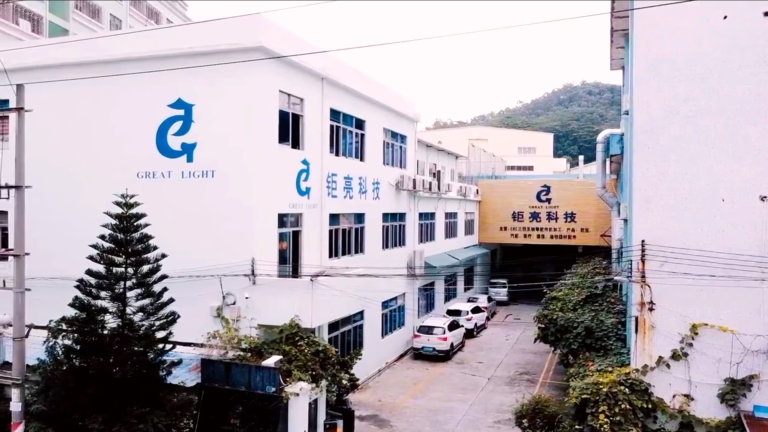
GreatLight runs three wholly-owned plants in Dongguan covering 7,600 m², with 127 high-precision CNC machines including 16 simultaneous 5-axis centers. Additive parts go straight onto the same machining and finishing lines as our billet work.
- 1Red flagThe supplier cannot name their heat treat vendor.
- 2Red flagSupport removal is quoted as a separate job.
- 3Green flagOne job number follows the part through every step.
DFM support: the difference between a vendor and a partner
A perfect 3D model can still print badly. Overhangs below 45° need support that leaves marks. Thick sections trap residual stress and crack at the baseplate. Trapped powder cannot be removed from a closed cavity with no escape hole.
A supplier with additive engineering will send back a marked-up model before quoting. They will suggest a build orientation that puts critical faces away from supports, add escape holes for powder removal, and tell you where to add stock for machining.
This is the cheapest step in the whole project. Moving a support face off a sealing surface at the DFM stage costs nothing. Discovering it after the first article costs a redesign and two weeks.
We return a quotation and a free DFM analysis within 12 hours, and production can start within 24 hours of approval. If the design needs changes, you hear about it before the machine is booked, not after.
- 1OrientationCritical faces away from support contact.
- 2Escape holesAt least Ø2 mm for powder removal in closed cavities.
- 3Machining stock0.3–0.5 mm on faces you will cut later.
Post-processing, certification and the hidden cost trap
As-built surfaces from laser powder bed fusion sit around Ra 8–12 μm, and support scars are worse. If your part sees a seal, a bearing or a sliding fit, it needs machining. Bead blasting alone will not produce a sealing surface, and inconsistent blasting produces a finish that varies part to part.
Certification is a scope question, not a logo question. ISO 9001:2015 covers general quality management. IATF 16949:2016 adds automotive process control and traceability. ISO 13485:2016 covers medical devices. ISO 27001:2022 covers information security, which matters if you are sending proprietary CAD files to an overseas supplier.
The hidden cost trap is the low quote. A cheap print price that ends in a rejected batch, a rework cycle and a delayed launch is the most expensive option on the table. Price the part per good unit, including inspection and any rework risk you are carrying.
We quote against the drawing, not against a weight estimate. If a feature is likely to fail first article, we say so at quotation. That is why our historical late-delivery probability stays below 2% and our qualification rate runs at 99.99%.
- 1FinishingMachining to Ra 0.8–1.6 μm where a seal or fit is required.
- 2CertificatesMatch the scope to your industry, not just the logo.
- 3CostingCompare cost per accepted part, not per printed part.
A seven-step supplier evaluation you can finish in a week
Run this on your next metal part and keep the answers in the project file.
- 1Send one representative partPick something with a critical fit and an internal feature. Include the 2D drawing with tolerances marked.
- 2Request a written DFM analysisYou want orientation, support strategy, escape holes and machining stock in writing, not a phone call.
- 3Ask for the powder certificateMill certificate with heat number and lot, plus the reuse policy for that alloy.
- 4Ask where heat treat and finishing happenIf they are outside vendors, ask how the job number follows the part between them.
- 5Order a first articleInspect it yourself. Check the critical dimensions, the surface on sealing faces and the internal channel for trapped powder.
- 6Request the inspection reportRaw material check, in-process monitoring and final inspection records for the specific job number.
- 7Compare cost per accepted partAdd rework, inspection and delay risk to each quote before you compare the headline number.
Questions engineers ask before ordering
Can metal 3D printing hold ±0.005 mm as-built?
No. Laser powder bed fusion holds around ±0.1 mm on supported features, and thin walls or long overhangs are worse.
To reach ±0.005 mm you print near net shape with 0.3–0.5 mm of stock on the critical faces and machine them afterwards on a 5-axis center. That is the normal route for functional parts.
Is reused powder acceptable?
It is standard practice in laser powder bed fusion, and it is not automatically a defect. What matters is the reuse count, the sieving routine and whether oxygen and moisture are tracked.
Ask for the reuse policy in writing and require a heat number on the certificate for every build that matters.
What is the smallest internal channel you can clear of powder?
As a working rule, keep escape holes at Ø2 mm or larger and avoid closed cavities with no exit. Smaller channels print, but powder removal becomes unreliable and inspection cannot confirm the inside.
If the channel is functional, tell the supplier at DFM stage so the orientation and escape holes are planned around it.
Which certifications actually matter?
It depends on the part. ISO 9001:2015 is the baseline. IATF 16949:2016 matters for automotive and EV work. ISO 13485:2016 matters for medical devices. ISO 27001:2022 matters when you are sending proprietary CAD files offshore.
Check the scope on the certificate, not just the logo. A certificate that does not cover your part family does not help you.
What order quantity makes sense?
Metal additive is usually competitive from one piece up to a few thousand, depending on geometry. Tooling costs are zero, so the first part and the hundredth part cost roughly the same per unit.
We run from a single prototype to 10,000+ part runs with no minimum order quantity. If your volume is high and the geometry allows it, we will tell you when die casting or CNC from billet becomes the cheaper route.
How do I keep my design confidential?
Uploads are secure and confidential, and an NDA is available on request before you share files.
If your program requires it, ask for the information security certificate and confirm who inside the supplier can open the files.
Send your drawing, get a DFM review in 12 hours
Upload the part and the 2D drawing. We return a quotation and a free DFM analysis within 12 hours, and production can start within 24 hours of approval.
12-hour quoteFree DFM analysis100% inspectionNo minimum order quantity
More from the shop floor
We publish setup notes, tooling trials and inspection data from the factory floor.











