
How to Vet Chinese 3 Axis CNC Machining Makers
This guide is for engineers and sourcing staff who need 3-axis milled parts from China and want to separate real machine shops from trading accounts. You will get a checklist of what to ask, what numbers to compare, and which answers should end the conversation.
In this article
- 1
- 2
- 3
- 4
- 5
- 6
- 7
- 8
Key takeaways
What to Compare Across Chinese 3 Axis CNC Machining Makers
Use the same questions with every supplier and score the answers side by side.
| Criterion | Weak answer | Strong answer | How to verify |
|---|---|---|---|
| Machine ownership | We have many partners | 27 three-axis machines in-house | Live video walkthrough |
| Tolerance claim | ±0.05 mm general | ±0.005 mm on critical features | First article report |
| Certification | ISO listed on website | ISO 9001, IATF 16949, ISO 13485 | Certificate scope and date |
| MOQ | 1,000 pieces minimum | One prototype to 10,000+ | Sample order test |
| Quote turnaround | About a week | Within 12 hours with DFM notes | Send a real drawing |
| Lead time | 4–6 weeks | Parts ship in 3–5 days | Track first PO dates |
| Inspection | Spot checks | 100% before shipment | Ask for the report |
| Finishing | Outsourced, no control | Anodizing, plating, marking in chain | Ask which steps are external |
What 3-Axis Work Actually Fits a Chinese Supplier
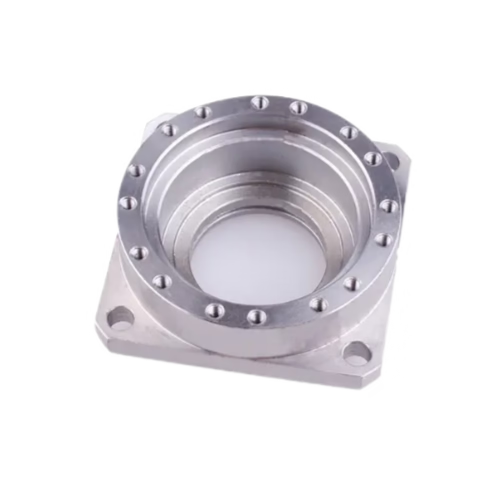
Three-axis milling cuts from one direction at a time. The spindle moves in X, Y, and Z while the part stays fixed, or the table moves under a fixed spindle. That geometry suits prismatic parts: plates, brackets, housings with open faces, manifolds, heat sinks, fixture plates, and most enclosure panels.
It does not suit every part. Deep pockets with undercuts, impellers, turbine blades, and parts with features on five or six faces need either multiple setups or a 4-axis and 5-axis machine. Multiple setups add cost and stacking error, so a shop quoting a complex part on 3-axis alone is telling you something about how it reads drawings.
For a lot of production parts, though, 3-axis is the right call. It is faster to program, cheaper per hour, and easier to inspect. If your part can be reached from two or three directions, spending 5-axis rates on it is waste.
The parts that fail this test usually fail on one feature, not the whole design. One angled port, one cross-hole, one curved pocket. Ask the supplier to flag those features during DFM review rather than after the first article.
- 1Good fitPlates, brackets, housings, manifolds, panels, fixture bases
- 2Marginal fitParts with one or two angled features that need a second setup
- 3Wrong fitImpellers, deep undercuts, features on five faces
Tolerance, Surface Finish, and What the Numbers Mean
A tolerance of ±0.005 mm sounds impressive on a website. In practice it applies to specific features on specific materials under specific conditions. Aluminum 6061 holds it more easily than 316 stainless, and thin walls move after clamping is released no matter who machines them.
Surface finish follows the same logic. Ra 1.6–3.2 μm is a normal as-machined finish from a sharp cutter. Ra 0.8–1.6 μm needs a lighter pass, a smaller stepover, or a finishing tool. Ra 0.2–0.8 μm usually means additional operations and a slower cycle.
When you send a drawing, mark which dimensions are critical and which are reference. A shop that receives a drawing with every dimension at ±0.01 mm will either over-inspect and overcharge, or quietly ignore the tight ones. Neither is good.
Ask how the shop measures. A calibrated CMM, a height gauge, and a micrometer give different levels of confidence. For a first article, ask for the measurement method next to the result.
- 1As-machinedRa 1.6–3.2 μm, standard cutter pass
- 2Fine finishRa 0.8–1.6 μm, reduced stepover
- 3Mirror-levelRa 0.2–0.8 μm, extra operations
Certifications That Matter for Chinese 3 Axis CNC Machining Makers
ISO 9001:2015 tells you the shop documents its process and audits itself. It does not tell you the process is capable. Still, it is the floor. A supplier without it has no formal quality system at all.
IATF 16949:2016 matters if you build automotive or EV parts. It adds traceability, change control, and failure analysis requirements that general ISO 9001 does not cover. Ask for the certificate scope, not just the logo.
ISO 13485:2016 is the medical device standard. If your part touches a patient or a diagnostic instrument, this is the relevant one. ISO 27001:2022 covers information security, which matters when you send CAD files and drawings across borders.
Check the certificate number, the issuing body, and the expiry date. Certificates get shared between trading companies and factories, so confirm the legal entity on the certificate matches the company quoting you.
- 1General machiningISO 9001:2015
- 2Automotive and EVIATF 16949:2016
- 3Medical devicesISO 13485:2016
- 4Data and IPISO 27001:2022
Lead Time, MOQ, and Quote Quality
A quotation is a window into how the shop works. If it comes back as a single number with no questions, the shop either did not look closely or plans to figure it out later. Both outcomes cost you time.
Good quotes arrive with DFM notes: thin walls, tight tolerances, features that need a second setup, material availability, and suggested finish. GreatLight returns a quote and free DFM analysis within 12 hours, and production can start within 24 hours of approval.
MOQ is the other quick filter. No minimum order quantity means the shop has its own setup and programming staff and is willing to run one piece. That is normal for prototype and low-volume work. A high minimum usually means the supplier is routing your job to someone else.
Lead time claims need a baseline. Ask what the 3–5 day shipping window covers: which quantities, which materials, which finishes. A shop that ships simple aluminum brackets in three days may need longer for 17-4PH stainless with hardcoat anodizing.
- 1Quote with DFM notesWithin 12 hours
- 2Production startWithin 24 hours of approval
- 3MOQOne prototype to 10,000+ parts
Red Flags When Screening Chinese 3 Axis CNC Machining Makers
The most common problem is a trading company posing as a factory. The tell is vague answers about machines. Ask how many 3-axis machines they run, what the travels are, and who programs the jobs. A factory answers in specifics. A trading desk deflects.
The second problem is outsourced finishing. Anodizing, plating, and heat treatment involve chemicals and ovens that many machine shops do not run. If those steps go to a third party, the shop loses control of lead time and color match. Ask which steps happen inside the building.
The third is inconsistent inspection. Some shops inspect the first part and then trust the process. That works until a tool wears or a fixture slips. Ask whether inspection is 100% before shipment and whether reports come with the parts.
Finally, watch for price that is too low to be real. If a quote is far below the others, ask what is excluded: material certification, finishing, inspection reports, packaging, or freight. The gap usually shows up after the PO.
- 1Vague machine answersLikely a trading account
- 2Finishing outsourcedLead time and color risk
- 3No inspection reportQuality depends on luck
- 4Price far below marketSomething is excluded
Step by Step: How to Qualify a 3-Axis Supplier
Run these in order. Each step filters out suppliers before you spend engineering time.
- 1Send one real drawingUse a part you already make, with critical dimensions marked. See whether the quote includes DFM notes or just a price.
- 2Ask for the machine listRequest 3-axis machine count, travels, and spindle hours. Compare against the part envelope you need.
- 3Verify certification scopeCheck certificate number, issuing body, expiry date, and legal entity name against the quoting company.
- 4Order one prototypeNo MOQ should mean one piece is accepted. Measure it yourself and compare against the drawing.
- 5Request the inspection reportConfirm 100% inspection before shipment and that measurement methods match the tolerance class.
- 6Confirm which steps are in-houseMachining, finishing, and inspection should stay under one roof where possible. Ask explicitly.
- 7Sign an NDA before releasing CADUploads should be secure and confidential. Request an NDA if your design is sensitive.
Frequently asked questions
Is 3-axis machining cheaper than 5-axis in China?
Yes, per machine hour. A 3-axis mill has a simpler control, faster programming, and lower setup cost, so the shop rate is lower.
The saving disappears if the part needs three or more setups to reach all features. At that point, compare total cost per part, not hourly rate.
What tolerance can a Chinese 3-axis shop realistically hold?
For aluminum and mild steel with stable fixturing, ±0.005 mm is achievable on critical features. For stainless and titanium, expect a wider band because of tool wear and thermal movement.
Always tie the tolerance to a specific feature. A blanket tight tolerance across a whole drawing drives cost without improving function.
Do I need IATF 16949 for a simple bracket?
Not for a bracket that is not part of a vehicle safety or powertrain system. ISO 9001:2015 is usually enough.
If the bracket goes into an EV battery pack or a structural assembly, the automotive requirements apply and IATF 16949:2016 becomes relevant.
How do I check that a supplier is a factory and not a trader?
Ask for a live video walkthrough of the shop floor during working hours. Request the machine count and travels, and ask who programs the jobs.
A factory will show you machines, fixtures, and staff. A trading account will send photos and delay the call.
What happens if the first article fails inspection?
A competent shop treats this as a process problem, not a customer problem. They review the setup, tooling, and program, then rework or remake at their cost.
Ask this question before the PO. The answer tells you more about the supplier than any certificate.
Can one shop handle machining, finishing, and assembly?
Some can. GreatLight runs machining, surface finishing, die casting, sheet metal, and 3D printing under one quality system, which reduces hand-off risk.
If the shop outsources anodizing or heat treatment, ask for the vendor name and their process control records.
Send a Drawing, Get a Quote and DFM Notes
We quote within 12 hours, flag features that will add cost, and run 100% inspection before shipment. No minimum order quantity.
Quote in 12 hoursNo MOQ100% inspectionNDA available
More from the shop floor
We publish setup notes, tooling trials and inspection data from the factory floor.











