
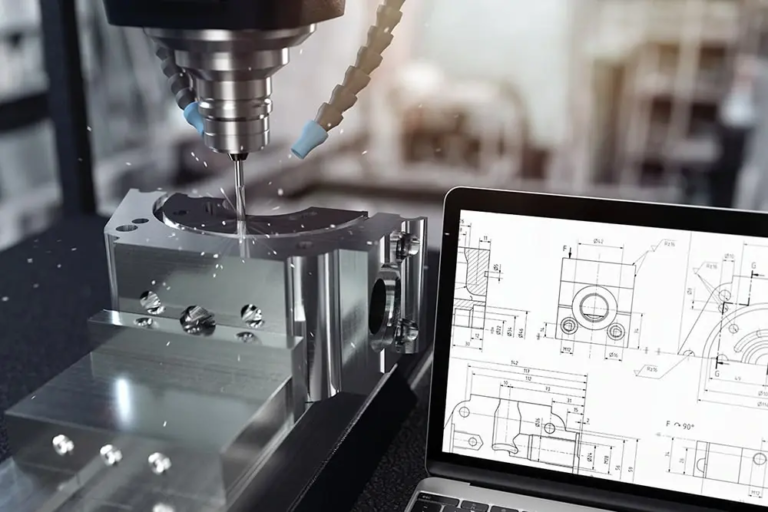
The rise of rapid prototyping: revolutionizing the future of CNC machining
In recent years, the CNC machining world has seen a major shift in rapid prototyping, thus changing the way manufacturers produce complex mechanical parts. This innovative approach gives companies the ability to design, develop and test their products in a faster and more cost-effective way. In this article, we will dig into the evolution of rapid prototyping, its benefits and their impact on the CNC processing industry.
Rapid prototyping, also known as additive manufacturing, involves creating physical models of parts or products through material layering. This process revolutionizes how companies develop products, allowing them to iterate and refine their designs faster and more efficiently. Gone are the days of traditional subtraction manufacturing, and metal is cut off to create parts. Now, with fast prototyping, manufacturers can easily create complex geometric shapes and complex details.
The rise of rapid prototyping is driven by computer-aided design (CAD) software, advances in 3D printing technology, and the growing demand for customized and complex products. Companies are now able to create functional prototypes, test their performance and make necessary adjustments before investing in full-size production. This approach reduces prototype costs, reduces product life cycle and enables companies to remain competitive in the market.
Other benefits of rapid prototyping include:
*Reduced delivery time: Fast prototyping enables companies to speed up product development cycles, enables products to be marketed faster and gain competitive advantage.
*Improving accuracy: The layer-by-layer construction process of rapid prototyping ensures accurate, accurate results, reducing the risk of errors and defects.
* Improved flexibility: With rapid prototyping, manufacturers can quickly and easily change their designs to adapt to new demands and market demands.
With the continuous development of the CNC processing industry, companies must adapt to the new landscape of rapid prototyping. By adopting this technology, manufacturers can increase efficiency, reduce costs and stay ahead of the curve.
in conclusion
————
The rise of rapid prototyping has changed the world of CNC machining, providing businesses with faster, more cost-effective, and more accurate ways to develop and test their products. As the industry continues to grow, it is crucial for companies to adapt to the new landscape of rapid prototyping, adopting new technologies and processes to remain competitive.
Frequently Asked Questions
————————————–
Q: What is a rapid prototype?
A: Rapid prototyping is a manufacturing process that creates physical models of parts or products through material layers.
Q: What are the benefits of rapid prototyping?
A: Rapid prototyping reduces prototype costs, reduces product life cycle, and enables companies to remain competitive in the market.
Q: Is rapid prototype a subspecies of 3D printing?
A: Yes, rapid prototyping is a type of 3D printing, but not all 3D printing is rapid prototyping. Although they have some similarities, there are obvious differences in their purpose and application.
Q: Can rapid prototypes be used for quality production?
A: Although rapid prototyping is usually used to produce small batches, it is not suitable for mass production. For larger production runs, traditional methods such as CNC machining are still the best choice.



















