
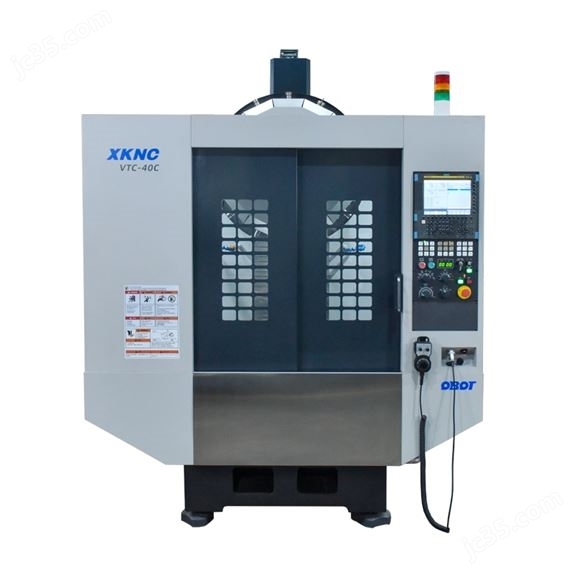
Beyond Bench Space: The Expanding Universe of Small Vertical Machining Centers
For decades, the image of a machining center was synonymous with colossal footprints, exorbitant price tags, and the thunderous roar suitable only for heavy industry. But a quiet revolution has reshaped precision manufacturing. Small Vertical Machining Centers (VMCs), once niche tools, have evolved into indispensable powerhouses, proving that stature doesn’t define capability. Compact, agile, and surprisingly potent, these machines are redefining workflows across mold shops, educational institutions, and agile production floors worldwide.
Compact Footprint, Colossal Capability: Dismantling the Size Bias
The core appeal of the small VMC is undeniable: minimal spatial demands translating into drastically lower facility costs. Yet, dismissing them as "entry-level" or "inferior" couldn’t be more misguided. Modern small VMCs pack extraordinary technological sophistication into their modest frames. Think high-speed spindles effortlessly reaching 20,000 RPM and beyond, rigid cast-iron constructions ensuring stability, and precision linear guides coupled with high-resolution encoders. This synergy enables these machines to achieve positional accuracies consistently within ±0.005 mm (±0.0002 inches) and surface finishes rivaling hand polishing – capabilities once reserved for far larger, more expensive equipment.
Mold Making Reimagined: Precision, Speed, and Flexibility
The mold industry is perhaps the most voracious adopter of small VMCs, finding them perfectly matched to its demanding precision and dynamic project nature.
- Surface Perfection Unleashed: Experience the future of surface finishing. High-RPM spindles (like the 20,000 RPM example cited) combined meticulously with ball-nosed end mills allow small VMCs to machine cavity surfaces directly on hardened steels (like 45# steel) achieving stunning 0.8 μm mirror-like finishes. This drastically reduces, or even eliminates, expensive, time-consuming manual polishing stages – a radical leap in efficiency for mold finishing.
- Complex Geometry Made Simple: The intricate, flowing contours of modern products (think smartphone casings, wearable tech, complex appliance parts) demand perfect translation from 3D CAD model to machined steel. Small VMCs excel at intricate 3-axis contouring. Sophisticated CNC controls precisely track minute curvature changes, ensuring the final mold cavity faithfully replicates the digital design within microns. This precision is non-negotiable for guaranteeing flawless injection-molded part aesthetics and function.
- Tooling Agility = Business Agility: The "small batch, high customization" nature of many molds demands rapid setup changes. Here, the near-instantaneous tool-change capabilities of many small VMCs become a strategic advantage. Tool change times under 2 seconds (some achieving the mentioned 1.5 seconds) enable seamless shifts between different mold inserts, cores, or cavity details. This nimbleness slashes mold trial iterations and dramatically accelerates customer delivery times, making shops incredibly responsive to market demands. Imagine a mold insert change feeling more like an F1 pit stop than a lengthy operational pause.
Education & Research: The Precision Learning Curve
Beyond the factory floor, small VMCs are proving transformative in shaping the next generation of engineers and technicians and enabling cutting-edge material science.
- The Ultimate Teaching Platform: Tactile learning is irreplaceable. Small VMCs offer industrial-grade CNC training in a safe, manageable scale. Students master fundamental machining concepts (face milling on compact 300mm worktables, precise hole boring & threading, fixture setup) using actual G-code, not just simulation. Crucially, integrated machine-tool simulation checks code before execution, preventing costly crashes and broken tools – a vital safety net while learning. This bridges the gap between textbook theory and real-world machining fluency.
- Lab-Scale Research Powerhouse: Scientific rigour requires absolute precision. Researchers leverage small VMCs to create specialized, custom test specimens with dimensional perfection unattainable by conventional workshop tools. Imagine crafting ultra-precise miniature tensile test bars for aerospace alloys, intricate static test components for composite materials, or uniquely shaped surfaces for tribology studies. The multi-axis rigidity ensures consistency, while the programmability guarantees repeatable production of complex geometries crucial for reliable material performance data. These are the proving grounds for the materials of tomorrow, enabled by today’s compact machining capability.
Small-Batch Production Revolution: Versatility Meets Automation
The era of niche customization and just-in-time manufacturing is tailor-made for the small VMC’s strengths, extending far beyond just metal.
- Material Mastery Unlocked: Small VMCs aren’t shackled to steel and aluminum. Modern spindles paired with the right cutting tools empower them to handle diverse materials with impressive results. They deftly machine automotive-grade aluminum connectors for EVs (achieving critical hole tolerance and surface quality for conductive seals) while precisely controlling process temperature to mitigate thermal drift. Surprisingly effectively, they switch tools and strategies to tackle engineered woods (like dense plywood), hardwoods, even certain composites and technical resins for custom components in furniture, fixtures, signage, or specialized equipment accessories. This material diversity expands their value exponentially.
- The Nucleus of Lean Automation: The true game-changer emerges when small VMCs integrate seamlessly with pallet changers, robotic arms, or gantry loaders. This transforms a single machine into a compact, flexible manufacturing cell capable of lights-out operation for small-to-medium production runs. Need 500 iterations of 10 different, complex electronic housings? A small VMC automated cell, relatively inexpensive and easy to reconfigure, handles this multi-variety, limited-volume challenge efficiently. For electronics assembly jigs, custom appliance trim components, medical device prototypes, or bespoke instrument parts, this represents the "sweet spot" solution – offering unparalleled cost-performance and agility specific to flexible manufacturing demands.
More Than Machines: The Future is Compact, Complex, and Agile
The small vertical machining center is no longer merely a space-saving alternative. It is a sophisticated precision instrument democratizing high-level manufacturing capabilities. It empowers mold makers with unprecedented surface quality and agility, equips learners with genuine industrial skills, provides researchers with flawless experimental tools, and enables manufacturers to thrive in the competitive landscape of customization and rapid delivery. By delivering industrial performance at a manageable scale and investment, these compact giants are fundamentally reshaping the boundaries of what’s possible in modern workshops, labs, and classrooms. As technology continues to push spindle speeds higher, control systems smarter, and automation tighter, the strategic value of the small VMC will only continue to ascend.



















