
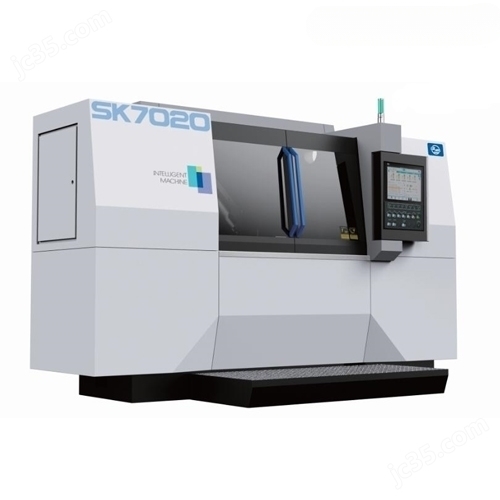
The Silent Sculptors: Unlocking Extreme Precision with Advanced Thread Grinding Technology
In the high-stakes arena of precision manufacturing, where tolerances are measured in microns and surface perfection is non-negotiable, a specialized class of machinery operates with near-silent determination. Often overshadowed by flashier CNC machining centers, precision thread grinders serve as the unsung architects of mission-critical components. These technological marvels transform raw alloys into geometrically perfect threaded masterpieces through a breathtaking fusion of mechanical ingenuity and digital intelligence.
Engineering Ballet: The Core Mechanics of Perfection
At the heart of every industrial-grade thread grinder lies a meticulously orchestrated synchronized motion system far surpassing conventional cylindrical grinders. While basic models offer single-axis control, advanced thread grinders conduct a symphony in two directions simultaneously:
- Rotational Choreography: The workpiece rotates at a precisely managed constant speed
- Translational Precision: A high-frequency grinding wheel traverses along the part’s axis at a mathematically determined rate
This dual-motion dance generates the helical path of the thread. The complexity deepens when considering the closed-loop control systems governing this process. Engineers achieve near-impossible stability using:
- High-accuracy worm gear sets with minimal backlash
- Direct-drive servo motors with nanometer-scale positioning feedback
- Vibration-dampening hydrostatic bearings
A deviation of even 0.0005" in timing can distort thread profiles, rendering aerospace fasteners or medical implants useless. Modern systems now integrate lasenc feedback for real-time error correction during traversal.
Conquering Unforgiving Materials: Where Others Fail
Thread grinders specialize in machining components that would cripple conventional tools. Consider the real-world challenges:
| Material | Hardness (HRC) | Key Obstacles | Grinding Solutions |
|---|---|---|---|
| Tool Steels | 60-67 | Work hardening, thermal stress | CBN abrasives, cryogenic cooling |
| Titanium Alloys | 36-45 | Low conductivity, galling | High-pressure coolant jets |
| Nickel Superalloys | 45-50 | Abrasive grains, strength | Slow traverse, zoned wheel dressing |
The secret weapon? Engineered abrasive grains. Cubic Boron Nitride (CBN) wheels now feature multilayer bonds with precisely graded grit sizes. These micro-cutting edges generate mirror finishes below 0.1μm Ra, even on impossible geometries like variable-pitch ball screw profiles. For reactive materials, high-pressure through-wheel coolant systems penetrate the cut zone at 1,500 PSI, dissolving heat before it distorts the microscopic thread flanks.
The Art-Science Balance: Operator Expertise Meets Adaptive Tech
Mastering these machines requires a hybrid skillset blending metallurgical knowledge with sensor-driven intuition. Expert technicians perform material-specific alchemy:
- Stainless Steel: Pulse grinding cycles alternating with high-frequency flushing combat material adhesion
- Cast Iron: Reduced wheel speeds and specialized porosity wheels prevent micro-fracturing
- Exotic Composites: Dynamic parameter shifts adjust for fiber orientation changes
Newer systems elevate this expertise with multi-sensor adaptive control. Integrated capacitive probes measure part expansion mid-operation, while acoustic emission sensors detect wheel loading. When machining a critical rocket engine injector thread, the system might auto-adjust:
- Compensation for a 2μm thermal expansion
- Wheel speed modulation upon detecting chatter frequencies
- Coolant flow rate changes based on IR part temperatures
The Digital Twin Revolution: Simulation Meets Reality
Forward-thinking manufacturers are shifting from reactive to predictive operations through virtual process twins. Consider the workflow transformation:
- Pre-Production Simulation: CAD models undergo physics-based grinding tests in software, predicting thermal distortion points and spiral deviation risks
- Parameter Optimization: AI algorithms process simulation data to generate ideal feed/speed profiles before metal touches wheel
- Real-Time Correlation: On-machine sensors cross-verify actual vs. predicted results during processing
This digital infrastructure enables astonishing capabilities. An automotive plant producing electric drive units links eight screw grinders via IIoT protocols. When Grinder #3 achieves a superior surface finish on hardened steel rotor threads, its parameters instantly propagate across the network. Closed-loop quality systems then automatically adjust downstream honing operations based on actual thread topography data – a self-optimizing manufacturing cell.
Intelligent Integration: The Production Ecosystem Mindset
The standalone screw grinder is disappearing. Instead, we see cyber-physical machining systems:
Precision Thread Grinding in the Age of Automation: Robotic arms and vision systems integrate grinders into seamless workflows
Vision-guided robots now load blanks with micron-level repeatability, while inline coordinate measuring machines (CMMs) perform non-contact thread scans during workpiece rotation. Adaptive algorithms compare results to golden samples in milliseconds. This ecosystem approach yields transformative results:
- Lead time reduction for medical bone screws: 63% faster
- Scrap rate decrease in aerospace studs: Under 0.02%
- Quality documentation automation: Full digital traceability
One NASA contractor recently demonstrated this with turbine-blade root threads. After grinding, an automated micro-CT scanner analyzes internal thread root geometry, sending adjustment vectors to the grinder before the next part cycle begins – true self-correcting precision.
Redefining What’s Possible
As we push deeper into micron-level manufacturing, thread grinders evolve from specialist tools to central nervous systems in smart factories. The latest frontier combines multi-axis contouring with AI-driven shape optimization. Imagine grinding variable-helix threads conforming exactly to load distribution simulations, or bio-mimetic porous surfaces stimulating cell growth on orthopedic implants.
The revolution lies not merely in tighter tolerances, but in manufactured geometries that were once theoretically impossible. Through the convergence of engineered abrasives, closed-loop physics, and cognitive computing, these silent sculptors continue redefining art of the achievable at nanometer scales.
Cover Image Caption: Modern thread grinding cells exemplify Industry 4.0 integration: robotic handling, real-time monitoring, and lights-out manufacturing capabilities for continuous high-precision production.



















