
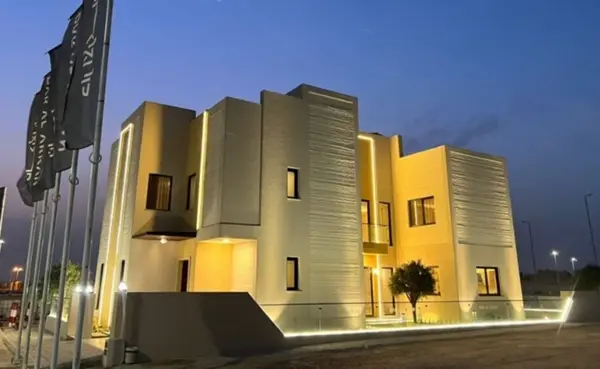
Recently, the “world’s largest on-site 3D printing building” project, constructed using concrete 3D printing technology in Saudi Arabia, successfully demonstrated the increasingly complex side of 3D printing technology. The success of this project not only demonstrates the potential of 3D printing technology, but also promotes the application of this technology in the construction sector.
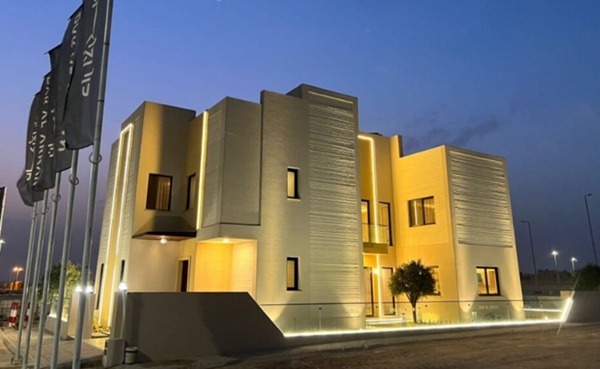
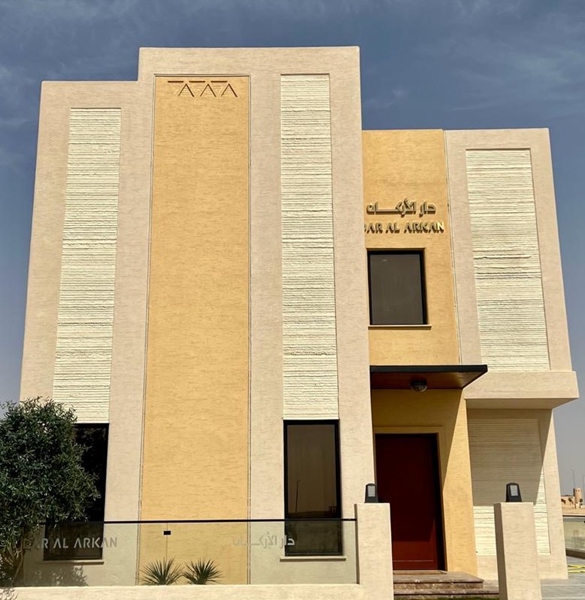
△The world’s largest on-site 3D printing building has been completed in Saudi Arabia
On March 31, 2023, Mohou.com learned that this three-story 3D printed villa is located in Riyadh, the capital of Saudi Arabia. It was built in 26 days by Saudi Arabia’s largest real estate developer and complies with all construction industry standards. The building is 9.9 meters high and has a construction area of 330 square meters. It is equipped with staff offices, conference rooms, restaurants and kitchens.
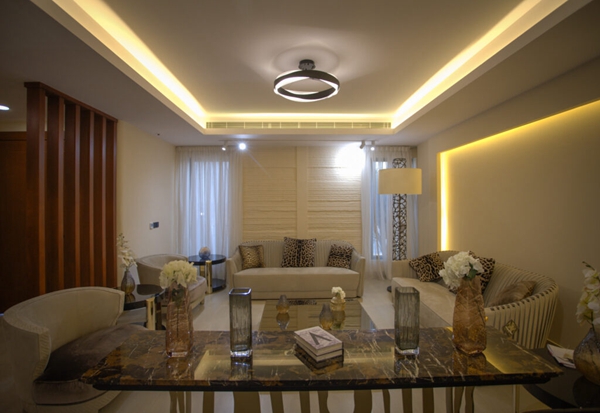
△The 3D printed building has complete functions and facilities
The project uses D.fab, a concrete 3D printing material jointly developed by CEMEX, the world’s leading cement and concrete manufacturer, and COBOD, a Danish 3D printing manufacturing technology company. This material has the capacity to use 99% local materials, with only 1% of 3D printed structures requiring centralized production. This production method reduces carbon emissions and transportation costs while better protecting the environment.
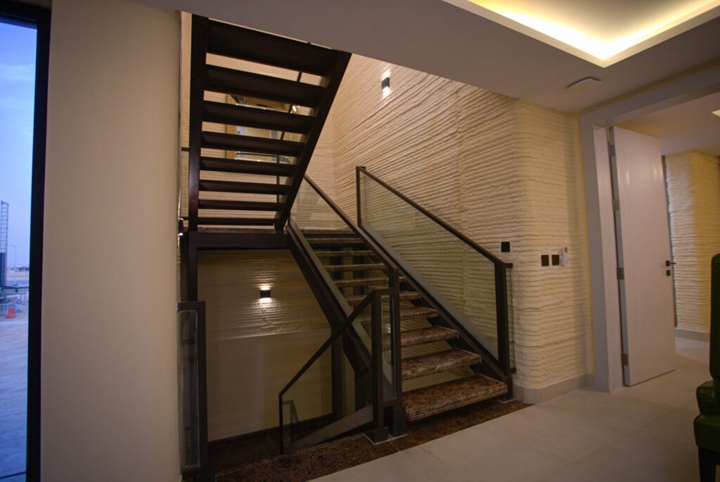
△A corner of the interior of Saudi Arabia’s latest 3D printed villa
Features of the 3-story 3D printed Saudi villa
The villa is powered by nine solar panels and equipped with a series of smart IoT tools to achieve intelligent control. To improve heat resistance, heat-reflecting “nanotechnology” was used for the exterior cladding, which is claimed to be four times stronger than traditional buildings. The features of this villa are: eco-friendly, smart, heat-resistant and robust.
Dar Al Arkan customers can now quickly and easily customize their buildings to suit their needs. The company’s construction 3D printing project manager emphasized that its work focuses on integrating the latest trends and technologies to improve the local real estate sector and achieve the 2030 goals. Architectural 3D printing can increase productivity, reduce costs and enable greater design flexibility, allowing them to better meet customer needs.
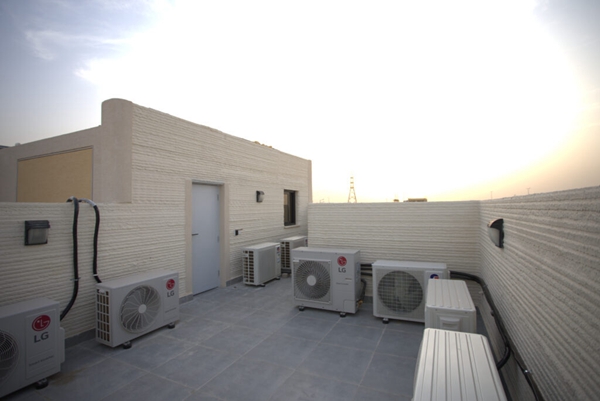
△Saudi Arabia wants to accelerate the development of the construction sector with smart technology
Saudi Arabia’s future plans for 3D printing technology
Fahad al Nasar, head of innovation at Saudi Arabia’s Ministry of Housing, said when talking about the 3D printed villa project that Saudi Arabia is accelerating the development of the construction industry by introducing new technologies construction and implementing new technologies in order to have 70% of the population by 2030. % of the Saudi population will be able to own their own home. He also highlighted the country’s strategy to change people’s perception of housing through a smart futuristic approach.
Dar Al Arkan, one of Saudi Arabia’s largest real estate developers, has already become involved in 3D printing technology. They plan to transform the local real estate sector by integrating the latest technologies and trends and achieve the goals of Vision 2030. The introduction of 3D printing technology allows them to achieve greater design flexibility, increase productivity and achieve better profitability, which is very important for the future development of their business. As Saudi Arabia adopts its Vision 2030 strategy to move away from a fossil fuel-based economy and toward technology, 3D printed buildings are now part of economic and infrastructural reforms.
Additionally, Matthew Kremenetsky, an analyst at Macro, a consulting firm that focuses on analyzing global economic and political events, highlighted a $10 billion (about 68.8 billion yuan) plan called ” Global Supply Chain Resilience Plan”, aimed at improving the resilience of the global supply chain. supply chain elasticity and flexibility through the use of 3D printing technology.
△3D printing center built by Saudi Aramco
Additionally, we have seen some of the Kingdom’s largest companies already adopting 3D printing manufacturing technology, including Saudi Aramco using technology from 3D Systems to build a new 3D printing center, and Al Seer using “the largest polymer 3D printer in the world. print unmanned ships, etc.
Advanced manufacturing will clearly be an important pillar of an economy that is not dependent on fossil fuels. We are therefore witnessing a new era for the countries of the Middle East.
Source: 3D Printing Network
Daguang focuses on providing solutions such as precision CNC machining services (3-axis, 4-axis, 5-axis machining), CNC milling, 3D printing and rapid prototyping services.



















