
Additive manufacturing will enable the rapid advancement and development of personalized medical devices.3DThanks to advances in printers, manufacturers are innovating new materials and related products for medical applications, providing patients with custom orthotics, prosthetics, dentures and more. The medical additive manufacturing market is constantly expanding, and the associated materials and technologies are also constantly innovating.3DWhat are the applications of printing in the medical field? What are the development directions for medical additive manufacturing?

3DPrinting applications in the medical field
In addition to metals commonly used in implants3DIn addition to printing, related to medical applications3DThere are two main types of printing: stereolithography(YEARS) and selective laser sintering(SLS)。YEARS Dominates the healthcare industry with its high manufacturing precision and ability to produce prototypes and final parts with fine features, high precision and isotropy. Additionally, biocompatible materials are already available for 3D SLA In printers, these materials are designed to meet the needs of sterilization and skin contact and are available in a variety of colors, such as black, white, clear or amber, to suit different uses .
3D SLSPrinting, a technology that uses high-powered lasers to sinter small particles of polymer powder into solid structures, is booming and a popular choice for manufacturers in other industries.SLSThe low cost per part and high productivity make it ideal for rapid prototyping and creating final parts. used for SLS New skin-friendly printer material will benefit medical industry 3D Benefit from printing types. relevant3DPrint media are tested before being placed on the market and comply withISOSkin irritation and sensitization standards so that it can be used in custom medical applications such as prosthetics, medical devices, bolus devices, sports equipment, orthotics, etc.
New materials drive innovation

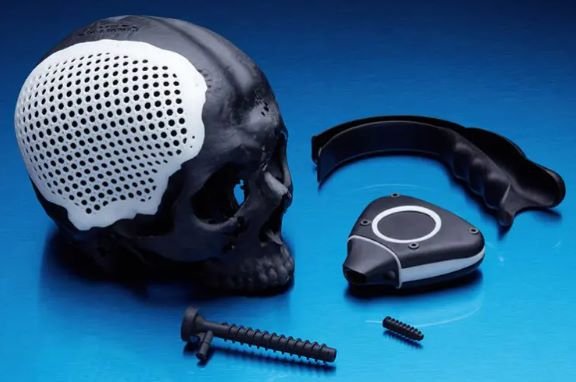
△Use 3D Printing of various medical devices and components.
Material innovation and3DThere is a direct correlation between medical applications of printing. All new medical technologies must meet regulatory standards to ensure patient safety, and additive manufacturing leaders must adhere to these standards.3DThe printing industry must create materials that meet medical requirements to achieve3DInnovations and new applications for printing. For example, dental labs and clinics use hybrid materials to create custom crowns and bridges, implants, dentures and more easily and affordably.
The development of new medical-grade materials is critical to expanding the use of point-of-care manufacturing by healthcare professionals. The manufacturing process of healthcare materials involves ISO 13485 the certificate,FDA register,ISO 10993 And USP Biocompatibility and sterilization compatibility tests. Innovation and adoption of additive manufacturing will advance as new materials are developed with safety and healthcare applications in mind. Not only does this increase opportunities for personalized healthcare, but it can also lay the foundation for a more agile medical supply chain while improving surgical practices, medical student education, and patient engagement for years to come.
3D What’s next for printing innovation?
Miscellaneous for medical applications 3D Print workflows and documents will advance healthcare, giving researchers, surgeons, radiologists, device engineers, dentists and orthodontists the tools needed to provide personalized and precise patient care. In addition to providing patient-specific devices and new medical device innovations at lower cost, these materials help reduce risk and increase agility in the medical supply chain while improving procedures, training trainees and patient engagement for years to come.

early 3D Printing technology is used to create personalized anatomical models for patients, advanced prosthetics, medical devices, and more. During the epidemic,3DPrinting technology could reduce medical response times when nasal swabs are scarceUSF Health、Northwell Health And Tampa General Hospital Cooperate inform laboratoriesprinted onCOVID-19 Nasal swab. This flexible response shows how healthcare leaders can take advantage of 3D Print and use these documents to create more flexible supply chains ready for the next crisis. This is a case study in how global healthcare organizations are working together to save lives.
To move forward, medical device designers and manufacturers must understand3DPrinting technologies and materials are available for healthcare applications, and with the development of new medically safe materials, the opportunity to provide patient care at lower costs increases. material innovation and3DThe growing adoption of printing technology in healthcare will allow providers, facilities and manufacturers to become more agile and respond to crises and patient needs faster than ever before.
Source: 3D Printing Network
Daguang focuses on providing solutions such as precision CNC machining services (3-axis, 4-axis, 5-axis machining), CNC milling, 3D printing and rapid prototyping services.


















