

Aston, British luxury sports car manufacturerAston Martin has launched a new sports car with a unique rear component 3D printed by Divergent Technologies. At the rear of its 705 horsepower DBR22 two-seater, Aston Martin would have integrated a support structure made up of several 3D printed aluminum parts glued together, allowing for significant weight savings. The subframe is made by Divergent Technologies, maker of the 3D-printed Czinger 21C supercar and supplier to a major OEM whose customers have until now been kept secret.
“It’s great to see some of our OEM projects being made public,” Lukas Czinger, co-founder of Czinger Vehicles, said on Linkedin. “The Divergent team is excited to work with the world-renowned Aston Martin Lagonda Ltd brand to develop existing and next-generation performance vehicles.”

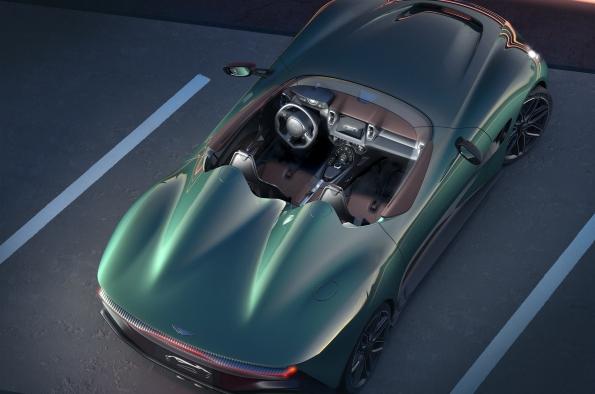
The new Aston Martin model DBR22 roadster. Image via Aston Martin.
Divergent Technologies “DAPS” system
Divergent’s business is centered around its Divergent Adaptive Production System, or “DAPS,” an end-to-end hardware-software assembly platform designed to replace traditional automotive production processes. Through the combination of 3D printing and generative design, DAPS is “model agnostic” as it allows the production of several different car models on the same machine. As you might imagine, given its ability to design, print and assemble parts by computer, the system also allows for rapid iteration, while its flexible configuration makes it more efficient and environmentally friendly than conventional methods. current automobile manufacturing.
To date, the most notable application of this technology is The Czinger 21C, a $2 million supercar capable of going from 0 to 60 mph in 1.9 seconds, was developed by Divergent’s sister company, Czinger Vehicles. As the Czinger 21C test at Goodwood revealed, the vehicle features an almost entirely 3D printed chassis, with components integrated into 3D printed nodes, resulting in weight savings of up to 40 %.
Over the past four months,The technology behind 21C has received huge support, with Divergent securing $160 million in funding in April, followed by an $80 million credit line in July. Czinger Vehicles also plans to unveil a new vehicle at the Pebble Beach Auto Show later this month. Even if the nature of this beast remains unknown, its production apparently relies on DAPS.
Aston Martin DBR22 increases AM stake
Although The DBR22 is designed to feature cutting-edge production technology, but it’s not the first Aston Martin model to feature 3D printed parts. In 2019, Aston Martin’s AM-RB 003 concept car debuted at the Geneva Motor Show, equipped with a 3D-printed center console and other lightweight interior components. Since then, hydraulics manufacturer Domin and Cranfield University have worked with the company to develop a fully-fledged 3D printed suspension system for Aston Martin. The system is based on Domin’s patented valve technology, where a 3D printed core containing 25 fluid channels work together to deliver hydraulic fluid, and is claimed to offer “infinite” damping variability while weighing just 4 kg.
However, with its latest futuristic design concept, Aston Martin has now The use of 3D printing has reached the next level by introducing integrated structural elements into high-performance sports cars. Unveiled at Monterey Car Week, the open-cockpit, coach-built DBR22 features modern technology, styling similar to the 1956 DBR1, and a new V12 that powers it from 0 to 60 miles /h in 3.4 seconds.
Regarding the vehicle’s rear subframe, Aston Martin states:The 3D printing system allows it to become lighter without reducing rigidity, which is ideal for making “very low volume model elements when necessary”. This model could be transformative for OEMs, according to Kevin Czinger, CEO of Divergent and Czinger Vehicles, which aims to deploy DAPS more widely in the future.
“Divergent is proud to work with Aston Martin Lagonda and other leading global manufacturers to change the future of automotive design and engineering,” added Kevin Czinger on Linkedin. “Starting next month and continuing over the next several years, the Divergent team will expand multiple modular factories across the United States and Europe to deploy DAPS. We are a Tier 1 supplier to major OEM brands with volume production plans for their frame and suspension systems. the range goes from 100 units per model per year to tens of thousands by 2025.”
Aston MartinThe rear design of the DBR22 design concept. Image via Aston Martin.
support 3D printed high performance exotics
Aston Martin is not the only company turning to A manufacturer of 3D printed supercars, the technology continues to be used as a means to produce low-volume, high-value custom car parts. Late last year, Spyros Panopoulos Automotive revealed that it was 3D printing Chaos supercar body panels, making them light enough to achieve sub-2-second 0-60 speeds.
the project recalls rodin car parts 3D printing of “FZERO,” an upcoming supercar that will feature an additively manufactured gearbox. Believed to be the first of its kind, the gearbox is designed to include a hydraulically operated differential, which helps manage the torque generated by its 1,000 hp engine.
On a smaller scale, the technology is also used by Arash Automotive, which 3D printing of end-use electric supercar parts. Specifically, the company has used MakerBot 3D printers to successfully produce components ranging from prototype cars and carbon engine cartridges to electric motors and high-capacity batteries.
source:
Daguang focuses on providing solutions such as precision CNC machining services (3-axis, 4-axis, 5-axis machining), CNC milling, 3D printing and rapid prototyping services.



















