
ODM Metal Die Casting Factories Global: A Sourcing Guide for Engineers
This page is for engineers and procurement teams comparing ODM metal die casting factories global supply chains can actually audit. You will get the checks that separate a real ODM partner from a broker with a machine list, plus the numbers behind tolerance, tooling, lead time, and MOQ. Read it before you send an RFQ.
In this article
- 1
- 2
- 3
- 4
- 5
- 6
- 7
- 8
Key takeaways
What to check before you shortlist a factory
Use the left column as your RFQ checklist. The right column tells you what a weak answer looks like.
| Check | Strong answer | Weak signal |
|---|---|---|
| DFM feedback | Marked-up CAD within 12 hours | Verbal comments only, no file |
| Tool ownership | Named owner, written in PO | Owner never discussed |
| Casting tolerance | Stated per feature, with datum | One blanket number for all |
| CNC tolerance | ±0.005 mm on machined faces | Unwilling to commit in writing |
| Surface finish | Ra 0.8–1.6 μm stated on drawing | Finish left to shop floor |
| MOQ | One prototype to 10,000+ parts | Tooling cost forces 5,000 min |
| Lead time | Quote in 12 h, ship in 3–5 days | Vague, no milestone dates |
| Certifications | ISO 9001, IATF 16949, ISO 13485 | Certificate photo, no scope |
Pick the factory that edits your CAD, not the one that only quotes it
If the supplier cannot mark up your model, state a tolerance split, and name the tool owner in writing, keep looking. Everything else is price talk.
What ODM actually means in die casting
ODM stands for original design manufacturing. In die casting, that means the factory takes your functional requirements and owns the path to a finished part. They adjust the CAD for draft, wall thickness, fillet radii, and gate location. They build or commission the tool. They cast, machine, finish, inspect, and ship. You approve drawings and first articles, but you do not coordinate five separate vendors.
The alternative is a chain: a design house, a tool shop, a casting plant, two or three finishing shops, and a logistics broker. Each handoff needs its own quote, its own quality plan, and its own schedule. When a dimension drifts, nobody wants to own the root cause because the process crossed three companies.
For a program with 200 to 10,000 parts a year, the coordination overhead of that chain often costs more than the casting itself. That is the gap ODM metal die casting factories are supposed to close. A factory with in-house tooling, CNC, and finishing removes those handoffs. It also removes the excuses.
Not every supplier that says ODM does this. Some quote from your file and forward the tool to a subcontractor. The test is simple. Ask who edits the 3D model and who signs the first-article report. If the answer is a third party, you are buying a broker service, not ODM.
Process capability: casting versus machining
Die casting is fast and cheap per part, but it is not a precision process by itself. As-cast dimensions on aluminium ADC12 typically hold around ±0.05 mm on small features, and worse across a long parting line. Draft angles of 1–2° are normal. Thin walls below 0.8 mm on aluminium or 0.5 mm on zinc start to run cold and mis-fill.
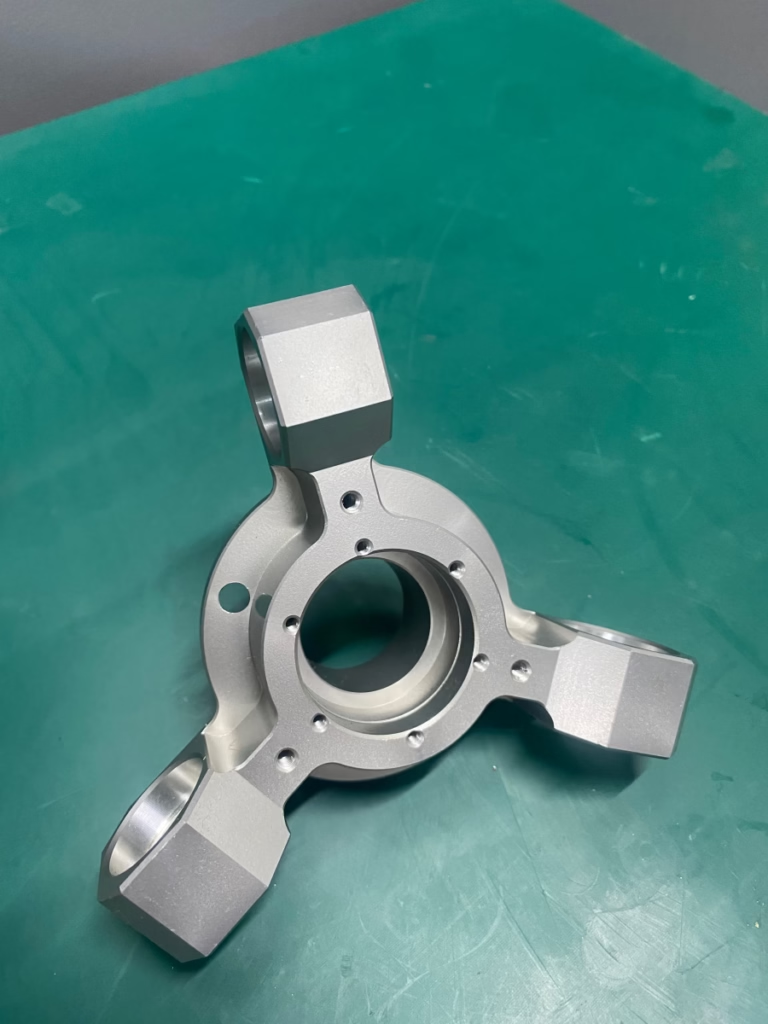
That means the drawing has to separate as-cast surfaces from machined surfaces. Bores, sealing faces, bearing seats, and threaded holes belong in the machined group. Everything else can stay as-cast, which keeps cycle time down. A factory that treats the whole part as precision will quote a slow, expensive process. A factory that treats everything as as-cast will ship parts that do not assemble.
This is where vertical integration pays. A plant that casts and then machines to ±0.005 mm can hold one datum scheme across both operations. The casting is fixtured off the same features the machining uses, so stack-up does not compound across two vendors. That single decision usually removes one tolerance band from the stack.
For magnesium AZ91D and AZ31B, the same logic applies with tighter thermal control. Magnesium machines fast and leaves a good finish, but it needs chip handling and fixturing that many aluminium-only shops do not have. Ask about material-specific experience before you assume it carries over.
- 1As-castKeep draft 1–2°, walls above 0.8 mm (aluminium), and generous fillets.
- 2MachinedBores, sealing faces, and threads: hold ±0.005 mm and Ra 0.8–1.6 μm.
- 3MixedState which surfaces are which on the drawing. Do not leave it to the shop floor.
Tooling, MOQ, and who carries the risk
Tooling is where most sourcing arguments start. A die-casting mold for a mid-size part can run into tens of thousands of dollars, and that cost has to land somewhere. Some factories amortize it into the part price and require a minimum volume to recover it. Others charge it up front and keep the part price low. Neither is wrong, but you need to know which model you are buying.
The important question is ownership. If the factory owns the tool, moving the program later is expensive and slow. If you own it, you need a written clause that lets you take possession, plus a defined condition and a spare-cavity policy. Ask for this before the PO, not after a quality problem.
MOQ is the other lever. A factory with in-house tooling and CNC can run one prototype and then scale to 10,000+ parts without re-quoting the process. That flexibility matters for hardware teams that need to validate a design before committing to volume. If a supplier insists on a 5,000-piece minimum before they will make a sample, you are locked in early.
First-article revisions are part of the same risk. A good ODM partner budgets two or three tooling iterations into the plan and tells you what each one costs. A weak one quotes a single number and then bills every change as a surprise. Get the revision policy in writing.
Finishing, inspection, and certifications
Finishing often takes longer than the casting. Anodizing, electroless nickel, zinc plating, powder coating, and black oxide each need their own line, their own racking, and their own cure or dwell time. Bead blasting and polishing add manual labor. If the finish is not confirmed in the first RFQ, it will surface as a schedule problem later.
Inspection is where you separate a real quality system from a promise. Ask what is checked, at which stage, and what report you get. A proper plan covers incoming raw material, in-process monitoring, and final inspection before shipment. Dimensional reports on request are normal. A factory that cannot show a first-article inspection report is not ready for a regulated program.
Certifications matter by industry. ISO 9001:2015 covers general quality management. IATF 16949:2016 is the automotive and EV baseline. ISO 13485:2016 applies to medical devices. ISO 27001:2022 covers information security, which matters if you are sharing CAD for an unreleased product. Check the scope on the certificate, not just the logo.
Confidentiality belongs here too. Uploads should be secure, and an NDA should be available on request. If a supplier shares your drawings with a subcontractor tool shop without telling you, the certificate on the wall does not help.
Lead time, quote speed, and the numbers to ask for
Quote speed tells you how the factory works. A supplier that returns a quotation and a free DFM analysis within 12 hours is reading your file, not just filling a template. That DFM pass is where draft angles get fixed and wall thickness gets flagged. It is the cheapest engineering you will ever receive.
Production should start within 24 hours of PO and tooling sign-off. Parts should ship in 3–5 days for standard runs. Those numbers only hold if the tool is ready and the material is in stock, so ask which alloys are held on site. A factory that stocks 6061, ADC12, and AZ91D will not stall a program waiting on a mill order.
Late delivery is the metric nobody wants to talk about. Ask for the historical late-delivery rate and how it is measured. A number below 2% is a reasonable target for a plant with in-house scheduling. If the supplier cannot answer, that is your answer.
Finally, ask for capacity in writing. Machine counts, maximum part size, and which axes are available tell you whether the factory can actually make your part. A supplier with 16 simultaneous 5-axis centers and a 4,000 mm maximum processing size can handle large housings that a small shop cannot fixture.
How to qualify a factory in six steps
- 1Send the full data set3D model, 2D drawing with datums and tolerances, alloy, finish, annual volume, and target date. Missing finish specs are the most common cause of a re-quote.
- 2Request written DFM feedbackAsk for a marked-up CAD file, not a summary email. Look for draft angle changes, wall thickness flags, and gate or ejector pin locations.
- 3Confirm the tolerance splitMark as-cast versus machined surfaces together. Agree that machined features hold ±0.005 mm and Ra 0.8–1.6 μm before the tool is cut.
- 4Settle tooling ownership and revisionsPut the owner, the handover condition, and the number of included revisions in the PO. Budget two or three iterations for a new part.
- 5Audit the inspection planRequire raw material check, in-process monitoring, and final inspection. Ask for a first-article report and a dimensional report on request.
- 6Verify lead time and capacityGet quote and DFM in 12 hours, production start within 24 hours, and shipping in 3–5 days in writing. Match machine size to your part envelope.
Questions buyers ask before awarding the PO
Is die casting accurate enough without CNC machining?
For many features, yes. As-cast dimensions on aluminium and zinc hold roughly ±0.05 mm on small features, which is fine for brackets, covers, and housings where the surface is not a datum.
Bores, sealing faces, bearing seats, and threaded holes are different. Those need machining to reach ±0.005 mm and Ra 0.8–1.6 μm. Mark them on the drawing so the quote reflects both operations.
What is a fair MOQ for a first die-casting run?
Tooling cost drives MOQ, not the casting process itself. If a factory amortizes the mold into the part price, they will want volume to recover it, often several thousand pieces.
A factory with in-house tooling and CNC can run one prototype and scale to 10,000+ parts without changing the process. That removes the forced minimum and lets you validate before committing.
Who should own the die-casting mold?
Either model can work, but the terms have to be explicit. If the factory owns the tool, moving the program later is slow and expensive. If you own it, you need a handover clause and a defined tool condition.
Ask for the ownership, the revision policy, and the spare-cavity plan in writing before the PO. A verbal agreement is not enough when a quality issue appears.
Which certifications should I require?
ISO 9001:2015 is the general baseline. Add IATF 16949:2016 for automotive and EV work, and ISO 13485:2016 for medical devices.
If you share unreleased CAD, check for ISO 27001:2022 and confirm the certificate scope. An NDA available on request is standard practice for confidential programs.
How long should a quote and DFM review take?
A factory that reads your file can return a quotation and a free DFM analysis within 12 hours. Slower than that usually means the file is sitting in a queue.
Production start within 24 hours of sign-off and shipping in 3–5 days are reasonable targets for standard runs. Confirm the alloy is stocked before you rely on those numbers.
Can one factory handle casting, machining, and finishing?
Yes, and that is the main argument for ODM. Keeping casting, CNC, and finishing under one roof means one datum scheme, one inspection plan, and one schedule owner.
If the work is split across vendors, each handoff adds a tolerance band and a lead-time buffer. For tight-tolerance parts, that stack-up is usually the reason the assembly fails.
Send your die-casting part for a DFM review
Upload the 3D model and 2D drawing. We return a quotation and a free DFM analysis within 12 hours, with the tolerance split and tooling terms spelled out.
Quote and DFM in 12 hoursNo minimum order quantity100% inspection before shipmentNDA available on request
More from the shop floor
We publish setup notes, tooling trials and inspection data from the factory floor.











